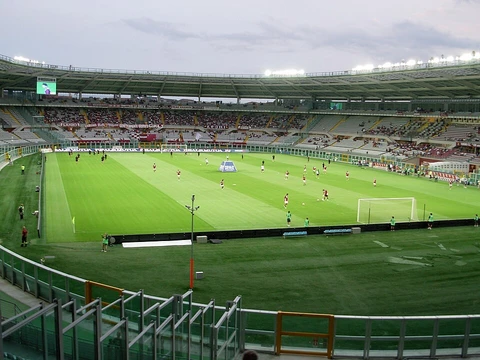
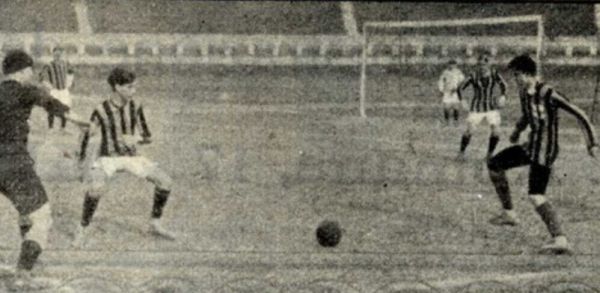
Torino vs Inter
Torino FC: A historic club with a 1985–86 top-5 finish and UEFA Cup qualification.

Unknown author · Public domain
Torino FC is a football club based in Turin, Italy. The club's Serie A titles include those officially recognized by the Italian Football Federation; the 1927–28 title was later revoked and is not officially recognized.
Lore & Background
Torino and Inter first met in Serie A in the 1929–30 season, the league's inaugural season.
Reader's Guide
In the 1985–86 season, Torino finished in the top 5 of Serie A and qualified for the UEFA Cup. The squad included goalkeepers Silvano Martina, Renato Copparoni, and Renato Biasi; defenders Paolo Beruatto, Massimo Brambati, Giancarlo Corradini, Roberto Cravero, Luigi Danova, Giovanni Francini, Vittorio Pusceddu, and Ezio Rossi; midfielders Flavio Chiti, Antonio Comi, Giuseppe Dossena, Giacomo Ferri, Júnior, Marco Osio, Danilo Pileggi, Antonio Sabato, and Renato Zaccarelli; and attackers Franco Lerda, Pietro Mariani, Walter Schachner, and Lirio Torregrossa. Top scorers in Serie A were Antonio Comi (7), Júnior (4), Giancarlo Corradini (3), Giovanni Francini (3), and Walter Schachner (3).
A Step Back from the Summit
Torino's 1985/86 campaign marked a noticeable dip from the heights of the preceding season. Where the Granata had previously secured a top-three league position, this time around they could not sustain that level of consistency throughout the Serie A schedule. The squad ultimately settled in the top five of the standings, a respectable but ultimately underwhelming outcome for a club accustomed to competing at the very top of Italian football. That said, the season was not without silver lining. Finishing in that upper bracket of the table earned Torino a fresh berth in the UEFA Cup, ensuring the club would continue to feature in European competition the following year. The contrast between the two seasons underscores the fine margins that separate a title-chasing campaign from a solid mid-table performance in a league as competitive as Italy's top flight. For Torino's supporters, the UEFA Cup qualification served as a reminder that the club's European pedigree remained intact, even as the domestic title race slipped just beyond their grasp.
A Deep and Balanced Roster
Torino's 1985/86 squad was built on breadth across every line of the pitch. In goal, the club could call upon three keepers—Silvano Martina, Renato Copparoni, and Renato Biasi—providing reliable cover across a demanding multi-competition schedule. The defensive unit featured eight players, including Paolo Beruatto, Massimo Brambati, Giancarlo Corradini, Roberto Cravero, Luigi Danova, Giovanni Francini, Vittorio Pusceddu, and Ezio Rossi, giving the coaching staff considerable flexibility in formation and rotation. The midfield was the deepest area of the squad, with nine names listed: Flavio Chiti, Antonio Comi, Giuseppe Dossena, Giacomo Ferri, Júnior, Marco Osio, Danilo Pileggi, Antonio Sabato, and Renato Zaccarelli. Up front, four attackers—Franco Lerda, Pietro Mariani, Walter Schachner, and Lirio Torregrossa—provided the finishing options. Altogether, the twenty-four registered players reflected a club that valued depth and positional versatility over reliance on a handful of stars.
Goals Shared Across the Squad
Rather than depending on a single talismanic striker, Torino's 1985/86 scoring was remarkably distributed. Antonio Comi, operating from midfield, led the club's top-scorer list with seven league goals, a notable contribution for a player whose primary role was not that of a pure forward. Júnior followed with four goals, while three players—Giancarlo Corradini, Giovanni Francini, and Walter Schachner—each netted three. What stands out is the positional spread of those contributors: Corradini and Francini were defenders, Schachner an attacker, and Comi a midfielder. This pattern suggests a team in which set pieces, overlapping runs, and collective pressing generated chances rather than isolated individual brilliance. With no player exceeding seven goals in the league, Torino's attacking output was a product of shared responsibility, a hallmark of a well-drilled unit that found ways to create and convert from multiple areas of the pitch.
Three Fronts of Competition
Torino's 1985/86 season was defined by the logistical and tactical demands of competing simultaneously in three separate competitions. In Serie A, the club navigated the full league schedule to secure a top-five finish. In the Coppa Italia, Torino progressed through the first round and the eightfinals before ultimately reaching the quarterfinal stage, where their domestic cup run concluded. On the European front, the UEFA Cup provided an additional test: Torino advanced through the first round and into the second round of the competition before their continental campaign ended. Managing squad rotation across these three fronts was no small task, particularly given the depth of the roster and the physical toll of a full domestic season. The fact that Torino remained competitive in all three tournaments—reaching the quarterfinals domestically and the second round in Europe—speaks to the squad's resilience and the coaching staff's ability to field effective lineups week after week across multiple formats.
Gallery
Frequently Asked Questions
What is the Torino vs Inter rivalry?
It is a cross-city Serie A fixture pitting Torino's Granata against Inter's Nerazzurri, two northern clubs that each dominated a different era of Italian football. Torino was the pre-war and post-war powerhouse (titles in 1942-43 and 1975-76), while Inter built its legendary La Grande Inter dynasty in the early 1960s under Helenio Herrera.
How is Torino vs Inter different from Derby della Mole?
Derby della Mole is Torino's intra-city derby against Juventus, defined by local identity and street-level passion. The Inter rivalry spans two cities and two distinct footballing philosophies — Torino's collective, physical dominance versus Inter's tactical revolution — giving it a broader historical and strategic weight.
What makes Torino vs Inter tactically significant?
Their encounters from the 1950s through the 1970s regularly featured some of the most strategically dense fixtures in the competition. Torino's physical, team-first identity met Inter's revolutionary catenaccio and counter-attacking systems under Herrera, producing a chess match that fans still cite as a benchmark for tactical rivalry.
More in Great Rivalries
Elsewhere in Torino FC
Spotted an error? Know more?
Reader corrections go straight into our review queue. Suggest an edit · How this site is sourced