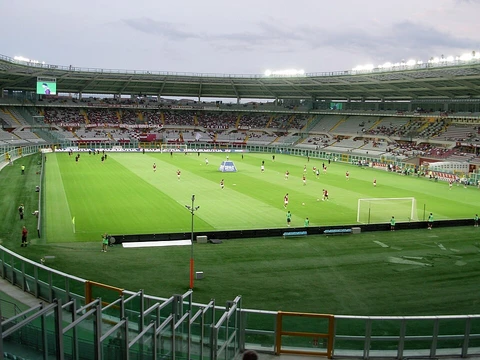
Torino vs Juventus, Derby della Mole, 1975-76
Two cities in one, two colours in one, and ninety minutes that belong to no league table.
The Derby della Mole of the 1975-76 Serie A season is one of the many chapters in the oldest and most emotionally charged local rivalry in Italian football: Torino FC against Juventus FC, two clubs born in the same city, sharing the same sky, the same Mole Antonelliana watching over the pitch. In 1975-76, both sides were competitive mid-to-upper-table Serie A outfits, and the two fixtures that season carried the weight of a rivalry that had already spanned four decades of bitter, beautiful, and sometimes violent history.
For a Torino supporter, the derby is not merely a league match. It is a weekly reckoning, a reminder of what the club once was in the golden era of the Grande Torino, and a declaration that the granata heart still beats in the Santa Rita district. The 1975-76 season sits in a quieter period for Torino compared to their 1940s and 1950s glory, which made the derby all the more a matter of pride, identity, and refusal to be overshadowed by the city's other giant.
Quick Facts
- Rivalry
- Torino FC vs Juventus FC
- City
- Turin (Torino), Italy
- Competition
- Serie A (Italian top flight)
- Season
- 1975-76
- Nickname origin
- Mole Antonelliana, Turin's landmark tower
- Torino colours
- Granata (dark maroon/burgundy)
Lore & Background
The Derby della Mole predates the modern Serie A and the very concept of a national championship. Torino FC was founded in 1906 and Juventus in 1897, and from the earliest days of organised football in Turin the two clubs were natural antagonists. The name itself is a piece of civic poetry: the Mole Antonelliana, the neo-Gothic and neo-Baroque tower that has crowned the city since 1889, is the single landmark both sets of fans point to when they say 'this is our city.' The derby is, in a very literal sense, the city arguing with itself.
By the 1975-76 season, Torino had long since passed through the cataclysm of the Superga air disaster of 1949, which killed the entire Grande Torino squad and reset the club's identity for a generation. The 1970s were a period of rebuilding, of finding new heroes in a city that still measured its footballing soul against the ghosts of Valcareggi, Mazzola, and Sivori. Juventus, meanwhile, was a well-oiled machine of the mid-1970s, a club that had consolidated its national dominance. The asymmetry made the derby even more personal for the granata faithful: this was the fight to prove that Turin was not a one-club city.
The atmosphere at the ground on derby days in the 1970s was a phenomenon of its own. The Santa Rita end, the Curva Sud, the terraces packed with fans in burgundy scarves, the smell of cheap cigarettes and wet wool, the drums and the chanting that began before kickoff and did not stop after the final whistle. It was raw, it was loud, and it was, for those who were there, the closest thing to a sacred rite that football offers.
Reader's Guide
Competition: Serie A, 1975-76 season. Two fixtures between Torino and Juventus, played at both clubs' home grounds in Turin.
You don't remember the exact minute. You remember the feeling. Minute eighty, maybe, or maybe it was the seventy-eighth, and the legs are lead, and the cold has worked its way through your jacket, and the Juventus end across the ground is a wall of white and black that seems to stretch to the horizon. The ball is in the air, a Torino cross, and for two seconds the entire curva goes silent, that terrible silence where every single person is holding their breath, and then it is not a goal, it is a post, it is a defender, it is something, and the silence breaks into a groan that is also a roar, because the next ball will come, it always comes, and you are still here, you are still standing, you are still granata.
The final whistle. The score is what it is, and it will be argued about in bars for weeks, in kitchens, in the factory canteens. But the feeling, the feeling is the thing you keep. The derby does not live in the results column. It lives in the cold hands and the hot throat and the Mole standing over everything, indifferent and eternal, the way it has stood over every single one of these matches since the first one was played under a sky that was not yet a sky but a promise.
In Torino mythology, the 1975-76 derbies are not the loudest chapter. They are the steady ones. The ones where the club was not at the top of the world but was still in the fight, still in the city, still granata. And that, for a Torino fan, is enough. That is everything.
Did You Know?
- The name 'Derby della Mole' comes from the Mole Antonelliana, Turin's iconic tower, which has served as the city's symbol since the late 19th century and is visible from both clubs' training grounds.
- Torino and Juventus are the only two professional football clubs based in the same Italian city, making the Derby della Mole one of the few true 'intra-city' derbies in European top-flight football.
More in Iconic Matches
Elsewhere in Torino FC
Spotted an error? Know more?
Reader corrections go straight into our review queue. Suggest an edit · How this site is sourced