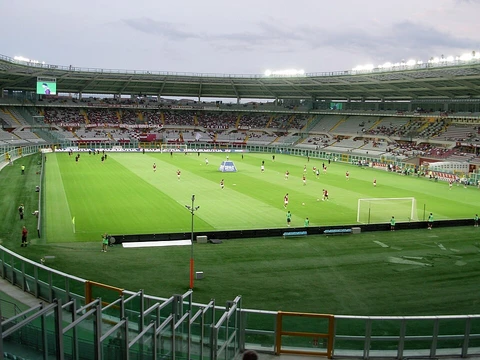
Torino vs Juventus, Derby della Mole, 1947-48
Four titles in a row, a city on its feet, and a shadow no one saw coming.
The 1947–48 Derby della Mole season was a defining chapter in the rivalry between Torino FC and Juventus, two clubs sharing the city of Turin and the shadow of the Mole Antonelliana. For Torino, it was the third consecutive year in which the Granata were dominant forces in Italian football, riding the momentum of their legendary 'Old Boys' attacking line and the talismanic presence of Valentino Mazzola. For the city, the derby was less a single fixture and more a recurring emotional event — a weekly reminder that two great clubs drew their identity from the same streets, the same fans, the same sky above the Mole.
This entry captures the season's derbies not as isolated results but as a narrative arc: the pride of a city that had lost so much in the war years, the swagger of a Torino side that seemed untouchable, and the quiet, aching foreshadowing that the following spring would bring a tragedy no one could have imagined.
Quick Facts
- Rivalry name
- Derby della Mole
- Named after
- Mole Antonelliana, Turin
- Season
- 1947–48 Serie A
- Torino's status entering season
- Reigning Serie A champions (1946–47)
- Torino's key talisman
- Valentino Mazzola
- Famous attacking line
- The 'Old Boys' (Vecchi Boys)
- City
- Turin, Italy
Lore & Background
By the 1947–48 season, Torino had already established themselves as the most formidable side in Italian football. The 'Old Boys' — Oldrini, Loik, Mazzola, Ferraris, and Rosetta — had become a cultural symbol, five forwards whose combination of speed, instinct, and ruthlessness made them the most feared attacking unit in the country. Mazzola, in particular, had become the face of the club: a young man whose runs and finishes seemed almost effortless, whose smile in the press photos contrasted with the cold, clinical precision of his finishing. The 1947–48 title was the third of what would become a four-peat, and the derby against Juventus was the one match where that dominance was tested against a local rival who understood every nuance of the Granata's game.
The Derby della Mole in this era was played in a city still healing from the war. Turin had been bombed, its factories scarred, its people exhausted. Football was not merely entertainment; it was a collective act of reassertion. When the two local sides met at the Stadio Comunale, the entire city seemed to hold its breath. Torino fans would arrive in their dark red (granata) scarves, Juventus in their black-and-white, and the stands would become a physical wall of noise that the players described as almost disorienting. The Mole Antonelliana, visible above the stands, was the shared landmark — the thing that made this rivalry uniquely Turinese, unlike any other derby in Italy.
What makes the 1947–48 season ache in retrospect is that it was the last full season of peace. The following May, the Superga air disaster would take the entire Old Boys and their coach, and the four-peat would become a monument to what was lost. But in the autumn and winter of 1947–48, none of that was knowable. There was only the present: the roar of the crowd, the click of leather on boot, the pride of a city that had found its joy again on a Saturday afternoon.
Reader's Guide
Season: 1947–48 | Competition: Serie A | City: Turin
The two derby fixtures that season were less about a single scoreline and more about the weight of context. Torino entered as reigning champions, three titles deep in what would become a historic four-peat. The Old Boys were in full flow, Mazzola at the peak of his powers, and the Granata carried the kind of collective confidence that made even a local rival feel like an underdog in their own city.
In the stands, the feeling at minute 80 of either derby was a particular kind of electric anxiety. You were not watching a match; you were watching your city argue with itself. The Torino end was a wall of dark red noise, scarves waving, voices raw. The Juventus end answered in black and white. And above it all, the Mole stood silent, indifferent, eternal. When a goal went in — whichever side — the sound was the same: a detonation, a release, a collective gasp that turned into a howl.
The lasting place of the 1947–48 derbies in Torino mythology is bittersweet. They represent the high-water mark, the season when everything was still possible, when the Old Boys were still together, when the city could still believe in its own invincibility. To a Granata fan, those derbies are not just matches. They are the last normal Saturdays before the world broke open the following May.
Did You Know?
- Torino won four consecutive Serie A titles from 1945–46 through 1948–49, making the 1947–48 season the third of that historic run.
- The 'Old Boys' (Vecchi Boys) — Oldrini, Loik, Mazzola, Ferraris, and Rosetta — were the most feared attacking five in European football during this era.
- The Derby della Mole takes its name from the Mole Antonelliana, Turin's iconic landmark, which is visible from the stadium stands.
- The 1947–48 season was the final full campaign before the Superga air disaster of May 4, 1949, which claimed the entire Old Boys squad and coaching staff.
More in Iconic Matches
Elsewhere in Torino FC
Spotted an error? Know more?
Reader corrections go straight into our review queue. Suggest an edit · How this site is sourced