Siamosaurus
A spinosaurid dinosaur known mainly from its distinctive teeth.
Last updated
Siamosaurus is a potentially dubious genus of spinosaurid dinosaur known primarily from tooth fossils discovered in Thailand and possibly China. It represents the first reported spinosaurid from Asia and lived during the Early Cretaceous period, from the Barremian to Aptian stages.
Scientific classification
- Family†Spinosauridae
- Genus†Siamosaurus
- SpeciesSiamosaurus suteethorni
Named by Buffetaut & Ingavat, 1986
Sources: Wikipedia taxobox: Siamosaurus (CC BY-SA 4.0)
How big is it?
Largest length in the source, 0.06 m, next to a 1.8 m person.
Diagram: drawn by Codexery, schematic shapes to scale (not a likeness). Length: Wikipedia: Siamosaurus
Where the siamosaurus has been recorded
Map: drawn by Codexery. Data: Natural Earth basemap (public domain) · place coordinates: Wikipedia (CC BY-SA 4.0)
Quick Facts
- Species
- suteethorni
Facts from the source article.
History of discovery
The first Siamosaurus fossils were discovered in the Sao Khua Formation, part of the Khorat Group, which dates to the Barremian stage of the Early Cretaceous, approximately 129.4 to 125 million years ago. In 1983, French palaeontologist Éric Buffetaut and Thai colleague Rucha Ingavat described a set of fossil teeth from the Phu Pratu Teema locality in the Phu Wiang area of Khon Kaen Province, but did not assign them to a specific animal, suggesting they belonged either to an unusual theropod dinosaur or an unknown crocodilian.
In 1986, the same authors reassessed the remains and named a new genus and species, Siamosaurus suteethorni. The generic name refers to the ancient name of Thailand, Siam, combined with the Greek word for lizard; the specific name honours Thai palaeontologist Varavudh Suteethorn. The best-preserved tooth, DMR TF 2043a, was designated the holotype, with eight other teeth as paratypes. These fossils are housed in the Department of Mineral Resources in Bangkok.
Siamosaurus teeth are common in the Sao Khua Formation, and further isolated specimens were found later. Sculptures of the animal have been erected in several locations in northeastern Thailand, and it was illustrated on Thai postage stamps in 1997.
Description
Body size estimates for Siamosaurus vary considerably due to the fragmentary nature of the remains. In 2004, Don Lessem estimated a length of 9.1 m; in 2005, Sussana Davidson and colleagues gave an estimate of 8 m and 1 tonne; and in 2016, Rubén Molina-Pérez and Asier Larramendi estimated about 5.1 m long, 1.45 m tall at the hips, and 255 kg.
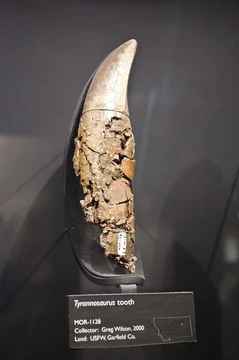
The holotype tooth is 62.5 mm in total length, with a crown 47.7 mm long and 16.6 by 12.5 mm at the base. A much smaller specimen measures 24.3 mm, suggesting variation due to age or position in the jaw. As a spinosaurid, Siamosaurus would have had low, narrow, elongated jaws, robust forelimbs, relatively short hindlimbs, and possibly a sail on its back formed by elongated neural spines.
Classification
In 1986, Buffetaut and Ingavat classified Siamosaurus as a theropod based on its straight, tall crown and double sideways recurvature. The combination of longitudinal fluting and lack of serrations was unusual among theropods at the time.
Similarities to ceratosaur teeth were considered but ruled out because ceratosaur teeth are more blade-like, have fewer flutes, and bear serrations. The authors concluded that the closest taxon in dentition was Spinosaurus aegyptiacus, which also had straight, unserrated conical teeth, though Spinosaurus lacked the developed flutes seen in Siamosaurus. They tentatively placed Siamosaurus in the family Spinosauridae.
Did You Know?
- Four teeth from China previously attributed to the pliosaur 'Sinopliosaurus' fusuiensis were identified in 2009 as possibly belonging to Siamosaurus.
- Isotope analysis of Siamosaurus teeth indicates semiaquatic habits.
- Siamosaurus teeth have wrinkled enamel, similar to teeth of the related genus Baryonyx.
More in Tooth Taxa
Sources
Compiled from Wikipedia and the sources listed below. Text from Wikipedia is available under CC BY-SA 4.0; this entry is adapted from it.
- Wikipedia: Siamosaurus (CC BY-SA 4.0).
- Occurrence records: GBIF (CC0 / CC BY). Basemap: Natural Earth (public domain).
- Word definitions: the , each quoted from its Wikipedia article.
Spotted an error? Know more?
Reader corrections go straight into our review queue. Suggest an edit · How this site is sourced