Dysganus
Dubious ceratopsian genus from the Late Cretaceous.
Last updated
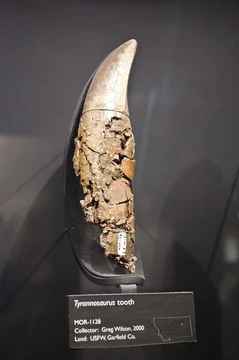
Dysganus (pronounced dis-GANN-us) means "rough enamel." This dubious ceratopsian genus dates to the Campanian stage of the Late Cretaceous. Charles Sternberg first collected its fossil teeth from Montana's Judith River Formation, and Edward Drinker Cope later described them. All its species are now considered dubious ceratopsians, though some material from New Mexico, once referred here, actually belongs to tyrannosaurids and hadrosaurids.
Scientific classification
- KingdomAnimalia
- PhylumChordata
- ClassReptilia
- Clade
- Clade
- Clade†Ceratopsia
- Family
- Genus†Dysganus
Named by Cope, 1876
Sources: Wikipedia taxobox: Dysganus (CC BY-SA 4.0)
Quick Facts
- Type species
- Dysganus encaustus
- Subdivision
- D. bicarinatus, Cope, 1876, D. peiganus, Cope, 1876, D. haydenianus, Cope, 1876
Facts from the source article.
History and species
Edward Drinker Cope first described Dysganus in 1876, with D. encaustus as the type species based on several fragmentary teeth, which he believed belonged to a small herbivorous dinosaur related to Cionodon and Hadrosaurus. Cope also named D. haydenianus, D. bicarinatus, and D. peiganus from fragmentary teeth collected by Charles Sternberg from Campanian strata of the Judith River Formation east of the Judith River in Montana. The type specimens consist of one to eight detached teeth, likely from different individuals.
Cope named Dysganus during the Bone Wars, his competition with Othniel Charles Marsh, leading to hastily published papers that later caused taxonomic issues. After Cope's death, all specimens were sold to the American Museum of Natural History in New York, where they remain.
Cope also referred teeth from the San Juan Basin in New Mexico, likely from hadrosaurids and tyrannosaurids. In 1907, John Bell Hatcher redescribed the teeth and found them to be a chimera of hadrosaur and ceratopsid teeth, making the genus a nomen dubium. William Matthew later designated holotype teeth due to their composite nature.
Etymology
The name Dysganus combines Greek dys, meaning “bad,” with ganos, for tooth enamel, translating to “rough enamel.” The type species D. encaustus means “burnt in,” a reference to its concave tooth tip. D. bicarinatus, meaning “two keels,” describes the two ridges on its type teeth. D. haydenianus honors Ferdinand V. Hayden, an American paleontologist and biologist. D. peiganus takes its name from Montana’s Peigan Native Americans, where the type specimen was found.
Classification
Cope originally placed Dysganus in Trachodontidae, a family now considered a junior synonym of Hadrosauridae. In 1901, Franz Nopcsa von Felső-Szilvás assigned it to Ceratopsia, possibly following Cope's indirect suggestion from 1890. In 1907, Hatcher et al. republished Cope's descriptions and concluded that the holotype of D. encaustus included teeth of both hadrosaurids and ceratopsids. The teeth of D. peiganus were later thought to be from a stegosaurian by Lull and Wright in 1942, but subsequent analysis by Walter Coombs and Peter Galton showed all teeth were ceratopsian, from different mouth positions and erosion stages.
Paleoecology
All four named species come from the Judith River Formation, where Edward Drinker Cope's crews collected during the early Bone Wars. Other fossils from the formation include large tyrannosaurid theropods such as Aublysodon and Deinodon, the small dromaeosaurid Zapsalis, hadrosaurids like Trachodon, Cionodon and Pteropelyx, and common ceratopsians such as Monoclonius and Ceratops. The ankylosaur Palaeoscincus is also known from scattered teeth.
More in Tooth Taxa
Sources
Compiled from Wikipedia and the sources listed below. Text from Wikipedia is available under CC BY-SA 4.0; this entry is adapted from it.
- Wikipedia: Dysganus (CC BY-SA 4.0).
- Word definitions: the , each quoted from its Wikipedia article.
Spotted an error? Know more?
Reader corrections go straight into our review queue. Suggest an edit · How this site is sourced