Dryosaurus
Herbivorous ornithopod dinosaur from the Late Jurassic.
Last updated
Dryosaurus is an extinct genus of herbivorous ornithopod dinosaur from the Late Jurassic period. Its name, meaning 'tree lizard', reflects its forested habitat. Fossils have been found in the western United States, with the first discoveries made in the late 19th century.
Scientific classification
- KingdomAnimalia
- PhylumChordata
- ClassReptilia
- CladeDinosauria
- Clade†Ornithischia
- Clade†Ornithopoda
- Family†Dryosauridae
- Genus†Dryosaurus
Named by Marsh, 1894
Sources: Wikipedia taxobox: Dryosaurus (CC BY-SA 4.0)
Quick Facts
- Type species
- Dryosaurus altus
- Subdivision
- D. elderae; Carpenter & Galton, 2018
Facts from the source article.
Description
Dryosaurus reached up to 3 m long and weighed up to 100 kg, though no known adult specimens have been found, leaving adult size uncertain. In 2018, the largest specimen (CM 1949) was reassigned to another species, casting doubt on prior size and growth studies. It had a long neck, slender legs, a stiff tail, short arms with five fingers, a horny beak, and cheek teeth with a strong median ridge on the lateral surface.
Discovery and naming
In 1876, Samuel Wendell Williston discovered small euornithopod remains in Albany County, Wyoming. In 1878, Othniel Charles Marsh named them Laosaurus altus, with the specific name meaning 'tall' in Latin. In 1894, Marsh made it a separate genus, Dryosaurus, from Greek for 'tree, oak', referring to a forest-dwelling life mode.
The type species is Dryosaurus altus. The holotype, YPM 1876, from the Upper Brushy Basin Member of the Morrison Formation (Tithonian), includes a partial skeleton with a mostly complete skull. Other specimens from Wyoming, Utah, and Colorado have been referred to this species, including CM 1949, CM 11340, and BYU ESM-171R.
Paleobiology
Dryosaurus fed on low-growing vegetation in ancient floodplains. It was a quick, agile runner with strong legs, using its stiff tail as a counterbalance, and likely relied on speed for defense. A hatchling from Dinosaur National Monument showed that young had proportionally large eyes and short muzzles, which changed as the animal grew.
Paleoecology
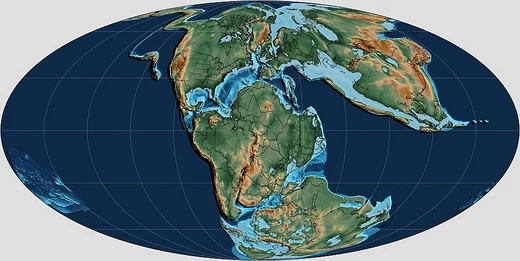
The Dryosaurus holotype was found in Reed's YPM Quarry 5, in the Upper Brushy Basin Member of the Morrison Formation. Dryosaurus remains occur in stratigraphic zones 2–6 of this formation, which dates from 156.3 to 146.8 million years ago (late Oxfordian to early Tithonian). The Morrison Formation is a sequence of shallow marine and alluvial sediments from a semiarid environment with wet and dry seasons. The Morrison Basin stretched from New Mexico to Alberta and Saskatchewan, with deposits from east-facing drainage basins carried by streams into swampy lowlands, lakes, river channels, and floodplains.
More in Tithonian Dinosaurs
Sources
Compiled from Wikipedia and the sources listed below. Text from Wikipedia is available under CC BY-SA 4.0; this entry is adapted from it.
- Wikipedia: Dryosaurus (CC BY-SA 4.0).
- Word definitions: the , each quoted from its Wikipedia article.
Spotted an error? Know more?
Reader corrections go straight into our review queue. Suggest an edit · How this site is sourced