Lourinhasaurus
Late Jurassic Portuguese sauropod related to Camarasaurus.
Last updated
Lourinhasaurus is a monotypic genus of herbivorous sauropod dinosaur from the Late Jurassic of Portugal. The only species, Lourinhasaurus alenquerensis, is based on a specimen discovered near Alenquer. The genus has a complex research history, including specimens later reassigned to other taxa.
Scientific classification
- KingdomAnimalia
- PhylumChordata
- ClassReptilia
- CladeDinosauria
- CladeSaurischia
- Clade†Sauropodomorpha
- Clade†Sauropoda
- Clade
- Family
- Genus†Lourinhasaurus
- SpeciesLourinhasaurus alenquerensis
Named by (Lapparent & Zbyszewski, 1957)
Sources: Wikipedia taxobox: Lourinhasaurus (CC BY-SA 4.0)
Where the lourinhasaurus has been recorded
Map: drawn by Codexery. Data: Natural Earth basemap (public domain) · place coordinates: Wikipedia (CC BY-SA 4.0)
Quick Facts
- Species
- alenquerensis
Facts from the source article.
Discovery
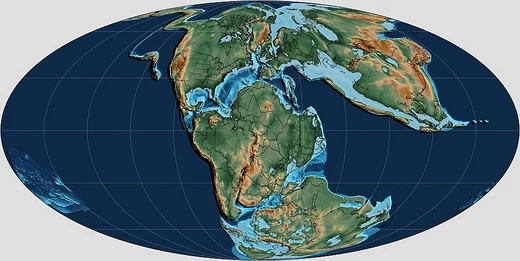
In June 1949, American geologist Harold Weston Robbins discovered a partial sauropod skeleton near Alenquer. Excavations at the Moinho do Carmo quarry were directed by Georges Zbyszewski for the geological Services of Portugal. The specimen, preserving over 26 vertebrae, dorsal ribs, and much of the appendicular skeleton except the hands and feet, is the most complete sauropod skeleton found in Portugal. The rocks belong to the Sobral Formation, deposited in an estuarine delta complex during the early Tithonian.
In 1957, Albert-Félix de Lapparent and Georges Zbyszewski described the specimen as a new species, Apatosaurus alenquerensis, also referring a caudal series from S. Bernardino and other fragments. The specific name refers to Alenquer. In 1983, a second partial skeleton was found at Porto Dinheiro in the Lourinhã municipality, excavated between 1987 and 1992 by teams from the Lourinhã Museum, the National Museum of Natural History and Science, Lisbon, and the University of Salamanca.
This specimen came from the Praia da Amoreira-Porto Novo Member of the Lourinhã Formation, late Kimmeridgian in age, slightly older than the Moinho do Carmo specimen. It includes nine neural spines, twelve complete posterior cervical and dorsal vertebrae, twelve dorsal ribs, and fragmentary appendicular material, plus a tooth and gastroliths. In 1998, Pedro Dantas and colleagues considered the Porto Dinheiro specimen conspecific with the Moinho do Carmo specimen and proposed the combination Lourinhasaurus alenquerensis, without designating a type specimen. The generic name refers to the Lourinhã municipality, where the Porto Dinheiro specimen was found.
Description
Lourinhasaurus alenquerensis was a big plant-eater and a close relative of Camarasaurus. Its skeleton had several distinctive traits: a hollow area on the underside of its front and middle back vertebrae, very tall hip vertebrae, a rear-facing hip bone projection, equal-length shin and calf bones, and a thighbone that curved outward without the extra bump seen in titanosaurs. The ratio of its upper arm to thigh length suggests it stood a bit more upright than Camarasaurus. This dinosaur reached about 15 to 18 meters long, weighed roughly 5 metric tons, and its thighbone measured 1.68 meters.
Classification
Originally described as Apatosaurus alenquerensis, the species was later reassigned to Atlantosaurus alenquerensis by Rodney Steel in 1970 and to Brontosaurus alenquerensis by George Olshevsky in 1978. In 1990, John Stanton McIntosh proposed close affinity to Camarasaurus based on opisthocoelic dorsal vertebrae, a broadly expanded distal scapular blade, a long slender humerus, and unexpanded distal ischia, provisionally naming it Camarasaurus alenquerensis.
McIntosh later suggested it might represent its own genus due to a higher humerus/femur length ratio. Subsequent classifications placed Lourinhasaurus as a basal eusauropod, a non-macronarian neosauropod, a basal macronarian, or related to Laurasiaformes. A 2014 re-description by Mocho and colleagues resolved its phylogenetic position as a basal macronarian closely related to Camarasaurus, and recovered Camarasauridae as a monophyletic clade including Camarasaurus, Lourinhasaurus, and Tehuelchesaurus.
More in Tithonian Dinosaurs
Sources
Compiled from Wikipedia and the sources listed below. Text from Wikipedia is available under CC BY-SA 4.0; this entry is adapted from it.
- Wikipedia: Lourinhasaurus (CC BY-SA 4.0).
- Occurrence records: GBIF (CC0 / CC BY). Basemap: Natural Earth (public domain).
- Word definitions: the , each quoted from its Wikipedia article.
Spotted an error? Know more?
Reader corrections go straight into our review queue. Suggest an edit · How this site is sourced