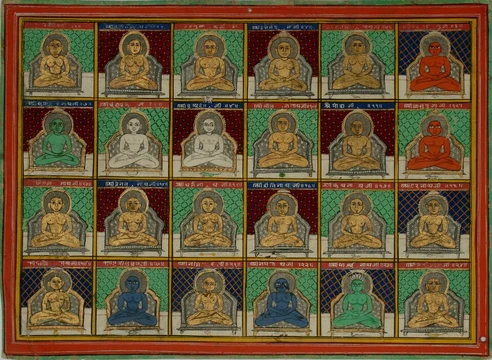
Neminatha
22nd tirthankara, cousin of Krishna, revered for compassion and renunciation.
His life story emphasizes absolute nonviolence and renunciation, with his wedding-day abandonment of worldly life serving as a central doctrinal example.[1][2] In Jain cosmology, the 22nd tirthankara of the current descending cycle (avasarpiṇī) is Neminatha.[3] Jain texts describe Neminatha as a direct cousin of Krishna, who is considered the ninth and final vasudeva.[3][4]
Quick Facts
- Venerated in
- Jainism
- Other names
- Nemi, Nem
- Father
- Samudravijaya
- Mother
- Śivādevī
- Predecessor
- Naminatha
- Successor
- Parshvanatha
- Birthplace
- Śaurīpura
- Moksha place
- Girnar
Facts from the source article.
Key facts and history
According to the 9th-10th century Jain text Uttarapurana and the 11th-century monk Hemachandra, the deity Indra named him Neminatha because he saw the Jina as the "rim of the wheel of dharma".[5] In Śvetāmbara texts his full name is Aristanemi, derived from his mother's dream of a "wheel of Arista jewels" during pregnancy.[6] He was born in Śaurīpura as the youngest son of King Samudravijaya and Queen Shivadevi, belonging to the Harivamsha branch of the Yadu dynasty.[7] He had 11 Ganadhara disciples led by Varadatta, and his monastic order included 18,000 male monks and 44,000 female monks.[8]
He attained liberation (moksha) on the fifth peak of Mount Girnar, known as Urjayant Parvat.[9] The Sanskrit components of "Neminatha" are "nemi," meaning either "rim of a wheel" or "thunderbolt," and "natha," meaning "lord, patron, protector."[10] According to traditional accounts, Neminatha lived approximately 84,000 years before the 23rd tirthankara Parshvanatha; however, Hemachandra's Trishashtishalakapurusha Charitra gives a figure of 81,000 years for that interval.[3] While traveling to his wedding with Rajmati, Neminatha heard animals crying out as they were being penned for slaughter; this caused him to abandon both the marriage and his royal life, becoming a monk on Mount Girnar.[1]
The Kalpa Sutra states that Neminatha ate only once every three days, spent 55 days in meditation, and achieved omniscience beneath a Mahavenu tree.[11]
What the cited sources add
Historian Jyotiprasad Jain notes an ethical alignment between Neminatha's doctrines and the virtues in the Hindu Chandogya Upanishad, prioritizing inner moral purity over external Vedic fire sacrifices.[12] The earliest known stone representations of Neminatha were excavated from Kankali Tila in Mathura, dating to the Kushan period (1st and 2nd centuries CE).[13] A 7th-century seated bronze idol of Neminatha was recovered from the Akota hoard in Gujarat, representing the post-Gupta Maitraka-era western Indian school of art.[13] The Hansi hoard from Asigarh Fort in Haryana, dated to the 8th and 9th centuries CE, contains an elaborate bronze idol of Neminatha seated in lotus posture, with six miniature standing tirthankaras on its pedestal flanked by Gomedha and Ambika.[14]
References
- Wikipedia, "Neminatha" (CC BY-SA 4.0), which cites: Sehdev Kumar 2001, p. 143–145; Umakant P. Shah 1987, p. ; Kailash Chand Jain 1991, p. 7; Umakant P. Shah 1987, p. ; Natubhai Shah 2004, p. 23–24; Sangave 2001, p. 104 (original not read by us) en.wikipedia.org
- Wikipedia, "Neminatha" (CC BY-SA 4.0), which cites: Dundas 2002, p. 24; Dundas 2002, p. 24; Jaini 1998, p. 259–260; Natubhai Shah 2004, p. 23–24 (original not read by us) en.wikipedia.org
- Wikipedia, "Neminatha" (CC BY-SA 4.0), which cites: Zimmer 1953, p. 225; Tukol 1980, p. 31; Natubhai Shah 2004, p. 23–24; Zimmer 1953, p. 225; von Glasenapp 1925, p. 317-318; Finegan 1952, p. 190; Zimmer 1953, p. 225; Finegan 1952, p. 190 (original not read by us) en.wikipedia.org
- Wikipedia, "Neminatha" (CC BY-SA 4.0), which cites: Umakant P. Shah 1987, p. ; Doniger 1993, p. 225; Natubhai Shah 2004, p. 23–24; Finegan 1952, p. 190; Sangave 2001, p. 104; Vyas 1995, p. 19 (original not read by us) en.wikipedia.org
- Wikipedia, "Neminatha" (CC BY-SA 4.0), which cites: Umakant P. Shah 1987, p. (original not read by us) en.wikipedia.org
- Wikipedia, "Neminatha" (CC BY-SA 4.0), which cites: Umakant P. Shah 1987, p. ; Jain Fischer 1978, p. 17; Zimmer 1953, p. 225; von Glasenapp 1925, p. 317-318 (original not read by us) en.wikipedia.org
- Wikipedia, "Neminatha" (CC BY-SA 4.0), which cites: Natubhai Shah 2004, p. 23–24; Doniger 1993, p. 225; Natubhai Shah 2004, p. 23–24; Dhere 2011, p. 193–196; Upinder Singh 2008, p. 313; Cort 2001a, p. 47; Tukol 1980, p. 31 (original not read by us) en.wikipedia.org
- Wikipedia, "Neminatha" (CC BY-SA 4.0), which cites: Umakant P. Shah 1987, p. ; Cort 2001a, p. 47 (original not read by us) en.wikipedia.org
- Wikipedia, "Neminatha" (CC BY-SA 4.0), which cites: Melton Baumann 2010, p. 1551; Natubhai Shah 2004, p. 23–24; Finegan 1952, p. 190; Sangave 2001, p. 104; Umakant P. Shah 1987, p. (original not read by us) en.wikipedia.org
- Wikipedia, "Neminatha" (CC BY-SA 4.0), which cites: Monier Williams, p. 569; Monier Williams, p. 569 (original not read by us) en.wikipedia.org
- Wikipedia, "Neminatha" (CC BY-SA 4.0), which cites: Jones Ryan 2006, p. 311; Jones Ryan 2006, p. 311; Umakant P. Shah 1987, p. (original not read by us) en.wikipedia.org
- Wikipedia, "Neminatha" (CC BY-SA 4.0), which cites: Jyotiprasad Jain 1983, p. 12; Natubhai Shah 2004, p. 23–24; Natubhai Shah 2004, p. 23–24; Bhattacharya 1966, p. 302; Bhattacharya 1966, p. 302; Natubhai Shah 2004, p. 23–24; Natubhai Shah 2004, p. 23–24 (original not read by us) en.wikipedia.org
- Wikipedia, "Neminatha" (CC BY-SA 4.0), which cites: Umakant P. Shah 1987, p. ; Umakant P. Shah 1987, p. ; Cort 2001a, p. 47; Umakant P. Shah 1987, p. ; Cort 2001a, p. 47; Umakant P. Shah 1987, p. ; Umakant P. Shah 1987, p. (original not read by us) en.wikipedia.org
- Wikipedia, "Neminatha" (CC BY-SA 4.0), which cites: Dangi 2017, p. 301–302; Handa 2002, p. 2–5; Handa 2002, p. 2–5 (original not read by us) en.wikipedia.org
Each numbered sentence above was checked against the source it cites before publication. Sentences citing Wikipedia adapt text from the English Wikipedia article Neminatha (contributors), used under CC BY-SA 4.0; this entry is available under the same licence. Other sources were used for facts only; no text or images are copied from them.
More in Tirthankaras
Spotted an error? Know more?
Reader corrections go straight into our review queue. Suggest an edit · How this site is sourced