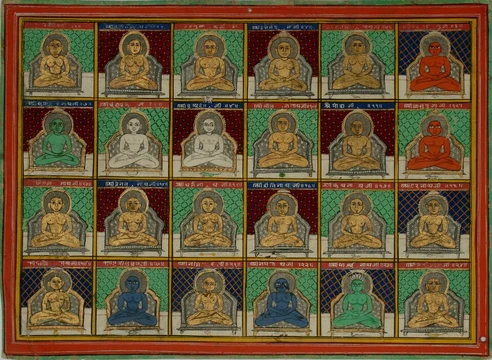
Kunthunatha
Seventeenth Tirthankara, sixth Chakravartin, and twelfth Kamadeva.
In Jain tradition, Kunthunatha is recognized as the seventeenth Tirthankara, the sixth Chakravartin, and the twelfth Kamadeva of the current Avasarpini half-cycle. He attained liberation, becoming a siddha free from all karma. Born in Hastinapur to King Surya (Sura) and Queen Shridevi of the Ikshvaku dynasty, his birth occurred on the fourteenth day of Vaishakh Krishna.
Quick Facts
- Deity of
- 17th Tirthankara
- 6th Chakravarti
- and 12th Kamadeva
- Venerated in
- Jainism
- Father
- Śurya
- Mother
- Śrīdevī
- Height
- 35 bows (105 metres)
- Predecessor
- Shantinatha
- Successor
- Aranatha
- Moksha place
- Sammed Shikhar
Facts from the source article.
Life
Kunthunatha, born in 27,695,000 BCE, stood 35 dhanusha tall. As a Chakravartin, he conquered all lands and attempted to inscribe his name on mountain foothills. Finding earlier Chakravartins’ names already there, his ambitions shrank, prompting him to abdicate and pursue ascetic penance. He achieved liberation and Moksha on Mount Shikharji at age 95,000 years. He was born half a palya after Shantinatha, and his successor Aranatha arrived one-quarter palya less 6,000 crore years later.
Iconography
Kunthunatha is conventionally depicted in a sitting or standing meditative posture, with a goat as his distinguishing emblem. He is associated with a golden physical complexion. The 11th-century Aluara hoard of Digambara bronzes, discovered near Dhanbad, Jharkhand, contains rare identifiable idols of Kunthunatha seated in padmasana, now preserved at the Patna Museum.
Famous Temple
On Mount Shikharji, a shrine (tonk) enshrining his footprints marks the site of his moksha. In Jaisalmer Fort, a 15th-century Śvētāmbara temple dedicated to Kunthunatha is known for intricate stone carvings. In southern India, the Karanthai Jain temple is a major centre, and the Ganigitti Jain temple in Hampi, built in 1385 CE during the Vijayanagara Empire by commander Iruguppa, is a 14th-century Dravidian-style monument with an inscription dedicating its primary sanctuary to Kunthunatha.
More in Tirthankaras
Spotted an error? Know more?
Reader corrections go straight into our review queue. Suggest an edit · How this site is sourced