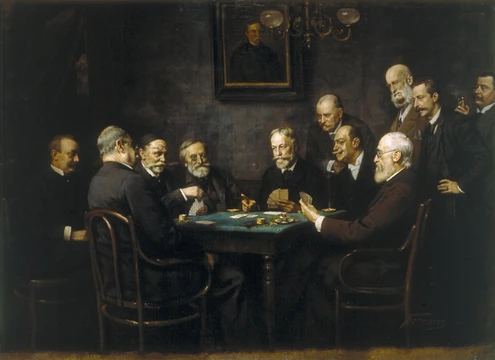
Mulatschak
Austrian Rams-family game aiming to reduce one's score to zero.
Last updated
Mulatschak, also called Fuchzenawa or "Fifteen Down," is an Austrian card game from the Salzburg area, considered the quintessential game of the region. It belongs to the Rams family, where players may drop out if they believe their hand is too weak to take a minimum number of tricks. Although long regarded as the national card game of Salzburg, its rules were almost certainly unpublished before 2004.
Background
The word mulatschak comes from the Hungarian mulatság, meaning "merriment" or "amusement," and refers to a traditional evening drinks celebration where glasses are hurled against the wall. The alternative name Fuchzenawa means "fifteen down." Mulatschak is a member of the Rams family, whose distinctive feature is that players may choose to opt out of a deal if their cards are not sufficiently good to win a trick or the minimum specified number of tricks. Geiser writes that Mulatschak "may justifiably be called the national card game of the state of Salzburg," as it is one of the most popular games there, especially among young and middle-age groups, and is rarely played elsewhere.
Rules
Mulatschak is a trick-taking game for four players. Each player begins with a score of 15 points in the Geiser variant or 21 points in the Murln variant; the Geiser rules are used here. The goal is to be the first to reduce your score to zero by winning tricks. The game uses a 36-card Double German pack, also called a William Tell pack, with four suits: Acorns, Leaves, Hearts, and Bells.
The card ranking from highest to lowest is Sow (also called Deuce or Ace), King, Ober, Unter, Ten, Nine, Eight, Seven, Six. The Weli is a permanent trump card that ranks second-highest. The dealer shuffles and offers the deck to the player on the right, called rearhand, to cut. Rearhand may look at the bottom card of the top packet; if it is the Weli, they show it to the other players and may schleck it, meaning they add it to their hand.
Dealing and cutting
Otherwise, no other player sees that card. The dealer then gives each player five cards in two packets: one of three cards and one of two. If rearhand schlecked the Weli, they receive only four cards. If any player holds a whiteout, or Weiße, meaning no court cards, they announce it, the hand is redealt, and the next deal counts double.
Bidding
Bidding starts with forehand and proceeds clockwise. Each player announces how many tricks they expect to win, from zero to five. A bid must be higher than the previous highest, or the player passes. The dealer, however, may hold the highest bid by saying selber.
Bidding continues until all but one player have passed. The winning bidder becomes the declarer and chooses the trump suit. A player may bid Mulatschak, which is a promise to win every trick without exchanging any cards. This bid can only be made on the player’s first turn to bid.
Exchanging
After winning the bid, the declarer may exchange any number of cards from their hand with cards from the talon. They place the cards they wish to discard face down on the table, and the dealer gives them the same number of cards from the remaining stock.
More in Three-player Card Games
Sources
Compiled from Wikipedia and the sources listed below. Text from Wikipedia is available under CC BY-SA 4.0; this entry is adapted from it.
- Wikipedia: Mulatschak (CC BY-SA 4.0).
Spotted an error? Know more?
Reader corrections go straight into our review queue. Suggest an edit · How this site is sourced