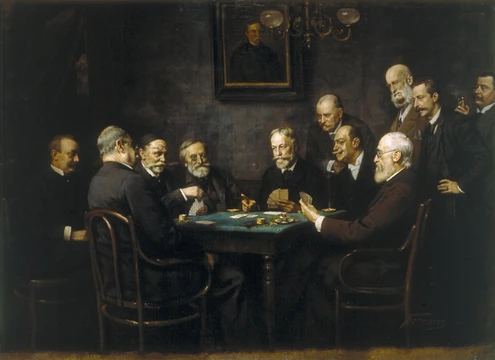
King (card game)
A Russian compendium card game with alternating negative and positive contracts.
Last updated
King is a compendium card game of the Hearts family, played by three or four players. Its origins are uncertain, though it may be related to Barbu and has been known since the 1920s. The game is notable for its two rounds of six contracts, alternating between negative and positive scoring.
Rules
King is a trick-taking card game for three players using a 36-card deck of Russian-pattern, French-suited cards. Aces are high, and the natural ranking order applies. Play and dealing proceed clockwise, with each player receiving 12 cards. The eldest hand leads the first trick, and players must follow suit if they can; otherwise, they may play any card.
The game has two rounds, each containing six contracts. The first round consists of negative games: No Tricks (6 penalty points per trick taken), No Hearts (8 points per heart, hearts cannot be led unless forced), No Men (9 points for each King or Jack), No Queens (18 points per Queen), No Last Two Tricks (36 points for taking either of the final two tricks), and No King of Hearts (72 points for that specific card; hearts may not be led unless necessary, and the King of Hearts must be played when unable to follow suit).
The second round repeats these same six contracts, but now they are positive games, awarding plus points instead of penalties. A four-player version exists with a 32-card deck, where each player gets 8 cards. Its penalty values are adjusted: 2 points per trick, 2 per heart, 2 per King or Jack, 4 per Queen, 8 for the last two tricks, and 16 for the King of Hearts. The positive round mirrors the negative one.
More in Three-player Card Games
Sources
Compiled from Wikipedia and the sources listed below. Text from Wikipedia is available under CC BY-SA 4.0; this entry is adapted from it.
- Wikipedia: King (card game) (CC BY-SA 4.0).
Spotted an error? Know more?
Reader corrections go straight into our review queue. Suggest an edit · How this site is sourced