North Asasif
Private tombs from Middle Kingdom to Ptolemaic period in the Theban Necropolis.
Last updated
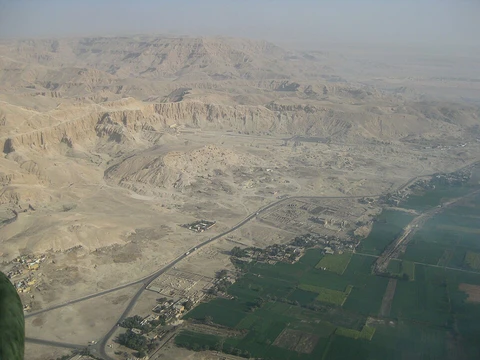
North Asasif is a section of the Theban Necropolis situated along the valley floor and slopes, following the processional routes to the royal mortuary temples at Deir el-Bahari. These include the temples of Mentuhotep II, Hatshepsut, and Thutmose III. The area contains private tombs spanning from the Middle Kingdom through the Ptolemaic period. Archaeological evidence reveals enduring connections between Asasif and Deir el-Bahari across different eras.
Quick Facts
- Period covered
- Middle Kingdom to Ptolemaic period
- Notable tombs
- TT 414 (Ankh-Hor)
- TT 28 (Vizier Amenhotep Huy)
- TT 33 (Padiaménopé)
- TT 103
- TT
Facts from the source article.
Recent archaeological research and discoveries
The Ankh-Hor Project, led by Julia Budka in partnership with LMU Munich and the Austrian Academy of Sciences, picked up where earlier Austrian work left off. Its goal is to finish documenting and conserving the area around Saite Theban Tomb 414, the burial place of Ankh-Hor, which should give experts a clearer picture of how people were buried and what grave goods they used in the first millennium BC. Between 2009 and 2014, a Spanish team from the Instituto de Estudios del Antiguo Egipto in Madrid looked into the chapel of Vizier Amenhotep Huy’s tomb, known as Asasif Tomb No. 28.
Since 2014, two more tombs in the necropolis, TT 103 and TT 366, have been under investigation by the Middle Kingdom Theban Project, run by Antonio J. Morales. In 2013, the Polish Asasif Project got underway, headed by Anastasia Stupko-Lubczyńska and Patryk Chudzik and backed by the Polish Centre of Mediterranean Archaeology at the University of Warsaw. This effort focuses on recording Middle Kingdom private funerary architecture, examining both the interiors of rock-cut tombs and their courtyards on the rocky hillsides.
The graves belong to high-ranking officials who served under Mentuhotep Nebhepetre II and later rulers of the 11th and 12th dynasties. By studying the architectural remains and small objects found, the team hopes to understand how these structures were later rebuilt and reused. Even though the necropolis had been explored for years, the Polish researchers made a notable find in 2014: a 12th-dynasty funerary chapel in one courtyard, complete with a piece of a limestone altar and burial offerings.
A newer project, the French Archaeological Mission in Asasif (FAMA), started in 2018. It is a joint venture of the Institut français du Proche-Orient, the University of Strasbourg, and the French National Centre for Scientific Research, directed by Frédéric Colin. This mission works on tomb TT33, studying its construction stages and later use to shed light on how the whole Asasif Valley developed. Egyptian researchers, concentrating on tombs at the valley floor, have turned up the most striking finds.
In 2019, they uncovered a cache of thirty wooden coffins from the 22nd dynasty, dating from 946 to 722 BC. These coffins held well-preserved mummies of priests and priestesses.
Did You Know?
- The Austrian excavations in Asasif were directed by Manfred Bietak from 1969 to 1977 as part of the “Austrian Excavations in the Asasif” project.
- Earlier archaeological research in Asasif was conducted in 1883 by the Supreme Council of Antiquities (SCA) and in the 1920s by an expedition directed by Herbert E. Winlock from the Metropolitan Museum of Art in New York.
More in Theban Necropolis
Sources
Compiled from Wikipedia and the sources listed below. Text from Wikipedia is available under CC BY-SA 4.0; this entry is adapted from it.
- Wikipedia: North Asasif (CC BY-SA 4.0).
Spotted an error? Know more?
Reader corrections go straight into our review queue. Suggest an edit · How this site is sourced