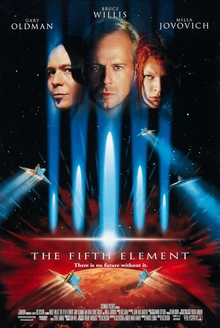
The Mute's Abilities
He does not speak; the city whispers through him.
The Mute is one of the most enigmatic supporting figures in The Fifth Element (1997), a silent, ancient-seeming guide whose extraordinary sensory powers and telepathic link to a scattered collective make him a living instrument of detection. He operates not as a warrior or a politician but as a sense-organ for a hidden network, translating the world's invisible vibrations into actionable knowledge for those who lack his gifts. His role in the story is pivotal: he is the one who confirms the identity of the Fifth Element and sets the central quest in motion.
Played with quiet, physical grace by Ian Holm, the Mute moves through the neon-drenched sprawl of the New York City of 2259 as a ghost with purpose. He speaks rarely, and when he does, the voice that emerges is not his own but the composite murmur of every Mute listening through him. His abilities—smell, touch, vibration-sensing, and that shared consciousness—form a toolkit that is entirely innate, contrasted against the small manufactured devices he carries for self-defense. Together, they make him a character who feels less like a person and more like a function the universe performs.
Quick Facts
- Character
- The Mute
- Played by
- Ian Holm
- Role
- Guide; Sensory scout for a telepathic collective
- Affiliation
- The Mutes (a distributed mind-network)
- First appears
- The Fifth Element (1997)
- Status
- Survives the film's events
Lore & Background
The Mutes are a distributed consciousness. Each individual Mute is a node, a sensory antenna planted in a different corner of the metropolis. They do not think alone; every Mute shares a single, vast awareness. When one Mute smells a particular chemical trace, every other Mute in the network registers it simultaneously. This is why the Mute who walks beside Kbale can identify the Fifth Element with such certainty—he is not guessing. He is reporting a consensus reached across dozens of distributed minds, each one pressing its face to a different wall of the world.
His personal sensory suite is staggering. His olfactory sense can pick up molecular traces across distance, letting him track a being by the faintest biochemical signature. His skin reads vibrations, textures, and thermal shifts with a precision that renders conventional sight almost redundant. He can feel the electromagnetic hum of a living cell, the particular frequency that marks one of the elemental beings. In a city of billions, this makes him a needle-finder in a haystack the size of a continent. The trade-off is that his awareness is not his own; he is as much a receiver as a person, and the boundary between his individual will and the collective's is thin, permeable, and sometimes indistinct.
Narratively, the Mute functions as the story's first act of recognition. Before any gun is fired, before any chase through the neon canyons, it is his quiet, almost reverent confirmation—'It is the Fifth Element'—that transforms a random encounter into a destiny. He is the hinge on which the plot swings, and his power is not force but perception. In a film obsessed with spectacle, his scene is stillness, and it lands harder for it.
Reader's Guide
The Mute's toolkit divides cleanly into two categories: the innate sensory and psychic gifts he was born with, and the small manufactured objects he carries for practical defense.
Innate abilities. The Mute's defining trait is his hyper-acute sensory perception. On screen, this manifests most clearly through smell—he can identify a being by its unique biochemical trace, which is how he confirms the Fifth Element's identity. His touch is equally refined; pressing his hand to a surface lets him read vibrations, thermal patterns, and residual energy, effectively giving him a form of tactile 'sight.' Most remarkably, these senses are not isolated to one body. The Mutes form a telepathic collective: when the Mute perceives something, every other Mute in the network perceives it simultaneously, and conversely, information gathered by any single node is available to all. This shared mind is how he 'speaks'—the voice that emerges is a composite, a chorus of distributed consciousness funneled through one throat. The limits shown in the film are subtle: the Mute appears to require physical contact or close proximity for his tactile and olfactory readings, and his communication, while vast, is slow and deliberate rather than instantaneous command-and-control. He is a sensor, not a weapon.
Manufactured objects. The Mute carries a small handheld device that, when activated, projects a brief energy pulse or force-field effect. In the film's action sequences, this is his only offensive tool, and it is used sparingly—just enough to deflect or disrupt, not to destroy. It is a sidearm, a last resort for a being whose primary function is perception, not combat. He also carries a small creature companion, a compact animal that moves with him and appears to serve as an additional sensory extension, its own instincts complementing the Mute's. The creature is not a weapon; it is a partner, a living antenna that extends the Mute's awareness into spaces his own body cannot reach.
Narrative function. The Mute's abilities serve the story's central thesis: that true power is not the capacity to destroy but the capacity to recognize. In a film saturated with energy weapons, force fields, and orbital bombardment, the Mute's scene is the one moment where nothing is thrown and nothing explodes. His power is a whisper, a touch, a smell. And it is the moment that changes everything. He is the narrative's proof that the most important act in the story is not a punch but a name.
Did You Know?
- When the Mute 'speaks' in the film, the voice is deliberately layered and composite, suggesting that the sound is not one man's voice but the merged output of the entire Mute collective channeling through a single body.
- The Mute's small energy device is used only a handful of times in the film, reinforcing the idea that a being whose primary power is perception would treat violence as a last resort rather than a default.
More in Powers & Artifacts
Elsewhere in The Fifth Element
Spotted an error? Know more?
Reader corrections go straight into our review queue. Suggest an edit · How this site is sourced