Agents of S.H.I.E.L.D.
The first MCU television series, following S.H.I.E.L.D. agents through seven seasons.

Marvel Television, ABC Studios · Public domain
Marvel's *Agents of S.H.I.E.L.D.* is an American television series created by Joss Whedon, Jed Whedon, and Maurissa Tancharoen for ABC. It is based on the Marvel Comics spy and peacekeeping organization S.H.I.E.L.D., which operates in a world of superheroes. As the first television series set in the Marvel Cinematic Universe (MCU), it respects the continuity of the franchise's films and other TV shows. The series was produced by ABC Studios, Marvel Television, and Mutant Enemy Productions, with showrunners Jed Whedon, Maurissa Tancharoen, and Jeffrey Bell.
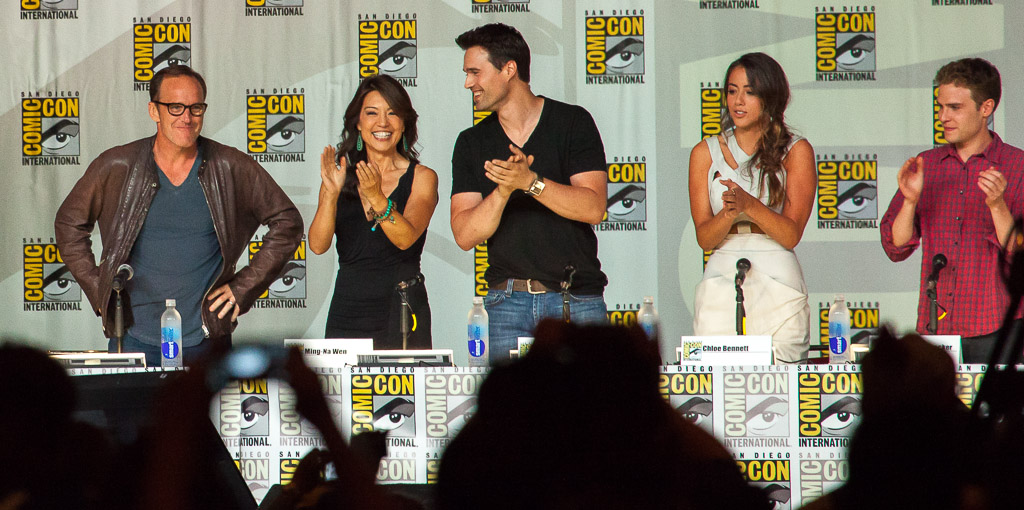
The cast is led by Clark Gregg, reprising his film role as Phil Coulson, alongside Ming-Na Wen, Brett Dalton, Chloe Bennet, Iain De Caestecker, and Elizabeth Henstridge. Later seasons added Nick Blood, Adrianne Palicki, Henry Simmons, Luke Mitchell, John Hannah, Natalia Cordova-Buckley, and Jeff Ward. The agents tackle strange cases and enemies such as Hydra, Inhumans, Life Model Decoys, alien species like the Kree and Chronicoms, and time travel. Several episodes directly cross over with MCU films or other series, most notably *Captain America: The Winter Soldier*, which heavily impacted the first season, and *Agent Carter*, whose regular Enver Gjokaj joined the cast for the seventh season. Other MCU actors also made guest appearances.
Joss Whedon, who wrote and directed *The Avengers*, began developing a S.H.I.E.L.D. pilot in August 2012. Gregg was confirmed to reprise his role that October, and ABC picked up the series in May 2013. The show aimed to replicate the production value of MCU films on a broadcast television budget while working within the constraints set by Marvel Studios and the films. Prosthetic makeup came from Glenn Hetrick's Optic Nerve Studios, with Legacy Effects handling other practical effects. Composer Bear McCreary recorded each episode's score with a full orchestra, and visual effects from multiple vendors earned several award nominations.
The series premiered on ABC on September 24, 2013, and ended with a two-part finale on August 12, 2020, totaling 136 episodes over seven seasons. Ratings started high in the first season but declined over time, though they remained more consistent within each season. Reviews were consistently positive across all seasons. Several characters created for the show have since appeared in comics and other media. An online digital series, *Agents of
- network
- ABC
- premiere_date
- September 24, 2013
- finale_date
- August 12, 2020
- seasons
- 7
- episodes
- 136
- showrunners
- Jed Whedon, Maurissa Tancharoen, Jeffrey Bell
- production_companies
- ABC Studios, Marvel Television, Mutant Enemy Productions
Quick Facts
- Genre
- Action / Drama / Science fiction / Superhero
- Creator
- Joss Whedon / Jed Whedon / Maurissa Tancharoen
- Based On
- S.H.I.E.L.D. · Stan Lee · Jack Kirby
- Showrunner
- Jed Whedon / Maurissa Tancharoen / Jeffrey Bell
- Composer
- Bear McCreary / Jason Akers (season 7)
- Country
- United States
- Language
- English
- Num Seasons
- 7
- Num Episodes
- 136
- List Episodes
- List of Agents of S.H.I.E.L.D. episodes
- Producer
- Garry A. Brown / Chris Cheramie
- Location
- Los Angeles / Culver City
Facts from the source article.
Lore & Background
The series stars Clark Gregg as Phil Coulson, reprising his role from the MCU films, alongside Ming-Na Wen, Brett Dalton, Chloe Bennet, Iain De Caestecker, and Elizabeth Henstridge. Later seasons added Nick Blood, Adrianne Palicki, Henry Simmons, Luke Mitchell, John Hannah, Natalia Cordova-Buckley, and Jeff Ward. The agents investigate Project Centipede and uncover Hydra's infiltration of S.H.I.E.L.D., leading to the organization's destruction as depicted in Captain America: The Winter Soldier. Subsequent seasons involve rebuilding S.H.I.E.L.D., dealing with Inhumans, the Secret Warriors, Ghost Rider, Life Model Decoys, time travel to the year 2091, and a Chronicom threat that forces the team to jump through time to prevent Earth's destruction.
Reader's Guide
Agents of S.H.I.E.L.D. holds significance as the first television series to be directly integrated into the Marvel Cinematic Universe, with episodes crossing over with MCU films such as Captain America: The Winter Soldier and the series Agent Carter. The show attempted to replicate the production value of the MCU films on a broadcast television budget, using prosthetic makeup from Optic Nerve Studios and practical effects from Legacy Effects, with composer Bear McCreary recording each episode's score with a full orchestra. Several characters created for the series were later introduced to the comic universe and other media. An online digital series, Agents of S.H.I.E.L.D.: Slingshot, centered on Elena 'Yo-Yo' Rodriguez, was released in December 2016. Other spin-offs were planned but never materialized. The series received consistently positive reviews across all seasons, though ratings declined after the first season.
Did You Know?
- The series was created by Joss Whedon, Jed Whedon, and Maurissa Tancharoen for ABC.
- Clark Gregg reprises his role as Phil Coulson from the MCU films.
- Several episodes directly cross over with MCU films, notably Captain America: The Winter Soldier.
- An online digital series, Agents of S.H.I.E.L.D.: Slingshot, was released in December 2016.
From Avengers to the Small Screen: Production Ambitions
Agents of S.H.I.E.L.D. traces its creative DNA directly to Joss Whedon's direction of The Avengers in 2012. By August of that year, Whedon had already begun shaping a television pilot that would extend the franchise beyond the theatrical format. Clark Gregg's return as Phil Coulson was locked in by October, and ABC gave the project its official green light in May 2013. The show was a joint production of ABC Studios, Marvel Television, and Whedon's Mutant Enemy Productions, with Jed Whedon, Maurissa Tancharoen, and Jeffrey Bell steering day-to-day creative decisions as showrunners. A central production challenge was matching the visual polish audiences had come to expect from the MCU films while operating on a broadcast television budget and within continuity rules set by Marvel Studios. To meet that bar, the team enlisted Glenn Hetrick's Optic Nerve Studios for prosthetic makeup work and Legacy Effects for additional practical effects. Composer Bear McCreary recorded every episode's score with a full orchestra, and visual effects were distributed across multiple vendors, earning the series numerous award nominations over its run.
Seven Seasons of Escalating Threats
Across one hundred and thirty-six episodes spanning seven seasons, the show's scope expanded from a single agency's internal betrayal to a war across time and space. Season one introduced the audience to Project Centipede and the terrifying revelation that Hydra had embedded itself deep within S.H.I.E.L.D.'s leadership. The destruction of the organization in Captain America: The Winter Soldier set up season two, in which Coulson assumed the director's chair and attempted to rebuild while confronting both Hydra and the newly revealed Inhumans. Season three pushed the stakes further with the Secret Warriors and the ancient Inhuman Hive, culminating in S.H.I.E.L.D.'s reinstatement under the Sokovia Accords. Season four returned Coulson to field work and introduced the Life Model Decoy and Framework virtual-reality projects alongside the Ghost Rider. Season five yanked the team into the year 2091 aboard the Lighthouse station before ending with Coulson's death. Season six split the cast between a space rescue and an Earth-based mercenary threat led by Sarge, while season seven sent a Life Model Decoy of Coulson and his surviving team hurtling through time to stop the Chronicoms from rewriting history.
Weaving the MCU Tapestry
As the first television series officially set in the Marvel Cinematic Universe, Agents of S.H.I.E.L.D. carried the unusual responsibility of acknowledging the continuity of the franchise's films and other shows while carving out its own narrative space. The impact of Captain America: The Winter Soldier on the first season was particularly significant, and the series later crossed over with Agent Carter, whose regular Enver Gjokaj joined the cast for the seventh season. Actors from across the MCU also appeared in guest roles, reinforcing the interconnected feel. The show's influence flowed outward as well. Several characters originally created for the series were subsequently introduced into the Marvel comic universe and other media properties. In December 2016, ABC.com released Slingshot, a digital spin-off centered on Natalia Cordova-Buckley's Elena "Yo-Yo" Rodriguez. Additional spin-off projects were reportedly planned during the series' run but never reached production. The show premiered on September 24, 2013, and wrapped with a two-part finale on August 12, 2020, leaving behind a body of work that helped define what a shared-universe television series could look like.
Coulson's Journey and the Ensemble
Clark Gregg's Phil Coulson served as the gravitational center of the entire series, and his arc was as layered as the show's mythology. Gregg agreed to reprise the role in April 2013 after hearing Whedon's explanation for the character's resurrection following The Avengers, describing the pitch as both "fascinating" and faithful to the comics. He approached Coulson's promotion to director as the character landing his dream job, which simultaneously demanded a more measured, Nick Fury-like demeanor. The ensemble around him was equally vital. Ming-Na Wen brought a S.H.I.E.L.D. ace pilot and weapons expert nicknamed "the Cavalry" to life, a character Whedon had been "rolling around in his head" for a long time and who originally appeared on casting sheets under the name Agent Althea Rice. Brett Dalton, Chloe Bennet, Iain De Caestecker, and Elizabeth Henstridge rounded out the core team, while later seasons added Nick Blood, Adrianne Palicki, Henry Simmons, Luke Mitchell, John Hannah, Natalia Cordova-Buckley, and Jeff Ward. By season six, Gregg was playing Sarge, a man who looked exactly like Coulson, and in season seven he portrayed a Chronicom-enhanced Life Model Decoy version of the character.
Gallery


Frequently Asked Questions
What is Agents of S.H.I.E.L.D. about?
The series follows the covert operations of S.H.I.E.L.D., a global intelligence agency, as its field agents confront threats from alien civilizations, rogue superhumans, and otherworldly entities. It ran for seven seasons and 136 episodes on ABC between 2013 and 2020.
How does Agents of S.H.I.E.L.D. connect to the Marvel movies?
As the first MCU television series, it shares direct continuity with the films, picking up after the events of The Avengers (2012). Clark Gregg reprises his role as Phil Coulson, and the show introduces characters and lore that later appear across the broader franchise.
What alien races and threats appear in Agents of S.H.I.E.L.D.?
The show features multiple extraterrestrial civilizations, including the Kree, the Skrulls, and the Inhumans, alongside cosmic entities like the Darkhold and the Watcher. These threats drive much of the series' central conflict across its seven seasons.
How does the Agents of S.H.I.E.L.D. story end?
In the season 7 finale, the remaining agents defeat the Watcher and his army, with Phil Coulson ultimately making a final sacrifice to prevent the destruction of the universe. The series closes with the surviving team regrouping and moving forward.
Why is Agents of S.H.I.E.L.D. important to the MCU?
It was the first live-action TV show to exist within the shared Marvel Cinematic Universe timeline, establishing that television could expand the franchise's lore. The series introduced the Inhumans and other characters who later appeared in other MCU properties.
More in Television series about extraterrestrial life 1-24
Spotted an error? Know more?
This is a living reference — every entry is fact-audited, and reader corrections feed straight into our audit queue. Suggest an edit · See this site's audit record