Teenage Mutant Ninja Turtles (2014 film)
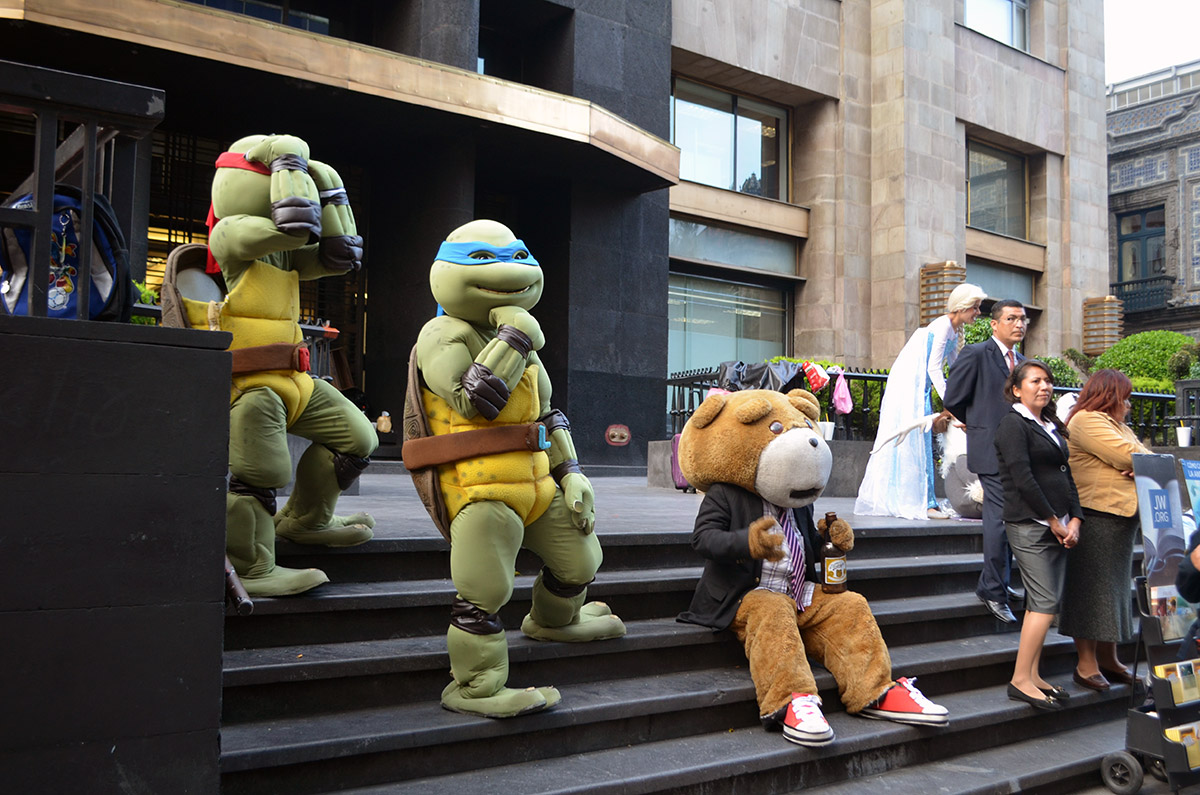
A reboot of the Teenage Mutant Ninja Turtles film series.

Dennis G. Jarvis · CC BY-SA 2.0
In 2014, a reboot of the Teenage Mutant Ninja Turtles film series hit theaters, directed by Jonathan Liebesman. The screenplay, credited to Josh Appelbaum, André Nemec, and Evan Daugherty, went through many revisions before its final form. The movie stars Megan Fox, Will Arnett, William Fichtner, Danny Woodburn, Abby Elliott, Noel Fisher, Jeremy Howard, Pete Ploszek, and Alan Ritchson, with vocal performances from Johnny Knoxville and Tony Shalhoub. The story centers on the four mutant turtles—Leonardo, Donatello, Raphael, and Michelangelo—who team up with reporter April O'Neil to stop the villainous Shredder and his Foot Clan from terrorizing New York City.
The project was announced shortly before the original characters were sold to Nickelodeon by co-creators Peter Laird and Kevin Eastman in October 2009. By late May 2010, Paramount Pictures and Nickelodeon Movies had brought on Michael Bay and his Platinum Dunes partners, Andrew Form and Brad Fuller, as producers. Liebesman began talks to direct in early 2012. Principal photography ran from March to August 2013 in Tupper Lake, New York. The film premiered in Mexico City on July 29, 2014, and went into wide release on August 8, 2014. Critics generally panned it for its writing and character portrayals, but it performed well at the box office, earning $485 million on a budget of $125–150 million. That made it the highest-grossing entry in the TMNT franchise at the time, though it was not the top earner for Nickelodeon Movies overall. A sequel, *Out of the Shadows*, came out in 2016 to slightly better reviews but lower ticket sales.
The plot begins with April O'Neil, a Channel 6 News reporter, looking into a crime spree by the Foot Clan. After witnessing a raid at a dock and a mysterious vigilante attack the thieves, she finds a strange symbol left behind. Her boss, Bernadette Thompson, dismisses her story. Later, at a charity event for Sacks Industries, April thanks CEO Eric Sacks, who once worked with her late father. To draw out the vigilante, Shredder orders the Foot to take hostages in a subway station. April is among them. Four mutant turtles appear, defeat the Clan, and free everyone. April follows them to a rooftop, faints in shock upon realizing what they are, and wakes to hear them tell her to keep their existence secret. She overhears the names Leonardo and Raphael.
Back at her apartment, April
- Release year
- 2014
- Director
- Jonathan Liebesman
- Writers
- Josh Appelbaum, André Nemec, Evan Daugherty
- Box office
- $485 million
- Budget
- $125–150 million
- Genre
- Superhero
- Production companies
- Paramount Pictures, Nickelodeon Movies, Platinum Dunes
Lore & Background
The film was announced shortly before the rights to the characters were sold to Nickelodeon by co-creators Peter Laird and Kevin Eastman in October 2009. In late May 2010, Paramount Pictures and Nickelodeon Movies brought Michael Bay and his Platinum Dunes partners Andrew Form and Brad Fuller on to produce the film. Jonathan Liebesman began negotiations to direct in early 2012. The screenplay went through numerous rewrites, with Applebaum, Nemec, and Daugherty ultimately getting final credit. Principal photography began in March 2013, in Tupper Lake, New York, and production concluded in August 2013.
Teenage Mutant Ninja Turtles premiered on July 29, 2014 in Mexico City, and was released in theaters on August 8, 2014. The film received generally negative reviews from critics, with criticism aimed at its
Reader's Guide
The 2014 Teenage Mutant Ninja Turtles film marked a significant reboot of the franchise, bringing the characters to a new generation of audiences. Despite generally negative reviews from critics, who criticized its screenplay and characterisations, the film was a commercial success, grossing $485 million worldwide. It became the highest-grossing film in the Teenage Mutant Ninja Turtles franchise and the highest-grossing film from Nickelodeon Movies. The film's production involved notable figures such as Michael Bay as a producer, and it underwent multiple script rewrites before final credits were assigned. The sequel, Out of the Shadows, followed in 2016 but did not match the first film's box office performance. The film's legacy includes its role in revitalizing the property for modern audiences and its financial success despite critical reception.
Did You Know?
- The film was announced shortly before Peter Laird sold the rights to the characters to Nickelodeon in October 2009.
- Principal photography began in March 2013 in Tupper Lake, New York, and concluded in August 2013.
- The film premiered on July 29, 2014 in Mexico City and was released in theaters on August 8, 2014.
- It became the highest-grossing film in the franchise and the highest-grossing film from Nickelodeon Movies.
The Shredder Takes Center Stage
The Shredder was originally conceived as the primary antagonist of Mutant Mayhem, but director Jeff Rowe made a deliberate creative choice to write him out of that film. His reasoning was that he wanted the first movie's villain to be a mutant the Turtles could relate to and feel tempted by, which led to Superfly filling that role. Now, in the sequel, the Shredder returns as the central threat, and Rowe has described his vision as a "villain-forward film" that still keeps the spotlight on the four brothers. He emphasized wanting a portrayal of the Shredder that feels fresh and unique while remaining true to the character's legacy, and he specifically aimed to make him a more intimidating presence than Superfly was in the first film. Adding to the threat level, Seth Rogen confirmed at CinemaCon 2026 that Krang would appear as an additional antagonist, layering the conflict with a second major villain. The result is a narrative structure where the Turtles face a dual-front battle against two of the franchise's most iconic adversaries, marking a significant escalation in stakes compared to their previous cinematic outing.
Production Turbulence and the Animation Crisis
The road to production for this sequel was far from smooth. Mikros Animation, which had handled the visual work on Mutant Mayhem, was confirmed in December 2024 as the returning animation studio. However, just two months later in February 2025, Mikros' parent company Technicolor Group abruptly ceased all operations due to mounting financial difficulties and an inability to secure new investors. This sudden shutdown immediately halted work on the Mutant Mayhem sequel and other active projects across Mikros' global operations. The situation was resolved in March 2025 when Rodeo FX stepped in, acquiring Mikros' Paris and Canadian divisions and committing to resume the paused projects. The disruption had a tangible downstream effect on the release schedule: the film was initially slated for October 9, 2026, then pushed to September 17, 2027, before settling on its current August 13, 2027 date. According to Animation Magazine, the first delay was attributed to unspecified setbacks in physical animation production, a direct consequence of the studio transition.
The Creative Team and Their Vision
The sequel assembles a core creative team that carries forward the DNA of Mutant Mayhem while expanding the scope. Jeff Rowe returns as director, now joined by co-directors Kyler Spears and Yashar Kassai, who previously served as co-director and production designer on the first film, respectively. Point Grey Pictures' slate of producers—Seth Rogen, Evan Goldberg, James Weaver, and Josh Fagen—remain attached alongside Ramsay McBean, who moved from executive producer to a full producer role. Kent Seki is back as head of cinematography, ensuring visual continuity. Writing on the project had already commenced by 2023, and by July 2024, Rogen confirmed the film had been given its working title and a completed animatic. The four original voice talents—Micah Abbey as Donatello, Shamon Brown Jr. as Michelangelo, Nicolas Cantu as Leonardo, and Brady Noon as Raphael—reprise their roles, with voice recording sessions underway by 2025. This continuity of both creative leadership and vocal performance anchors the sequel in the established world while the expanded directorial team signals an ambition to push the production further.
Franchise Expansion and the Road Ahead
Beyond the film itself, the sequel sits at the center of a broader franchise ecosystem that is actively evolving. In July 2023, alongside the greenlight for the movie, Paramount+ announced an animated television series titled Tales of the Teenage Mutant Ninja Turtles, creating a parallel narrative space for the characters. On the merchandise front, a significant shift occurred in December 2025 when Paramount chose not to renew its long-standing agreement with Playmates Toys, ending nearly four decades of that partnership. In February 2026, Mattel stepped in to acquire the franchise's master license, with their first product line based on the Mutant Mayhem sequel slated for 2027. Looking further ahead, by December 2025, Rogen and Point Grey Pictures were already in discussions with Paramount Skydance about producing a third installment in the series. This trajectory—spanning theatrical films, streaming content, toy lines, and a potential trilogy—positions the Mutant Mayhem franchise as a multi-platform property with considerable long-term ambition, building on the momentum of the 2023 original.
Gallery

Frequently Asked Questions
Who directed Teenage Mutant Ninja Turtles (2014)?
Jonathan Liebesman helmed this 2014 superhero film, which served as a full reboot of the long-running TMNT movie franchise. The screenplay was crafted by Josh Appelbaum, André Nemec, and Evan Daugherty after multiple rewrites.
Who voices or portrays the turtles in the 2014 TMNT film?
Danny Woodburn, Noel Fisher, Jeremy Howard, and Pete Ploszek physically perform as Leonardo, Donatello, Raphael, and Michelangelo respectively. Johnny Knoxville lends his voice to their mentor Splinter.
What is the main plot of Teenage Mutant Ninja Turtles (2014)?
The four mutant turtles join forces with news reporter April O'Neil to battle the ruthless Shredder and his army before they can take over New York City. Megan Fox plays April, while William Fichtner portrays the antagonist Shredder.
How does the 2014 TMNT movie end?
The turtles ultimately defeat Shredder and his henchmen in a climactic battle, saving New York from destruction. They also reunite with their master Splinter, who had been separated from them earlier in the story.
Was Teenage Mutant Ninja Turtles (2014) a box office hit?
Yes, the film collected approximately $485 million in global revenue against a production budget estimated between $125 and $150 million. Its commercial success helped solidify the franchise's place in the superhero genre.
More in Teen superhero films 1-22
Spotted an error? Know more?
This is a living reference — every entry is fact-audited, and reader corrections feed straight into our audit queue. Suggest an edit · See this site's audit record