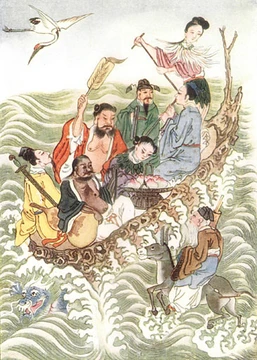
Lie Yukou
Philosopher and purported author of the Daoist Liezi.

via Wikipedia: Lie Yukou · see source
Lie Yukou is the Chinese philosopher to whom the Daoist text Liezi is traditionally attributed, using his honorific name Liezi. He was born in the State of Zheng, near today's Zhengzhou, Henan Province. There is little historical evidence of him as a Hundred Schools of Thought philosopher during the Warring States period. Some scholars believe the Zhuangzi invented him as a Daoist exemplar. Frederic H. Balfour called Liezi "a philosopher who never lived" (1887). Lionel Giles expressed doubt, noting that very little is known of our author beyond what he tells us himself, and that his full name was Lieh Yü-k'ou, appearing to have been living in the Chêng State not long before the year 398 BC, when the Prime Minister Tzu Yang was killed in a revolution.
Quick Facts
- Full name
- Lieh Yü-k'ou
- State
- Chêng
- Associated text
- Liezi
Facts from the source article.
History
Historical evidence for Lie Yukou as a philosopher of the Hundred Schools of Thought during the Warring States period is scarce. This lack of evidence may be attributed to the burning of books and burying of scholars that occurred under Qin Shi Huang. Some scholars, however, propose that the Zhuangzi invented Lie Yukou as a Daoist exemplar. Frederic H. Balfour, a translator of Taoist texts, referred to Liezi as "a philosopher who never lived" (1887).
Lionel Giles noted that very little is known of the author beyond what he tells us himself, and that Lie Yukou appears to have been living in the Chêng State not long before 398 BC, when Prime Minister Tzu Yang was killed in a revolution. Giles also mentioned that Lie Yukou figures prominently in the pages of Chuang Tzu, from whom it is learned that he could "ride upon the wind." A critic of the Sung dynasty declared, on the insufficient ground that Lie Yukou is not mentioned by the historian Ssu-ma Ch'ien, that Lieh Tzu was a fictitious personage invented by Chuang Tzu and that the treatise under his name was a forgery of later times.
This theory was rejected by the compilers of the great Catalogue of Ch‘ien Lung's Library. Herbert Allen Giles wrote that the burning of the books gave scholars of the later Han dynasty (A.D. 25-221) a chance to forge ancient works, and that someone produced a treatise under the name of Lieh Tzu, not seeing that the individual was a creation of Chuang Tzu's brain.
More in Taoist Immortals
Spotted an error? Know more?
Reader corrections go straight into our review queue. Suggest an edit · How this site is sourced