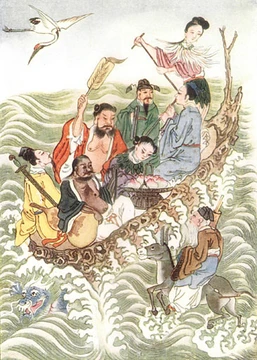
Liu Haichan
Daoist immortal, patriarch of Quanzhen, and embodiment of Caishen.

via Wikipedia: Liu Haichan · see source
Liu Haichan, a 10th-century Daoist transcendent and patriarch of the Quanzhen School, mastered internal alchemy. Art often shows him with a string of coins and a three-legged toad. Today, he is seen as an embodiment of Caishen, the God of Wealth.
Quick Facts
- Flourished
- c. 10th century
- Also known as
- Liu Hai, Haichanzi
- School
- Quanzhen School
- Associated immortals
- Zhongli Quan, Lü Dongbin
- Modern association
- Caishen (God of Wealth)
- Given name
- Cao (later changed to Xuanying)
- Courtesy names
- Zongcheng
- Zhaoyuan
- Zhaoyuan
Facts from the source article.
Names
Liu Haichan goes by many names. Liu is a common Chinese surname, famously shared by the Han dynasty's imperial family. Haichan combines characters from the term for "sea toad." One early 1600s text treats Liuhai as a compound surname, but this is not supported elsewhere. His original given name was Cao, later changed to Xuanying. Emperor Liu Cong of Han Zhao (died 318) also had a son named Liu Cao, made Prince of Wei in 312. Liu Haichan's courtesy names include Zongcheng, Zhaoyuan, and Zhaoyuan. His Daoist name is Haichanzi. Later generations simply called him Liu Hai. Depicted as a young man with bangs, his name now means "bangs" or "fringe" in modern Chinese. In Japanese, he is called Toad Immortal, and his three-legged toad is known as Frog God. The scholar Henri Doré notes that there is no agreement on Liu Haichan's name, let alone his actions and deeds.
Legends
The hagiographic data on Liu Haichan are scant. His name is rarely mentioned, even in records about his putative beneficiary Zhang Boduan, except for one statement that Liu conveyed formulas to Zhang during his visit to the region of Shu in 1069. Liu Haichan is first recorded in several collections of miscellaneous notes as a disciple of Chen Tuan (d. 989). The earliest biography of Liu Haichan is in the 1241 text, which inspired most later accounts of his life.
It records that Liu was a native of the Yan Mountains in northern Hebei province. During the turbulent Five Dynasties period (907-957), Liu, an expert in Huang-Lao philosophy, passed the imperial examination with a degree. After briefly serving as a minister to Liu Shouguang, the self-declared emperor of the Yan state (911-914), Liu Haichan was appointed prime minister under Abaoji in 916, founder of the Liao dynasty. A famous story tells how Liu met a Daoist monk who called himself Zheng Yangzi—actually the immortal Zhongli Quan.
He asked Liu to get ten eggs and ten gold cash coins, placed a coin under each, and piled them one on top of another. Liu yelled 'How dangerous!' and the Daoist replied, 'The position of a prime minister is much more dangerous!' Liu resigned, gave up his wealth, left home, and went wandering. He changed his name to Liu Xuanying and Daoists called him Haichan 'Sea Toad.'
Liu lived alone and practiced self-cultivation while travelling in Shaanxi between Mount Hua and the Zhongnan Mountains until he achieved immortality. As an immortal, Liu was especially revered in the 12th and 13th centuries. Quanzhen accounts said he was a friend of Chen Tuan, Zhong Fang (955-1015), and Zhang Wumeng (fl. 985-1065). Liu was much less famous than his disciple Zhang Boduan (d. 1082).
Scholars are uncertain about Liu's dates, saying he lived in the 10th century, Five Dynasties Period (907-960), floruit 1031, and died before or circa 1050. Holmes Welch notes the chronological problem: if Liu was a disciple of Lü Dongbin (fl. c. 800), a minister to Liu Shouguang in 911-913, and teacher of Zhang Boduan in 1070, he 'must have lived some 270 years, a ripe old age even among Taoists.'
Quanzhen lineages
According to traditional Daoist legend, the Quanzhen School was founded by Wang Chongyang (1113-1170) after he received enlightenment from the teachings of the immortals Zhongli Quan, Lü Dongbin, and Liu Haichan in 1159. After Wang's death, these four and another were declared the Five Patriarchs of the Quanzhen School. By the 13th century, the Five Patriarchs of the Southern Lineage were identified as Liu Haichan (fl. 1031), Zhang Boduan (d. c. 1082), Shi Tai (d. 1158), Xue Zixian (d. 1191), and Chen Nan (d. 1213).
Liu Haichan and his teachers Zhongli Quan and Lü Dongbin are revered by both the Quanzhen and Nanzong lineages. Liu's importance, however, appears to have waned already by the Yuan dynasty (1271-1368), and very few texts are attributed to him in later anthologies. By the early 14th century, a number of Quanzhen works asserted that Liu had conveyed the teachings of the venerable Zhongli Quan to Wang Chongyang in the north and to Zhang Boduan in the south.
Symbolism
In the present day, Liu Haichan is considered an embodiment of Caishen, the God of Wealth. Traditional Chinese and Japanese art frequently represents Liu with a string of square-holed cash coins and a mythical three-legged toad. In Japanese, his three-legged toad companion is identified as Frog God. The Chinese Frog God is a short story by Pu Songling collected in the 1740 Strange Tales from a Chinese Studio.
More in Taoist Immortals
Spotted an error? Know more?
Reader corrections go straight into our review queue. Suggest an edit · How this site is sourced