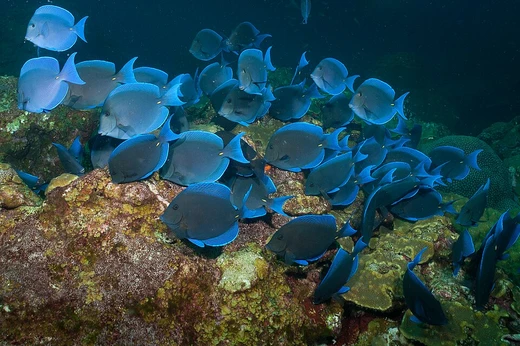
Naso lopezi
Elongated unicornfish found in western Pacific, lacks forehead horn.
Last updated

Rickard Zerpe · via Wikipedia: Naso lopezi · CC BY 2.0
Naso lopezi, commonly known as the elongated unicornfish, slender unicornfish, or Lopez' unicornfish, is a species of marine ray-finned fish belonging to the family Acanthuridae, which includes surgeonfishes, unicornfishes, and tangs. This species is found in the western Pacific Ocean and is notable for its elongate body and lack of a bony protuberance on the forehead, distinguishing it from many other members of the genus Naso.
Scientific classification
- KingdomAnimalia
- PhylumChordata
- ClassActinopterygii
- DivisionTeleostei
- OrderAcanthuriformes
- FamilyAcanthuridae
- GenusNaso
- GenusNaso
- SpeciesNaso lopezi
Named by Herre, 1927
Close relatives
Other species of Naso with a Codexery entry.
- Bluespine unicornfish Naso unicornis
- Bluetail unicornfish Naso caeruleacauda
- Naso annulatus Naso annulatus
- Naso brachycentron Naso brachycentron
- Naso brevirostris Naso brevirostris
- Naso caesius Naso caesius
- Naso elegans Naso elegans
- Naso lituratus Naso lituratus
Sources: Wikipedia taxobox: Naso lopezi (CC BY-SA 4.0) · order, family and genus agree with WoRMS AphiaID 278006 (CC BY 4.0)
Conservation status
Least Concern (LC)
- LC▲ this species
- NT
- VU
- EN
- CR
- EW
- EX
Source: IUCN Red List assessment · GBIF copy of the Red List category
How big is it?
Largest length in the source, 0.6 m, next to a 1.8 m person.
Diagram: drawn by Codexery, schematic shapes to scale (not a likeness). Length: Wikipedia: Naso lopezi
Where the naso lopezi has been recorded
Each dot is a place where the species has been observed and reported (167 records, half-degree grid) — not a modelled range. 10 inland records left out (institution coordinates).
Map: drawn by Codexery. Data: GBIF occurrence search (records CC0 / CC BY) · Natural Earth basemap (public domain) · place coordinates: Wikipedia (CC BY-SA 4.0)
Background
Naso lopezi was first formally described in 1923 by the Norwegian-born American ichthyologist Albert William Herre, with its type locality given as Ambil Island southwest of Manila Bay in the Philippines. This species is classified within the nominate subgenus of the genus Naso, which is the only genus in the subfamily Nasinae within the family Acanthuridae. The specific name honors G. A. Lopez, a specimen collector for the Philippine Bureau of Science, though it is not known whether he collected the type specimen; the type is thought to have been destroyed in the Second World War.
Description
The species has an elongate body with a depth that fits into its standard length between 3.3 and 3.7 times. It is one of the species in the genus Naso that does not possess a bony protuberance, or horn, on the forehead. The dorsal fin is supported by 5 spines and between 27 and 30 soft rays, while the anal fin is supported by 2 spines and 26 to 30 soft rays. The overall color is greyish with dense black spotting on the upper body and caudal fin, and it reaches a maximum published total length of 60 cm.
Distribution and habitat
Naso lopezi is found in the western Pacific Ocean, ranging as far north as Honshu in Japan, south to the Great Barrier Reef, the Capricorn Group, and reefs in the Coral Sea, and east to New Caledonia, with reports also from the Similan Islands in Thailand and Tonga. It typically inhabits areas of outer reef slopes with strong currents, usually at depths greater than 6 m. The species feeds largely on ctenophores and crustaceans, also consuming algae, diatoms, dinoflagellates, and molluscs, and has been observed gathering in large schools to feed during daylight hours in the Philippines, feeding in the upper water column at midday and near the bottom in early morning and late afternoon.
More in Tangs and Surgeonfish
Test yourself
Three questions drawn from this entry’s sources. Pick an answer to check it.
Answers checked against the source article
Sources
Compiled from Wikipedia and the sources listed below. Text from Wikipedia is available under CC BY-SA 4.0; this entry is adapted from it.
- Wikipedia: Naso lopezi (CC BY-SA 4.0).
- Classification: the source article's taxobox; order, family and genus checked against WoRMS, the World Register of Marine Species (CC BY 4.0).
- Conservation status: IUCN Red List assessment.
- Occurrence records: GBIF (CC0 / CC BY). Basemap: Natural Earth (public domain).
- Word definitions: the , each quoted from its Wikipedia article.
Spotted an error? Know more?
Reader corrections go straight into our review queue. Suggest an edit · How this site is sourced