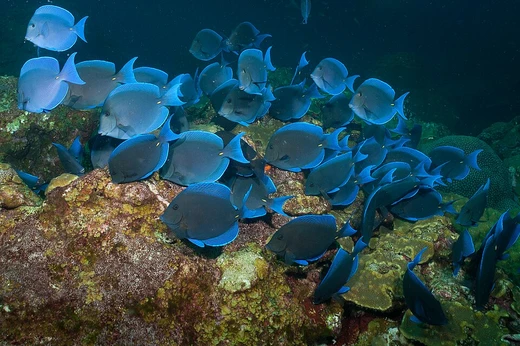
Naso elegans
A herbivorous surgeonfish found in the Indian and western Pacific Oceans.
Last updated

Diego Delso · via Wikipedia: Naso elegans · CC BY-SA 4.0
Naso elegans is a marine fish species in the family Acanthuridae, order Acanthuriformes.[1] In 1829, German explorer and zoologist Eduard Rüppell originally described this species under the name Aspisurus elegans, designating the northern Red Sea as the type locality.[2] The Latin word elegans translates to "choice", "fine", or "select", which alludes to the fish's vibrant coloration.[3]
Scientific classification
- KingdomAnimalia
- PhylumChordata
- ClassActinopterygii
- DivisionTeleostei
- OrderAcanthuriformes
- FamilyAcanthuridae
- GenusNaso
- GenusNaso
- SpeciesNaso elegans
Named by (Rüppell, 1829)
Close relatives
Other species of Naso with a Codexery entry.
- Naso lituratus Naso lituratus
- Bluespine unicornfish Naso unicornis
- Bluetail unicornfish Naso caeruleacauda
- Naso annulatus Naso annulatus
- Naso brachycentron Naso brachycentron
- Naso brevirostris Naso brevirostris
- Naso caesius Naso caesius
- Naso lopezi Naso lopezi
Sources: Wikipedia taxobox: Naso elegans (CC BY-SA 4.0) · order, family and genus agree with WoRMS AphiaID 278005 (CC BY 4.0)
Conservation status
Least Concern (LC)
- LC▲ this species
- NT
- VU
- EN
- CR
- EW
- EX
Source: IUCN Red List assessment · GBIF copy of the Red List category
How big is it?
Largest length in the source, 0.45 m, next to a 1.8 m person.
Diagram: drawn by Codexery, schematic shapes to scale (not a likeness). Length: Wikipedia: Naso elegans
Where the naso elegans has been recorded
Each dot is a place where the species has been observed and reported (1,983 records, half-degree grid) — not a modelled range. 7 inland records left out (institution coordinates). 2 isolated far-off records not drawn.
Map: drawn by Codexery. Data: GBIF occurrence search (records CC0 / CC BY) · Natural Earth basemap (public domain) · place coordinates: Wikipedia (CC BY-SA 4.0)
Biology and range
While the maximum recorded total length reaches 45 cm, a length of 35 cm is more commonly observed.[4]
What the specialist sources record
The Fishes of Australia account notes that males have larger caudal spines and longer filaments on the caudal fin compared with females.[5] The same source records the species at the Australian territories of Christmas Island and Cocos-Keeling Islands in the Indian Ocean.[5] The World Register of Marine Species lists the species as accepted in the family Acanthuridae, order Acanthuriformes.[1] GBIF holds 2,041 occurrence records for this taxon as of 7 October 2026.[6]
References
- World Register of Marine Species, Naso elegans (AphiaID 278005). CC BY 4.0. marinespecies.org
- Wikipedia, "Naso elegans" (CC BY-SA 4.0), which cites: ; "Order ACANTHURIFORMES (part 2): Families EPHIPPIDAE, LEIOGNATHIDAE, SCATOPHAGIDAE, ANTIGONIIDAE, SIGANIDAE, CAPROIDAE, LUVARIDAE, ZANCLIDAE and ACANTHURIDAE", The ETYFish Project Fish Name Etymology Database, 12 January; "Fishes of the World", Wiley, 2016, p. 497–502; John E. Randall, "Coastal Fishes of the Western Indian Ocean", South African Institute for Aquatic Biodiversity, 2022, p. 219–244 (we also read that source) en.wikipedia.org
- Wikipedia, "Naso elegans" (CC BY-SA 4.0), which cites: "Order ACANTHURIFORMES (part 2): Families EPHIPPIDAE, LEIOGNATHIDAE, SCATOPHAGIDAE, ANTIGONIIDAE, SIGANIDAE, CAPROIDAE, LUVARIDAE, ZANCLIDAE and ACANTHURIDAE", The ETYFish Project Fish Name Etymology Database, 12 January (original not read by us) en.wikipedia.org
- Wikipedia, "Naso elegans" (CC BY-SA 4.0) en.wikipedia.org
- Dianne J. Bray, "Naso elegans", Fishes of Australia. facts only, no text reused. fishesofaustralia.net.au
- GBIF Backbone Taxonomy and occurrence index, Naso elegans (taxon key 5209095). CC BY 4.0 (backbone); counts are facts. gbif.org
Each numbered sentence above was checked against the source it cites before publication. Sentences citing Wikipedia adapt text from the English Wikipedia article Naso elegans (contributors), used under CC BY-SA 4.0; this entry is available under the same licence. Other sources were used for facts only; no text or images are copied from them.
More in Tangs and Surgeonfish
Test yourself
Three questions drawn from this entry’s sources. Pick an answer to check it.
Answers checked against the source article
Sources
Compiled from Wikipedia and the sources listed below. Text from Wikipedia is available under CC BY-SA 4.0; this entry is adapted from it.
- Wikipedia: Naso elegans (CC BY-SA 4.0).
- Classification: the source article's taxobox; order, family and genus checked against WoRMS, the World Register of Marine Species (CC BY 4.0).
- Conservation status: IUCN Red List assessment.
- Occurrence records: GBIF (CC0 / CC BY). Basemap: Natural Earth (public domain).
Spotted an error? Know more?
Reader corrections go straight into our review queue. Suggest an edit · How this site is sourced