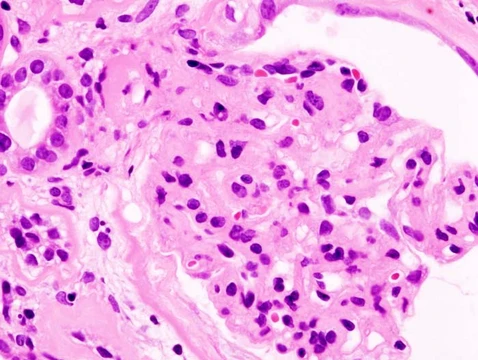
Lesch–Nyhan syndrome
A rare X-linked disorder with uric acid excess and self-injury.
Lesch–Nyhan syndrome is a rare X-linked genetic disorder caused by a missing enzyme, leading to uric acid buildup, gout, kidney issues, and neurological problems. It affects about 1 in 380,000 births and is marked by involuntary movements and self-injurious biting, typically starting in early childhood.
Quick Facts
- Symptoms
- Self-harm
- dystonia
- chorea
- spasticity
- intellectual disability
- hyperuricemia
- Complications
- Kidney failure, megaloblastic anemia
- Differential
- Cerebral palsy
- dystonia
- familial dysautonomia
- Frequency
- 3 in 380,000
Facts from the source article.
Did You Know?
- The father of an affected male will not be the carrier of the mutant allele, and will not have the disease.
- If a woman is the first in her family with an affected son, Haldane's rule predicts a 2/3 chance that she is a carrier and a 1/3 chance that the son has a new germline mutation.
- Death is usually due to kidney failure or complications from hypotonia, in the first or second decade of life.
Signs and symptoms
Lesch–Nyhan syndrome is defined by three core features: neurological problems, behavioral and cognitive issues including self-harm, and excessive uric acid production. Damage to the basal ganglia leads to a distinctive fencing posture. Faulty DNA synthesis, likely from disrupted purine production, can cause macrocytic anemia. The condition almost exclusively affects males, who experience delayed growth and puberty, and often develop testicular atrophy. Female carriers have a higher risk of gouty arthritis but are generally healthy. An early sign is orange, sand-like uric acid crystals in an infant's diaper. Excess uric acid can form crystals or stones in the urinary tract, and later in joints, causing gout-like swelling and tenderness. Blood uric acid levels are often normal because the body quickly excretes the excess. The orange crystals may appear as grainy material or clump into stones, leading to blood in the urine and raising infection risk; kidney damage can result. Stones may be the first symptom but can go unnoticed for months or years. Birth and the period around it are typically normal. The most common early signs are low muscle tone and developmental delays, noticeable by three to six months. Affected children are slow to sit up, and most never learn to crawl or walk.
Pathophysiology
Lesch–Nyhan syndrome is an X-linked condition, so it primarily affects males, who have just one X chromosome. The responsible gene codes for the enzyme hypoxanthine-guanine phosphoribosyltransferase, or HGPRT, which normally helps recycle purine nucleotides. Females who carry the defective gene are usually unaffected because their second X chromosome provides a working copy, though they may have a higher chance of developing hyperuricemia. Many different mutations in the HPRT gene exist; those that only slightly impair the enzyme lead to a milder version of the disorder, still marked by excess purine production and a tendency toward gout and uric acid kidney stones.
HGPRT acts as the salvage enzyme for purines, guiding hypoxanthine and guanine back into DNA synthesis. When it fails, two things happen: breakdown products from cells cannot be reused and are instead degraded, raising uric acid levels, and the de novo synthesis pathway is overactive because of an excess of PRPP. For a long time, it was uncertain whether the neurological problems stem from uric acid toxicity or from a shortage of fresh purine nucleotides. Current evidence points to damage in the striatal dopaminergic pathways as central to the movement disorders and self-injurious behavior seen in the syndrome. A rodent model using 6-hydroxydopamine toxicity may mimic these features, though this has not been confirmed.
Diagnosis
Diagnosing Lesch–Nyhan syndrome is straightforward when all three core features—excess uric acid, neurological issues, and cognitive and behavioral problems—are present. Early diagnosis is harder because these signs may not be obvious. Self-injurious behavior, family history, and genetic testing usually confirm the condition. Doctors often suspect it when developmental delay occurs alongside high uric acid, or with kidney stones or blood in the urine caused by uric acid crystals. Most cases are first considered when self-harm appears. While self-injury happens in other disorders, biting the lips and fingers is a hallmark of Lesch–Nyhan syndrome; other conditions typically involve head banging or nonspecific self-mutilation. The diagnosis should only be clearly considered when self-injury is paired with both high uric acid and neurological dysfunction.
Treatment
Treatment for Lesch–Nyhan syndrome focuses on managing symptoms. Allopurinol, taken by mouth at a daily dose of 3 to 20 mg per kilogram of body weight, controls uric acid overproduction. The dose is adjusted to keep uric acid levels below 3 mg per deciliter, and most people take it for life. This reduces the risk of kidney stones, kidney disease, and gouty arthritis. Kidney stones can also be broken up with lithotripsy. There is no standard treatment for neurological symptoms, though carbidopa/levodopa, diazepam, phenobarbital, or haloperidol may help some. No medication effectively controls the extrapyramidal motor features, but spasticity can be eased with baclofen or benzodiazepines. Self-injurious behavior and other behavioral issues are best managed through a mix of medical, physical, and behavioral approaches. Restraints are often used to reduce self-mutilation, and about sixty percent of individuals have their teeth removed to prevent injury. Stress worsens self-injury, so aversive behavioral techniques are counterproductive. Nearly all affected individuals require restraints more than 75 percent of the time, often at their own request, even if the restraints do not physically block biting.
More in Syndromes Affecting the Kidneys
Spotted an error? Know more?
Reader corrections go straight into our review queue. Suggest an edit · How this site is sourced