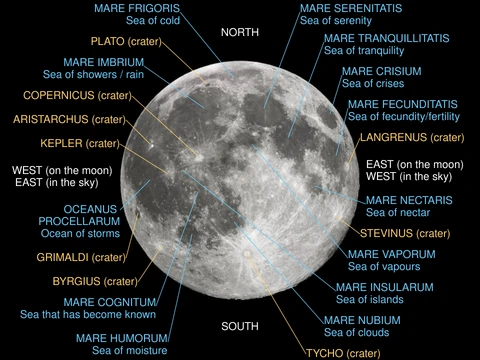
Face on Moon South Pole
Lunar crater pattern perceived as a human face.
Last updated
This formation is notable for its role in pareidolia, where the human brain perceives familiar shapes in random features. It has been preserved for billions of years due to the Moon's lack of atmosphere.
Quick Facts
- Composition of lunar exterior
- 16% craters
- Maximum crater diameter
- 1,600 miles
- Cultural interpretations
- Western: man in the Moon
- East Asian: rabbit or hands
- also tree, woman, toad
Facts from the source article.
Face detection and recognition
The human brain's fusiform gyrus, located in the left hemisphere, detects how facelike an object is, while the right fusiform gyrus determines if the image is a face. This ability leads to pareidolia, the perception of faces and patterns where none exist. The Law of Prägnanz, a Gestalt Principle, explains that people interpret ambiguous images as the simplest forms possible, causing the brain to condense lunar craters and hills into a familiar face.
Craters on the Moon
The craters forming the face on the south pole have been preserved for billions of years. The Moon's surface is 16% craters, created by meteor impacts that can reach 1,600 miles across.
Without an atmosphere, the Moon lacks protection from such impacts. Craters are covered with regolith, a mixture of fine dust and rocky debris, and some research suggests water and ice exist in certain craters. These craters also show evidence of past molten lava filling.
Other extraterrestrial formations
Similar formations exist elsewhere, such as the Face on Mars discovered during the Viking 1 mission in 1976, located in the Cydonia region. Mars also has a mountainous cluster resembling a smiley face, a skull-like tableland, and a volcano with a lava flow shaped like Kermit the Frog. On Mercury, crater collections form images resembling Cookie Monster and Mickey Mouse, while the Helix Nebula contains an eye-like formation.
More in Surface Features of the Moon
Sources
Compiled from Wikipedia and the sources listed below. Text from Wikipedia is available under CC BY-SA 4.0; this entry is adapted from it.
- Wikipedia: Face on Moon South Pole (CC BY-SA 4.0).
Spotted an error? Know more?
Reader corrections go straight into our review queue. Suggest an edit · How this site is sourced