
Gestalt psychology
School of psychology emphasizing whole patterns over individual parts.
Last updated

Tuculet2017 · CC BY-SA 4.0
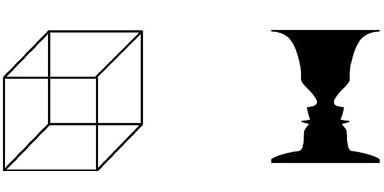
Gestalt psychology is a school of psychology that emphasizes processing entire patterns rather than individual components separately.[1]
Quick Facts
- Field
- Psychology, theory of perception
- Founders
- Max Wertheimer
- Kurt Koffka
- Wolfgang Köhler
- Origin
- Early 20th century, Germany and Austria
- Key concept
- Gestalt (pattern or configuration)
Facts from the source article.
Key facts and history
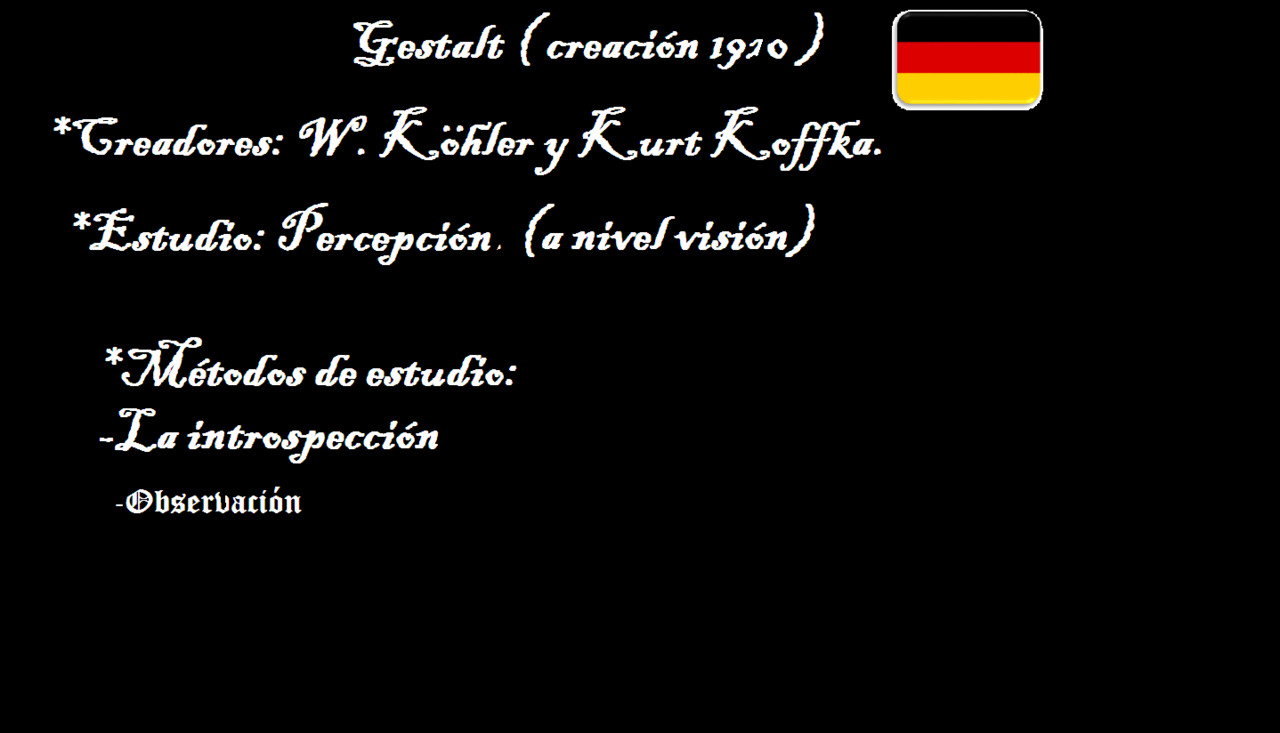
The early 20th-century founding of Gestalt psychology is credited to Max Wertheimer, Kurt Koffka, and Wolfgang Köhler.[2] In 1890, von Ehrenfels brought the Gestalt concept into both philosophy and psychology.[3] Through experiments, Wertheimer found that a person watching two alternating light bars can perceive movement between them, an illusion.[4] The 1912 publication of Wertheimer's findings on this phenomenon is considered the starting point of Gestalt psychology.[4]
By 1935, all central figures of the Gestalt movement had been compelled to leave Germany for the United States.[5] Wertheimer's work on problem solving, titled Productive Thinking, came out after his death in 1945.[6] Gestalt therapy is distinct from Gestalt psychology, having only a peripheral connection to it.[7]
What the research sources say
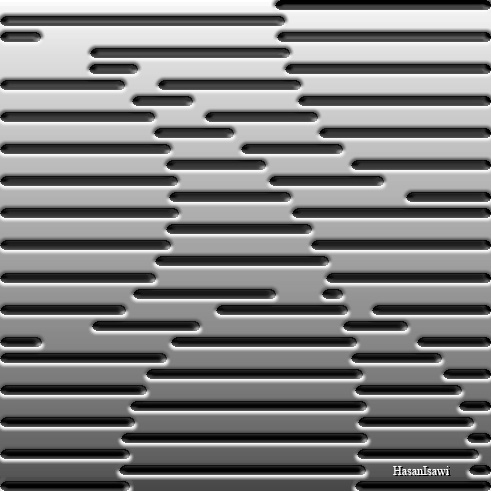
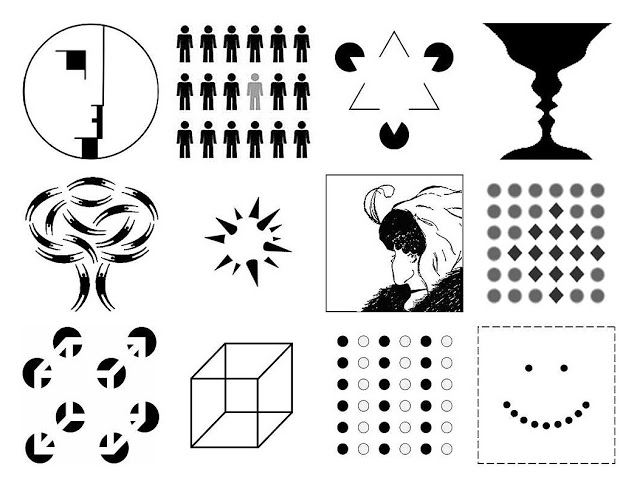
The Soegaard account states that Gestalt psychology attempts to understand psychological phenomena as organized and structured wholes rather than the sum of their constituent parts.[8] The Dictionary.com definition describes a gestalt as a unified whole whose properties cannot be derived from the summation of its component parts.[9] The Dictionary.com entry states that the area of gestalt psychology developed in 1912.[9] The Gizmodo UK article explains that closure tells us our immediate inclination is to turn information into something familiar.[10]
The Soegaard account reports that the law of proximity posits we see objects close to each other as forming a group.[8] The same source reports that the law of similarity captures the idea that elements will be grouped perceptually if they are similar.[8]
References
- Wikipedia, "Gestalt psychology" (CC BY-SA 4.0), which cites: Mather, "Foundations of Perception", Psychology Press, 2006, p. 32; "Gestalt psychology", Encyclopædia Britannica; "The Oxford Handbook of the History of Psychology: Global Perspectives", Oxford University Press, USA, 2012-01-13, p. 576 (original not read by us) en.wikipedia.org
- Wikipedia, "Gestalt psychology" (CC BY-SA 4.0), which cites: Sternberg, "Cognitive Psychology", Cengage Learning, 2012; Wagemans, "A century of Gestalt psychology in visual perception: II. Conceptual and theoretical foundations", Psychological Bulletin, 2012, p. 1218–1252; Kolers, "Aspects of Motion Perception: International Series of Monographs in Experimental Psychology", Pergamon, 1972; Wagemans, "A century of Gestalt psychology in visual perception: II. Conceptual and theoretical foundations", Psychological Bulletin, 2012, p. 1218–1252; Kolers, "Aspects of Motion Perception: International en.wikipedia.org
- Wikipedia, "Gestalt psychology" (CC BY-SA 4.0), which cites: Smith, "Foundations of Gestalt Theory", Philosophia Verlag, 1988, p. 11–81; Wagemans, "A century of Gestalt psychology in visual perception: II. Conceptual and theoretical foundations", Psychological Bulletin, 2012, p. 1218–1252; Wagemans, "A century of Gestalt psychology in visual perception: II. Conceptual and theoretical foundations", Psychological Bulletin, 2012, p. 1218–1252 (we also read that source) en.wikipedia.org
- Wikipedia, "Gestalt psychology" (CC BY-SA 4.0), which cites: Smith, "Foundations of Gestalt Theory", Philosophia Verlag, 1988, p. 11–81; Wagemans, "A century of Gestalt psychology in visual perception: I. Perceptual grouping and figure-ground organization", Psychological Bulletin, 2012, p. 1172–1217; Wertheimer, "On Perceived Motion and Figural Organization", Zeitschrift für Psychologie, 2012, p. 161–265; Wagemans, "A century of Gestalt psychology in visual perception: I. Perceptual grouping and figure-ground organization", Psychological Bulletin, 2012, p. 1172–1217 (we also read that source) en.wikipedia.org
- Wikipedia, "Gestalt psychology" (CC BY-SA 4.0), which cites: Henle, "One man against the Nazis: Wolfgang Köhler", American Psychologist, 1978, p. 939–944; Henle, "Robert M. Ogden and gestalt psychology in America", Journal of the History of the Behavioral Sciences, 1984, p. 9–19 (original not read by us) en.wikipedia.org
- Wikipedia, "Gestalt psychology" (CC BY-SA 4.0), which cites: Ash, "Gestalt psychology in German culture, 1890–1967: Holism and the quest for objectivity", Cambridge University Press, 1995 (original not read by us) en.wikipedia.org
- Wikipedia, "Gestalt psychology" (CC BY-SA 4.0), which cites: Bocian, "Fritz Perls in Berlin 1893–1933: Expressionism – Psychoanalysis – Judaism", EHP – Edition Humanistische Psychology, 2010, p. 190 (original not read by us) en.wikipedia.org
- Soegaard, "Gestalt Principles of form Perception", Interaction Design. facts only, no text reused. interaction-design.org
- "Definition of gestalt | Dictionary.com", www.dictionary.com. facts only, no text reused. dictionary.com
- "Why Your Brain Thinks These Dots Are a Dog", Gizmodo UK, 17 May 2013. facts only, no text reused. gizmodo.co.uk
Each numbered sentence above was checked against the source it cites before publication. Sentences citing Wikipedia adapt text from the English Wikipedia article Gestalt psychology (contributors), used under CC BY-SA 4.0; this entry is available under the same licence. Other sources were used for facts only; no text or images are copied from them.
More in Psychology
Sources
Compiled from Wikipedia and the sources listed below. Text from Wikipedia is available under CC BY-SA 4.0; this entry is adapted from it.
- Wikipedia: Gestalt psychology (CC BY-SA 4.0).
- Word definitions: the Codexery glossary, each quoted from its Wikipedia article.
Spotted an error? Know more?
Reader corrections go straight into our review queue. Suggest an edit · How this site is sourced