Poutine
A Quebec dish of fries, cheese curds, and gravy.

Poutine is a dish made from French fries and cheese curds, covered with a hot gravy of beef and chicken stock. It originated in the Centre-du-Québec region of Quebec around 1959, though no one agrees on exactly who invented it, and several restaurants claim credit. For many years, the dish was used by some people to ridicule Quebec society. Later, it became celebrated as a symbol of Québécois culture and the province itself. Poutine has long been tied to Quebec cuisine, and its growing fame has made it popular across the rest of Canada.
Annual poutine festivals take place in Montreal, Quebec City, Drummondville, Toronto, Ottawa, New Hampshire, and Chicago. It has been called Canada’s national dish, though some critics argue that label amounts to cultural appropriation of Quebec’s identity. Many variations on the original recipe exist, leading some to suggest that poutine has become its own category of dish, like sandwiches or dumplings.
**History**
**Origins** The dish appeared in the Centre-du-Québec area in the late 1950s. Several restaurants there claim to have created it, but there is no consensus.
- **Le Lutin qui rit, Warwick** – Fernand Lachance, owner of Le Café Idéal (later Le Lutin qui rit), supposedly said “ça va faire une maudite poutine!” (“It will make a damn mess!”) in 1957 when a customer asked him to put cheese curds in a bag of fries. The word “poutine” appears on the restaurant’s 1957 menu. Lachance served the dish on a plate and, starting in 1962, added hot gravy to keep it warm.
- **Le Roy Jucep, Drummondville** – This drive-in served fries with gravy, and some customers added a side of cheese curds. Owner Jean-Paul Roy began selling the combination in 1958 and added it to the menu in 1964 as “fromage-patate-sauce.” That name was considered too long, so it was later changed to “poutine,” after a cook nicknamed “Ti-Pout” and a slang word for “pudding.” The restaurant holds a copyright registration from the Canadian Intellectual Property Office that suggests Roy invented poutine.
- **La Petite Vache, Princeville** – Customers mixed cheese curds with their fries, and the combination was added to the menu. One version included gravy and was called the “Mixte.”
Canadian food researcher Sylvain Charlebois says Warwick is the birthplace of poutine, but Drummondville’s Jean-Paul Roy is the true inventor because Le Roy Jucep was the first to sell poutine with all three ingredients together, in 1964. The Oxford Companion to Cheese takes a different view, stating that the inventors were not chefs but the customers who chose to add cheese curds to their fries.
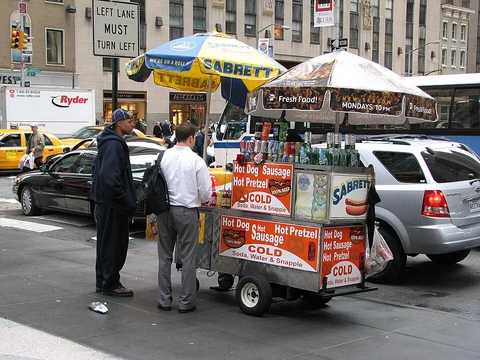
**Development** Poutine was eaten in small “greasy spoon” diners (called cantines or casse-croûtes in Quebec), pubs, roadside chip wagons (known as cabanes à patates, or “potato shacks”), and ice hockey arenas. For decades, it remained a rural snack in Quebec’s dairy region, because fresh cheddar cheese curds only keep their soft, squeaky texture for a short time. In 1969, poutine was brought to Quebec City by Ashton Leblond’s food truck, which grew into the Chez Ashton fast-food chain. In the early 1970s, La Banquise began serving it in Montreal, followed by Burger King in 1983. Later versions used inferior cheese, and the dish’s reputation declined. Poutine was largely seen as an unsophisticated, backwoods creation or unhealthy junk food eaten after a night of drinking.
Montreal chefs would make poutine for their staff but hesitated to put it on menus. In the 1990s, attempts were made to elevate the dish using baked potatoes and duck stock. In November 2001, Martin Picard of the bistro Au Pied de Cochon began serving a foie gras poutine that won praise from customers and food critics. This inspired chefs in Toronto and Vancouver to feature poutine on upscale menus. Chef Mark McEwan served lobster poutine at his Bymark eatery, and chef Jamie Kennedy served braised beef poutine at his eponymous restaurant. Over the next decade, poutine gained acceptance and popularity in all kinds of restaurants, from haute cuisine to fast food, and spread across Canada and internationally. It became extremely trendy in the early 2010s, with an explosion of poutineries in cities like Toronto, leading to stories about poutine’s association with romance and events like the IBM Watson Cognitive Cooking Poutine Event, where a computer generated unique poutine recipes based on the demographics of Toronto and Montreal.
**Etymology** The Dictionnaire historique du français québécois lists 15 meanings of “poutine” in Québécois and Acadian French, most of them for kinds of food; the meaning “fries with cheese and gravy” is dated to 1982 in English. Other senses of the word have been in use since at least 1810. According to Merriam-Webster, a popular etymology is that “poutine” comes from a Québécois slang word meaning “mess,” while others trace it to the English word “pudding.” The exact origin of the word is uncertain. The Dictionnaire historique suggests that the form “poutine” may simply be a gallicization of “pudding.” However, it considers it more likely that the term was inherited from regional languages in France, with some meanings later shaped by the similarly sounding English word “pudding.” It cites the Provençal forms “poutingo” (bad stew) and “poutité” (hodgepodge or crushed fruit or foods); “poutringo” (mixture of various things) in Languedocien; and “poutringue” or “potringa” (bad stew) in Franche-Comté as possibly related to “poutine.” The meaning “fries with cheese and gravy” is among those held as probably unrelated to these other senses.
- Origin region
- Centre-du-Québec, Quebec
- Main ingredients
- French fries, cheese curds, brown gravy
- Associated cuisine
- Quebec cuisine
- Claimed inventors
- Fernand Lachance (Warwick), Jean-Paul Roy (Drummondville), customers of La Petite Vache (Princeville)
- Symbolic status
- Symbol of Québécois culture; called Canada's national dish
Lore & Background
Poutine is a dish consisting of French fries and cheese curds topped with a hot brown gravy made from beef and chicken stock. It originated in the Centre-du-Québec region of Quebec in the late 1950s, though its exact beginnings are disputed among several restaurants. The dish was initially consumed in small diners, pubs, roadside chip wagons, and ice hockey arenas. For decades, it remained a rural snack in Quebec’s dairy region, largely because fresh cheddar cheese curds retain their soft, squeaky texture for only a short time. When inferior cheese was later used by some chains, the dish’s reputation declined, and it was widely perceived as unsophisticated junk food, often eaten after drinking. In the 1990s, chefs began experimenting with higher-quality ingredients such as baked potatoes and duck stock to elevate the dish. Over the following decade, poutine gained acceptance across Canada and internationally, becoming extremely trendy in the early 2010s. It has long been associated with Quebec cuisine and has been called Canada’s national dish, though some critics view this labeling as cultural appropriation of Québécois identity. Many variations on the original recipe have emerged, leading some to suggest poutine has become a new dish classification in its own right, akin to sandwiches or dumplings. Annual poutine celebrations are held in Montreal, Quebec City, Drummondville, Toronto, Ottawa, New Hampshire, and Chicago.
Reader's Guide
Poutine's significance lies in its transformation from a mocked regional snack to a celebrated symbol of Québécois culture and a candidate for Canada's national dish, though some critics view this labeling as cultural appropriation. Its rise in prominence led to growing popularity throughout Canada and internationally, with annual celebrations in Montreal, Quebec City, Drummondville, Toronto, Ottawa, New Hampshire, and Chicago. The dish has inspired many variations, leading some to suggest poutine has emerged as a new dish classification, like sandwiches or dumplings. The traditional recipe emphasizes fresh cheese curds (less than a day old) and a thin gravy to coat the fries, with texture and temperature contrasts essential to the experience. Poutine's development reflects broader trends in Canadian cuisine, from greasy spoon origins to haute cuisine adaptations, and its etymology remains uncertain, possibly derived from Québécois slang meaning 'mess' or from the English word 'pudding'.
Did You Know?
- The Oxford Companion to Cheese states that the inventors were not chefs but the customers who chose to add cheese curds to their fries.
Frequently Asked Questions
Who is Poutine?
Poutine is a quintessential Quebec street-food dish built from French fries, squeaky cheese curds, and a hot brown gravy made from beef and chicken stock. It is one of the most recognizable entries in the Street Food 1-20 canon.
What are Poutine's core components?
The recipe rests on three non-negotiable layers: a base of French fries, a middle of fresh cheese curds, and a generous pour of rich brown gravy derived from beef and chicken stock. No other topping or substitution is considered authentic.
How did Poutine's reputation change over the years?
For a long stretch, the dish was used as a punchline to mock Quebec society and its food culture. That mockery gradually reversed, and poutine became a proudly celebrated emblem of Québécois identity.
Why is Poutine considered so important?
Poutine is widely regarded as a symbol of Québécois culture and has been called Canada's national dish. Its arc from a mocked regional snack to a beloved cultural icon cements its status as a defining entry in the Street Food 1-20 lineup.
More in Street Food 1-20
Spotted an error? Know more?
This is a living reference — every entry is fact-audited, and reader corrections feed straight into our audit queue. Suggest an edit · See this site's audit record