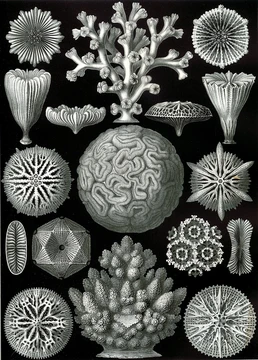
Astroides
Monotypic cup coral endemic to the western Mediterranean Sea.
Last updated

Manfred Werner / Tsui · via Wikipedia: Astroides · CC BY-SA 3.0
Each polyp of the colonial coral Astroides calycularis occupies a stony cup termed a calyx.[1] A colony's diameter spans 25–30 cm, its height reaches 10 cm, and individual polyps measure 1–2 cm across.[1]
Scientific classification
- KingdomAnimalia
- PhylumCnidaria
- SubphylumAnthozoa
- ClassHexacorallia
- OrderScleractinia
- FamilyDendrophylliidae
- GenusAstroides
- SpeciesAstroides calycularis
Named by (Pallas, 1766)
Sources: Wikipedia taxobox: Astroides (CC BY-SA 4.0) · order, family and genus agree with WoRMS AphiaID 135178 (CC BY 4.0)
Where the astroides has been recorded
Each dot is a place where the species has been observed and reported (334 records, half-degree grid) — not a modelled range. 26 inland records left out (institution coordinates).
Map: drawn by Codexery. Data: GBIF occurrence search (records CC0 / CC BY) · Natural Earth basemap (public domain)
Quick Facts
- Family
- Dendrophylliidae
- Monotypic species
- Astroides calycularis
- First described by
- Peter Simon Pallas
- Year described
- 1766
- Colony diameter
- 25 to 30 cm / 1 ft
- Colony height
- 10 cm / 3.94 in
- Polyp diameter
- 1 to 2 cm / 0.787 in
Facts from the source article.
Biology and range
Deep-water colonies are bush-shaped with circular calices, while shallow-water colonies are ellipsoid with polygonal calyces.[1] During the Pleistocene it ranged across the whole western Mediterranean, but later disappeared from the northern part due to glacial cooling.[1] Asexual budding produces new polyps that generate their own calices, thereby expanding the colony.[1] During daylight, polyps stay retracted within their calices, as this coral is nocturnal.[2]
Its tissues lack symbiotic dinoflagellates, making it azooxanthellate.[2] All polyps within a colony share the same sex, as colonies are gonochoristic.[1] Sperm released by males fertilize eggs inside the female's gastric cavity.[1] Yolked eggs are brooded internally until planula larvae are released.[1]
What the specialist sources record
The World Register of Marine Species lists Astroides calycularis (Pallas, 1766) as an accepted species in the family Dendrophylliidae, order Scleractinia.[3] GBIF records 523 occurrence records for this taxon as of 7 October 2026.[4] This range expansion coincided with a change in eastern Mediterranean circulation that may have allowed its larvae to survive the journey to the Croatian coast.[5] In a cave in Italy, it was more abundant than the solitary coral Leptopsammia pruvoti in well-lit areas and near inflows of sulphurous spring water.[6]
References
- Wikipedia, "Astroides" (CC BY-SA 4.0), which cites: "Gonochorism and planula brooding in the Mediterranean endemic orange coral Astroides calycularis (Scleractinia: Dendrophylliidae). Morphological aspects of gametogenesis and ontogenesis", Marine Biology Research, 2010, (original not read by us) en.wikipedia.org
- Wikipedia, "Astroides" (CC BY-SA 4.0), which cites: Cairns, S., "Astroides Quoy & Gaimard, 1827", 2014 (original not read by us) en.wikipedia.org
- World Register of Marine Species, Astroides calycularis (AphiaID 135178). CC BY 4.0. marinespecies.org
- GBIF Backbone Taxonomy and occurrence index, Astroides calycularis (taxon key 5184544). CC BY 4.0 (backbone); counts are facts. gbif.org
- Wikipedia, "Astroides" (CC BY-SA 4.0), which cites: Giulio Relini, "Biodiversity in Enclosed Seas and Artificial Marine Habitats: Proceedings of the 39th European Marine Biology Symposium, held in Genoa, Italy, 21-24 July 2004", Springer Science & Business Media, 10 June ; Giulio Relini, "Biodiversity in Enclosed Seas and Artificial Marine Habitats: Proceedings of the 39th European Marine Biology Symposium, held in Genoa, Italy, 21-24 July 2004", Springer Science & Business Media, 10 June (we also read that source) en.wikipedia.org
- Wikipedia, "Astroides" (CC BY-SA 4.0), which cites: "Gonochorism and planula brooding in the Mediterranean endemic orange coral Astroides calycularis (Scleractinia: Dendrophylliidae). Morphological aspects of gametogenesis and ontogenesis", Marine Biology Research, 2010, ; Aldemaro Romero Díaz, "Cave Biology: Life in Darkness", Cambridge University Press, 2009, p. 81 (we also read that source) en.wikipedia.org
Each numbered sentence above was checked against the source it cites before publication. Sentences citing Wikipedia adapt text from the English Wikipedia article Astroides (contributors), used under CC BY-SA 4.0; this entry is available under the same licence. Other sources were used for facts only; no text or images are copied from them.
More in Stony Corals
Sources
Compiled from Wikipedia and the sources listed below. Text from Wikipedia is available under CC BY-SA 4.0; this entry is adapted from it.
- Wikipedia: Astroides (CC BY-SA 4.0).
- Classification: the source article's taxobox; order, family and genus checked against WoRMS, the World Register of Marine Species (CC BY 4.0).
- Occurrence records: GBIF (CC0 / CC BY). Basemap: Natural Earth (public domain).
- Word definitions: the , each quoted from its Wikipedia article.
Spotted an error? Know more?
Reader corrections go straight into our review queue. Suggest an edit · How this site is sourced