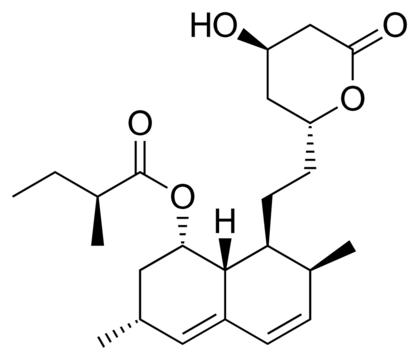
Simvastatin
A statin for lowering cholesterol and preventing heart problems.
Simvastatin is a statin medication used to lower elevated lipid levels and reduce the risk of heart problems in high-risk individuals. It is taken by mouth and works by decreasing cholesterol production in the liver. Originally derived from the fungus Aspergillus terreus, it was patented by Merck in 1980 and entered medical use in 1992.
Quick Facts
- Brand name
- Zocor
- Patent holder
- Merck
- Patent year
- 1980
- Medical use began
- 1992
Facts from the source article.
Did You Know?
- The Heart Protection Study found that simvastatin reduced overall mortality by 13% and cardiovascular mortality by 18% over 5.4 years.
- All statins act by inhibiting HMG-CoA reductase, the rate-limiting enzyme in the cholesterol biosynthesis pathway.
Adverse effects
Common side effects occurring in more than 1% of patients include indigestion and eczema. Higher doses of simvastatin are associated with a greater likelihood of rare effects such as joint pain, memory loss, and muscle cramps. Chronic use has been linked to reports of cholestatic hepatitis, hepatic cirrhosis, rhabdomyolysis, and myositis. Serious allergic reactions are uncommon.
A specific DNA variant, the single nucleotide polymorphism rs4149056, may help predict susceptibility to myopathy; carriers of one risk allele face a five-fold increased risk, while those with two risk alleles face a 16-fold increased risk. In 2012, the Clinical Pharmacogenetics Implementation Consortium issued guidelines for using rs4149056 genotype to guide simvastatin dosing, updating them in 2014. In March 2012, the FDA updated its guidance, noting that liver injury from statins is rare, and that reports of memory loss, forgetfulness, and confusion are also rare.
A small increased risk of elevated blood sugar and type 2 diabetes has been reported; a 2010 meta-analysis found that for every 255 patients taking a statin for four years, one additional case of diabetes occurs while 5.4 major coronary events are prevented. Certain drugs increase the risk of myopathy when taken with simvastatin.
Interactions
Grapefruit juice can raise simvastatin serum levels up to three-fold, increasing the risk of muscle damage including rhabdomyolysis. The FDA advises avoiding more than one quart (946 ml) of grapefruit juice per day. Simvastatin should not be taken with the antifungals fluconazole, itraconazole, or posaconazole; the antibiotics erythromycin, clarithromycin, or telithromycin; HIV protease inhibitors; the antidepressant nefazodone; the cardiovascular drug gemfibrozil; the immunosuppressant ciclosporin; or the endometriosis drug danazol. Reduced maximum doses are required for patients taking verapamil, diltiazem, amiodarone, amlodipine, or ranolazine.
History
Simvastatin’s story is tied to lovastatin. In the early 1950s, Merck biochemist Jesse Huff started studying how the body makes cholesterol. By 1956, Karl Folkers and Carl Hoffman at Merck had isolated mevalonic acid from yeast, and Huff’s team showed it was a key step in cholesterol production. In 1959, researchers at the Max Planck Institute discovered the enzyme HMG-CoA reductase, which drives internal cholesterol creation.
This spurred a global hunt for an inhibitor. In 1976, Akira Endo found the first one, mevastatin, in a fungus at Daiichi Sankyo. Three years later, Hoffman’s group isolated lovastatin from Aspergillus terreus. While working on lovastatin, Merck scientists created a more potent inhibitor from a fermentation product of that same fungus, calling it MK-733, later simvastatin.
The 1994 Scandinavian Simvastatin Survival Study (4S) offered the first solid proof that lowering LDL cholesterol with a statin cuts cardiovascular events and death. The trial randomized 4,444 people with heart disease and cholesterol levels between 5.5 and 8.0 mmol/L to simvastatin or placebo for about five years. Simvastatin cut overall mortality by 30%, coronary death by 42%, major coronary events by 34%, and revascularization procedures by 37%.
Society and culture
Before losing US patent protection, simvastatin was Merck & Co.'s largest-selling drug. Under the Patient Protection and Affordable Care Act, health plans may cover the costs of simvastatin 10 mg, 20 mg, and 40 mg for adults aged 40–75 based on USPSTF recommendations. The original patent for Zocor was set to expire in December 2005 but was extended by the USPTO to June 2006. Simvastatin is available generically in most countries after patent expiry.
A combination of simvastatin with ezetimibe is sold as Vytorin, jointly marketed by Merck and Schering-Plough. Brand names include Zocor, Zocor Heart Pro, Simlup, Simvotin, Simcard, Denan, Liponorm, Sinvacor, Sivastin, Lipovas, Lodales, Zocord, Zimstat, Simvahexal, Lipex, Simvastatin-Teva, Simvacor, Simvaxon, Simovil, and Bestatin. In July 2004, Zocor Heart Pro 10 mg became available over the counter in the UK, a decision criticized by the Drug and Therapeutics Bulletin.
More in Statins
Spotted an error? Know more?
Reader corrections go straight into our review queue. Suggest an edit · How this site is sourced