HD 190228
A metal-poor subgiant with a debated substellar companion.
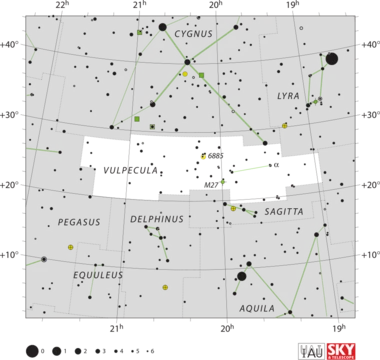
HD 190228 is a G5 IV subgiant star in the northern constellation Vulpecula, too faint to be seen with the naked eye at an apparent magnitude of 7.30. It hosts a substellar companion whose nature has been debated between a giant exoplanet and a brown dwarf. The star is metal-poor, older than the Sun, and located about 205 light-years from Earth.
Quick Facts
- Apparent magnitude
- 7.30
- Absolute magnitude
- 3.34
- Distance
- 205 ly
- Radial velocity
- −50 km/s
- Stellar classification
- G5 IV
- Mass
- 1.18 M☉
- Radius
- 2.4 R☉
- Luminosity
- 4.6 L / 4,600 cc☉
Facts from the source article.
Planetary system
In 2000, a giant exoplanet with a minimum mass of 5 Jupiter masses was announced orbiting HD 190228, designated HD 190228 b. The planetary nature was questioned due to the star's low metallicity, as giant planets typically form around metal-rich stars; it was argued the object might be a brown dwarf. A 2011 astrometric study using Hipparcos data found, with 95% confidence, that the companion is a brown dwarf of Jupiter masses in a nearly face-on orbit. However, later studies in 2022 and 2023 using both Hipparcos and Gaia astrometry found much lower true masses, close to the minimum mass. The former study notes its inclination measurement is poorly constrained, while the latter prefers the low-mass solution given the large uncertainty in Hipparcos data, making it likely that HD 190228 b is an exoplanet. It orbits the star every 3.1 years on an elliptical orbit with an eccentricity of 0.55.
More in Stars of Vulpecula
Spotted an error? Know more?
Reader corrections go straight into our review queue. Suggest an edit · How this site is sourced