HD 156668
K2 dwarf with a super-Earth and a suspected long-period planet.
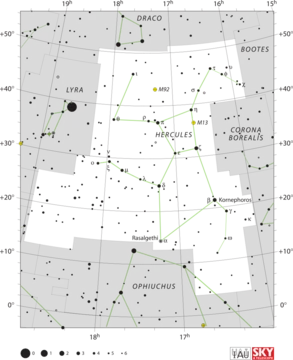
HD 156668 is a K2 dwarf star in the constellation Hercules, too faint for naked-eye viewing but visible with a small telescope. It lies about 79.3 light-years away and has a stellar activity cycle of roughly 10 years. The star is notable for hosting a multi-planet system, including a super-Earth discovered in 2010.
Quick Facts
- Apparent visual magnitude
- 8.4
- Distance
- 79.3 ly
- Stellar classification
- K2 dwarf
- Mass
- 77% of the Sun
- Diameter
- 72% of the Sun
- Bolometric luminosity
- 23% of the Sun
- Effective temperature
- 4850 K
Facts from the source article.
Observations
Between 1911 and 1915, Annie Jump Cannon and Edward Charles Pickering conducted photographic stellar spectrum surveys, with funding from Anna Mary Palmer, Henry Draper's wife. The star was first designated BD+29 2979 in the Bonner Durchmusterung catalogue published in 1863 by Friedrich Wilhelm Argelander, based on an 11-year observation of 324,198 stars. A 1957 proper motion survey included 9,867 stars in the Southern hemisphere. Later expansions came from the Cape Photographic Durchmusterung observatory in Córdoba, Argentina, and Henry Lee Giclas designated it G 181-34 in the Giclas catalogues. From 1990 to 1993, the star was observed at least twice and listed in the 6th annual Tokyo Photoelectric Meridian Circle catalogue among 6,649 stars.
Planetary system
Andrew Howard announced the discovery of HD 156668 b, a super-Earth, at the 215th American Astronomical Society meeting in January 2010. The planet orbits every 4.6 days at about 0.05 AU, with a minimum mass initially estimated at 4.15 Earth masses, later revised to 3.1 Earth masses. A second planet, HD 156668 c, was discovered in 2021, and the presence of an additional long-period object is suspected.
More in Stars of Hercules
Spotted an error? Know more?
Reader corrections go straight into our review queue. Suggest an edit · How this site is sourced