HD 147506
F8 dwarf with a massive transiting exoplanet and a second outer planet.
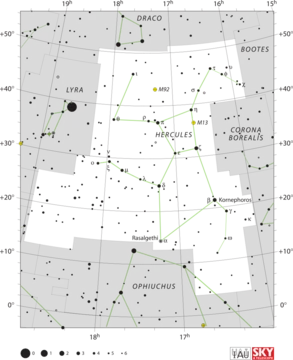
HD 147506, also known as HAT-P-2 and formally named Hunor, is an F8 dwarf star about 419 light-years from Earth near the keystone of Hercules. It is somewhat larger and hotter than the Sun and is estimated to be 2 to 3 billion years old, approaching the end of its main sequence life. The star hosts one known transiting exoplanet and a second planet not observed to transit.
Quick Facts
- Magnitude
- 8.7
- Spectral type
- F8 dwarf
- Distance from earth
- 419 ly
- Age
- 2 to 3 billion years
- Number of known planets
- 2
Facts from the source article.
Did You Know?
- The star exhibits stellar pulsations induced by its planet, the first known instance of a planet causing such pulsations in its host star.
- The pulsations have a very small amplitude of approximately 40 parts per million and correspond to exact harmonics of the planet's orbital frequency.
- In addition to being a planetary transit variable, the star's pulsations are of tidal origin.
Nomenclature
The star HD 147506, listed in the Henry Draper Catalogue, gained the name HAT-P-2 after the HATNet Project discovered a planet orbiting it, making it the second such star found by that project. Its proper name, Hunor, was chosen by Hungary during the NameExoWorlds campaign for the IAU's 100th anniversary. In legend, Hunor is the ancestor of the Huns and Hungarians, and brother of Magor, the name given to its planet, HAT-P-2b.
Planetary system
The transiting planet HAT-P-2b, later named Magor, was at its discovery the most massive transiting exoplanet known, with about nine times the mass of Jupiter and an estimated surface temperature of roughly 900 kelvins. Its orbital period is 5.6 days, and its orbital eccentricity is very large at 0.5. The planet's surface gravity is 25 times that of Earth, and its size is 10–20% larger than Jupiter. A long-term linear trend in radial velocity data over six years, combined with adaptive optics images from the Keck telescope, indicated a companion of at least 15 Jupiter masses, later confirmed in 2023 as a planetary-mass outer companion, HAT-P-2c, with a mass around 11 times that of Jupiter. The high eccentricity of the inner planet led to speculation that the outer planet is in orbital resonance with it.
More in Stars of Hercules
Spotted an error? Know more?
Reader corrections go straight into our review queue. Suggest an edit · How this site is sourced