HD 131399 Ab
A star mistaken for an exoplanet in Centaurus.
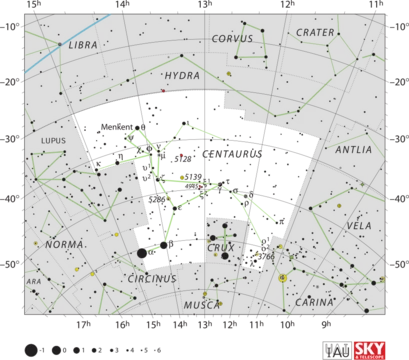
HD 131399 Ab, also called Scorpion-1b, is a K-type or M-type main-sequence star in Centaurus that was initially mistaken for an exoplanet orbiting the quadruple-star system HD 131399. It gained attention as a candidate directly imaged exoplanet before later observations identified it as a background star.
Quick Facts
- Alternative designation
- Scorpion-1b
- Spectral type
- K-type or M-type main-sequence star
- Constellation
- Centaurus
- System
- HD 131399
Facts from the source article.
Characteristics
The object was thought to be about 16 million years old, with a mass of 4 (± 1) Jupiter masses and a temperature of 850 K (± 50 K), which would have made it one of the coldest and least massive directly imaged exoplanets. Near-infrared spectroscopy (1.4–1.6 μm) indicated water and methane in its atmosphere. Scientists considered it unlikely to harbor life because it was gaseous, with no liquid water, extremely powerful winds, no surface, and liquid iron droplets raining just below the uppermost atmospheric layer. The central star HD 131399A is orbited by HD 131399B and HD 131399C at about 300 AU; the two less massive stars orbit each other at about 10 AU, while HD 131399 Ab was thought to orbit HD 131399A at about 80 AU. One orbit was thought to take 550 years, with a period of 100 to 140 years during which all three suns would be visible in a single day, leaving the planet in perpetual sunlight.
Discovery
HD 131399 Ab was first spotted using the SPHERE instrument on the Very Large Telescope in Chile, with its discovery reported in Science in July 2016. Had it been real, it would have been the first planet found by SPHERE and among the few directly imaged exoplanets. The image came from two separate SPHERE observations: one capturing the triple-star system and another aimed at the faint object. The discovery team gave the system the unofficial name Scorpion-1 and called the planet Scorpion-1b, referencing the Scorpion Planet Survey led by Daniel Apai. However, by May 2017, data from the Gemini Planet Imager and a fresh look at the original SPHERE images indicated the object was actually a background star. This was confirmed by later observations in 2022.
More in Stars of Centaurus
Spotted an error? Know more?
Reader corrections go straight into our review queue. Suggest an edit · How this site is sourced