Przybylski's Star
A chemically peculiar star with extreme rare-earth abundances.
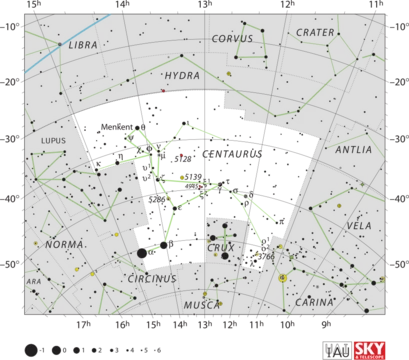
In the southern constellation Centaurus, about 356 light-years away, lies Przybylski's Star, also known as HD 101065. This rapidly oscillating Ap star has a bizarre chemical makeup: its spectrum reveals an overabundance of most rare-earth elements, yet it is surprisingly deficient in common elements like iron.
Quick Facts
- Designation
- HD 101065
- Distance
- roughly 356 ly
- Constellation
- Centaurus
- Apparent magnitude
- 8.5
- First recorded by
- Benjamin Apthorp Gould
- Date of first recording
- April 29, 1873
- Variable star type
- rapidly oscillating Ap star (roAp)
Facts from the source article.
Observation history
Benjamin Apthorp Gould first recorded this star on April 29, 1873, cataloguing it as the 10th star of Zone 257 with an apparent magnitude of 8.5. In 1961, the Polish-Australian astronomer Antoni Przybylski discovered that its spectrum did not fit standard stellar classification, showing unusually low amounts of iron and nickel but high amounts of elements such as strontium, holmium, niobium, scandium, yttrium, caesium, neodymium, praseodymium, thorium, ytterbium, and uranium. Przybylski initially doubted that iron was present at all; modern work indicates iron group elements are somewhat below normal, while lanthanides are highly over-abundant. Numerous attempts to assign a conventional spectral class have been made: the Henry Draper Catalogue gave B5, later estimates ranged from F8 or G0 to F0 or F5 to G0. It is likely a main sequence star hotter than the Sun, with spectral lines strongly blanketed by extreme metal abundances. A catalogue of chemically peculiar stars assigns the type F3 Ho, indicating an Ap star near spectral class F3 with strong holmium lines. HD 101065 also has a high peculiar velocity compared to neighboring stars.
Properties
HD 101065 has a mass of about and an age of around 1.5 billion years, calculated to be at the end of its main sequence life. Its bolometric luminosity is about at an effective temperature of . The star has a very slow projected rotational velocity for a hot main sequence star of just . Observations of its magnetic field suggest a possible rotation period of about 188 years, considered a minimum value. A published metallicity index ([Fe/H]) of −2.40 indicates less than 1% of the Sun's iron abundance, but this single value does not represent the star's overall chemical makeup, as levels of some other metals are thousands of times higher than in the Sun. The chemical peculiarities of Ap stars are largely due to stratification of elements allowed by very slow rotation, so the published metallicity likely does not reflect the proportion of heavy elements in the whole star. HD 101065 is the prototype of the rapidly oscillating Ap star class; in 1978 it was discovered to pulsate photometrically with a period of 12.15 minutes. A potential companion, a 14th-magnitude star in infrared 8 arc seconds away, indicates a minimum separation of just (0.02 light-years), but Gaia Data Release 2 suggests the pair is only optical, with the second star at a distance more than twice that of Przybylski's Star. The stellar atmosphere is highly magnetic, stratified, and chemically peculiar. Two different types of unusual spectroscopic observation have been reported. Many short-lived actinide elements—actinium, protactinium, neptunium, plutonium, americium, curium, berkelium, californium, and einsteinium—have been reported in the absorption spectrum, along with radioactive elements technetium and promethium. While the longest-lived known technetium isotopes have half-lives in millions of years, the longest-lived promethium isotope has a half-life of only 17.7 years, implying some process constantly replenishing the atmosphere. Models propose continuous bombardment by magnetically accelerated particles or from a companion neutron star, but more recent spectral analysis has not confirmed the existence of technetium or promethium.
More in Stars of Centaurus
Spotted an error? Know more?
Reader corrections go straight into our review queue. Suggest an edit · How this site is sourced