HD 45184
A solar twin with two Neptune-like planets and a debris disk.
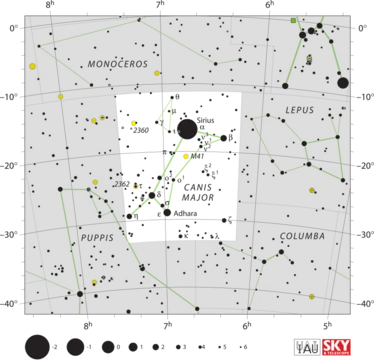
HD 45184 is a yellow-hued star in the southern constellation of Canis Major, near the lower limit of naked-eye visibility at an apparent visual magnitude of 6.37. It is an ordinary G-type main-sequence star classified as G2Va and considered a solar twin, located 71.4 light years from the Sun. The star is drifting closer with a radial velocity of −3.8 km/s.
Quick Facts
- Apparent visual magnitude
- 6.37
- Distance
- 71.4 light years
- Radial velocity
- −3.8 km/s
- Stellar classification
- G2Va
- Mass, size, and luminosity
- slightly higher than for the Sun
- Metallicity
- near solar
- Age
- around three billion years
- Rotation period
- 20 days
Facts from the source article.
Planetary system
HD 45184 hosts a planet about 12 times Earth's mass with an orbital period of 5.88 days, detected via the radial velocity method. Spitzer observations confirmed this planet and revealed a second candidate of similar mass orbiting every 13.1 days; no transit of the inner planet was detected. Both planets have near-circular orbits close to the star. An infrared excess at a wavelength observed by Spitzer indicates a debris disk candidate, with a blackbody-modeled mean temperature of 280 K, and a possible additional 60 K debris disk at a greater distance.
More in Stars of Canis Major
Spotted an error? Know more?
Reader corrections go straight into our review queue. Suggest an edit · How this site is sourced