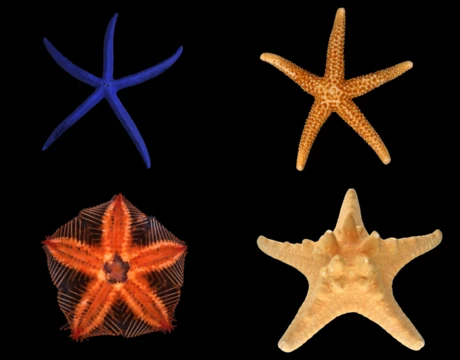
Orthasterias
A large North Pacific sea star with sharp spines.

Oregon Department of Fish & Wildlife · via Wikipedia: Orthasterias · CC BY-SA 2.0
Orthasterias is a genus of sea stars belonging to the family Asteriidae. Its sole member is Orthasterias koehleri, known as the rainbow star or red-banded sea star, inhabiting the North Pacific Ocean.
This starfish is large, reaching about 50 centimeters across, with arms up to 21 centimeters long. It typically has five slender, tapering arms. Its upper surface is pink or red, marked with irregular darker red, orange, or grey patches or bands. Sharp white or mauve spines cover the surface, each ringed by tiny pincer-like organs called pedicellariae.
The rainbow star ranges from California to Alaska in the northern Pacific, at depths down to roughly 250 meters. It also appears on mid-ocean knolls and seamounts. Uncommon, it usually lives on soft mud or sand bottoms, as well as on kelp or rock surfaces.
A predator, it feeds on various invertebrates, including gastropod molluscs, limpets, bivalves, brachiopods, chitons, barnacles, and tunicates. In Alaska, it particularly favors the ribbed clam Humilaria kennerleyi. It can dig buried clams from the substrate, using its tube feet to pry the valves apart. It then everts part of its stomach, inserting a fold into the bivalve and releasing digestive enzymes. Once the tissues liquefy, the stomach engulfs them and retracts.
The rainbow star is sometimes attacked by the voracious morning sun star (Solaster dawsoni). It defends itself by wrapping its arms around the attacker and nipping it with its numerous pedicellariae.
Quick Facts
- Species
- koehleri
Facts from the source article.
Lore & Background
The rainbow star is a large starfish, growing to a diameter of about 50 centimetres (20 in) with an arm length of 21 centimetres (8.3 in). It usually has five slender tapering arms and the aboral (upper) surface is pink or red with irregular patches or bands of darker red, orange or grey. The surface is covered with sharp white or mauve spines, each surrounded by a ring of pedicellariae, tiny pincer-like organs.
The rainbow star is found in northern parts of the Pacific Ocean with its range extending from California to Alaska at depths down to about 250 metres (820 ft). It also occurs in mid-ocean on knolls and seamounts. It is an uncommon species and is usually found on soft bottoms of mud or sand, or on kelp or rock surfaces.
The rainbow star is a predator and feeds on a range of invertebrates including gastropod molluscs, limpets, bivalves, brachiopods, chitons, barnacles and tunicates. In Alaska, it especially favours the ribbed clam Humilaria kennerleyi. It can dig up clams buried in the substrate and force the valves apart with the suction provided by its tube feet. It then everts part of its stomach, thrusting a fold inside the bivalve and excreting digestive enzymes onto the tissues. When these have liquefied sufficiently, the stomach engulfs them and is returned to its normal position inside the starfish. The rainbow star is sometimes attacked by a voracious predator, the morning sun star (Solaster dawsoni). It attempts to defend itself by winding its arms round the attacker and nipping it with its thousands of pedicellariae.
More in Starfish
Spotted an error? Know more?
Reader corrections go straight into our review queue. Suggest an edit · How this site is sourced