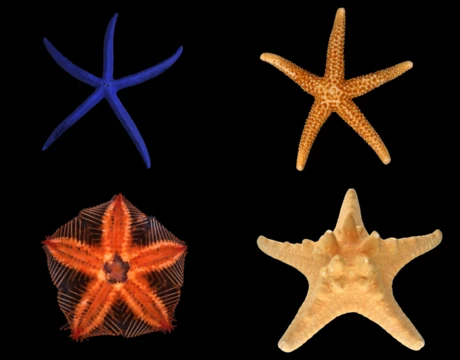
Forcipulatida
Order of sea stars with three families and 49 genera.

Hans Hillewaert · via Wikipedia: Forcipulatida · CC BY-SA 4.0
Forcipulatida is an order of sea stars made up of three families and 49 genera. Its members are distinguished by pedicellariae that feature a short stalk and three skeletal ossicles, a trait shared with brisingid sea stars, though forcipulatids generally have sturdier bodies. The order includes familiar species like the common starfish, Asterias rubens, and its range extends from North Carolina in the United States down to Santos in Brazil. The order is divided into three families: Asteriidae (39 genera), Heliasteridae (two genera), and Zoroasteridae (eight genera). An alternative classification from the World Register of Marine Species lists seven families and 64 genera: Asteriidae, Heliasteridae, Pedicellasteridae, Pycnopodiidae, Stichasteridae, Zoroasteridae. A 2020 study using phylogenetic analysis and scanning electron microscopy of skeletons and ossicles from the superorder Forcipulatacea found Asteriidae, Stichasteridae, Zoroasteridae, and Brisingida to be monophyletic.
Quick Facts
- Families
- 3
- Genera
- 49
- Well-known species
- Asterias rubens
- Geographic range
- from North Carolina in the United States to Santos in Brazil
- Families according to worms
- 7
- Genera according to worms
- 64
Facts from the source article.
Lore & Background
Forcipulatids share with brisingid sea stars distinctive pedicellariae, which are composed of a short stalk with three skeletal ossicles. Unlike brisingids, however, forcipulatids tend to have more robust bodies. The order includes some well-known species, such as the common starfish, Asterias rubens. This order can be commonly found from North Carolina in the United States all the way to Santos in Brazil. The World Register of Marine Species gives another taxonomy, with seven families and 64 genera, including Asteriidae, Heliasteridae, Pedicellasteridae, Pycnopodiidae, Stichasteridae, Zoroasteridae. A 2020 study involving phylogenetic analysis and scanning electron microscopy recovered Asteriidae, Stichasteridae, Zoroasteridae, and Brisingida as monophyletic. The extinct family Terminasteridae has also been placed in this order.
Reader's Guide
The Forcipulatida order is significant as it contains the common starfish, Asterias rubens, a well-known species. Its taxonomy is subject to dispute: the article presents a classification of three families and 49 genera, while the World Register of Marine Species lists seven families and 64 genera. A 2020 study using phylogenetic analysis and scanning electron microscopy recovered several families as monophyletic, including Asteriidae, Stichasteridae, Zoroasteridae, and Brisingida. The order's geographic range is documented from North Carolina in the United States to Santos in Brazil. The distinctive pedicellariae—a short stalk with three skeletal ossicles—are shared with brisingid sea stars, but forcipulatids have more robust bodies.
More in Starfish
Spotted an error? Know more?
Reader corrections go straight into our review queue. Suggest an edit · How this site is sourced