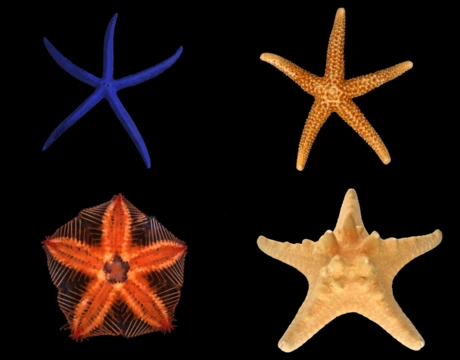
Brisingida
Last updated

NOAA/Monterey Bay Aquarium Research Institute · via Wikipedia: Brisingida · Public domain
They belong to the class Asteroidea and are grouped with Forcipulatida in the superorder Forcipulatacea.[1] The order contains about 100 species in 17 genera and 6 families.[1] Brisingids, which belong to the order Brisingida, are starfish that inhabit deep-sea environments.[2][1]
Scientific classification
- KingdomAnimalia
- PhylumEchinodermata
- ClassAsteroidea
- OrderBrisingida
Named by Fisher, 1928
Sources: Wikipedia taxobox: Brisingida (CC BY-SA 4.0)
Quick Facts
- Spiny arms range
- 7–20
- Depth range eastern pacific
- 1,820–2,418 m / 5,971–7,933 ft
- Genera
- 18
Facts from the source article.
Biology and range
They lack actinal plates and have a spool-like ambulacral column and crossed pedicellariae.[3] Brisingida occur in deep-sea locations, particularly in the Caribbean and New Zealand.[4] They are found in the eastern Pacific Ocean at depths of 1,820–2,418 m.[4] The order Brisingida was established by Fisher in 1928.[5]
The environment for all species is marine.[5] GBIF holds 5,750 occurrence records for this taxon.[6] For feeding by suspension, these starfish employ 6 to 16 long, slender arms.[3] Their features include a fused ring of disc plates, reduced abactinal plates, a single series of marginals, no actinal plates, a spool-like ambulacral column, and crossed pedicellariae.[3]
What the specialist sources record
That source reports about 100 species in 17 genera and 6 families.[1] It also notes that asteroid morphology is complex and diverse, though Brisingida can be clearly defined morphologically.[1] The WoRMS database lists Brisingida as an accepted order within class Asteroidea.[5] GBIF also accepts the order and records 5,750 occurrences as of October 2026.[6]
References
- "Asteroidea", Tolweb.org, 2004-10-07. facts only, no text reused. tolweb.org
- Wikipedia, "Brisingida" (CC BY-SA 4.0), which cites: "Asteroidea", Tolweb.org, 2004-10-07; Mah, C., "Brisingida", 2014 (we also read that source) en.wikipedia.org
- Wikipedia, "Brisingida" (CC BY-SA 4.0), which cites: "Asterozoa: Fossil groups: SciComms 05-06: Earth Sciences", Palaeo.gly.bris.ac.uk, 2005-11-22; "Revision of the Atlantic Brisingida (Echinodermata: Asteroidea), with Description of a New Genus and Family"; Zhang, "A new sponge-associated starfish, Astrolirus patricki sp. nov. (Asteroidea: Brisingida: Brisingidae), from the northwestern Pacific seamounts", May 27, 2020 (original not read by us) en.wikipedia.org
- Wikipedia, "Brisingida" (CC BY-SA 4.0), which cites: "Data Use Agreement – GBIF Portal", Gbif.net, July 2017; Zhang, "A new sponge-associated starfish, Astrolirus patricki sp. nov. (Asteroidea: Brisingida: Brisingidae), from the northwestern Pacific seamounts", May 27, 2020 (original not read by us) en.wikipedia.org
- World Register of Marine Species, Brisingida (AphiaID 123085). CC BY 4.0. marinespecies.org
- GBIF Backbone Taxonomy and occurrence index, Brisingida (taxon key 902). CC BY 4.0 (backbone); counts are facts. gbif.org
Each numbered sentence above was checked against the source it cites before publication. Sentences citing Wikipedia adapt text from the English Wikipedia article Brisingida (contributors), used under CC BY-SA 4.0; this entry is available under the same licence. Other sources were used for facts only; no text or images are copied from them.
More in Starfish
Sources
Compiled from Wikipedia and the sources listed below. Text from Wikipedia is available under CC BY-SA 4.0; this entry is adapted from it.
- Wikipedia: Brisingida (CC BY-SA 4.0).
- Word definitions: the Codexery glossary, each quoted from its Wikipedia article.
Spotted an error? Know more?
Reader corrections go straight into our review queue. Suggest an edit · How this site is sourced