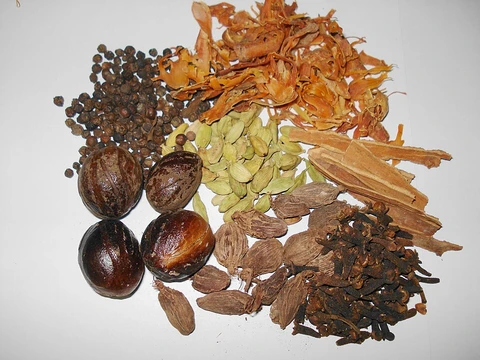
Nutmeg
The seed of the fragrant nutmeg tree, native to the Banda Islands and mainly produced there, yields both nutmeg and mace spices.
Nutmeg is the seed of several tree species in the genus Myristica, and the ground spice made from that seed.[1] The Banda Islands in Indonesia are the main producer of nutmeg and mace, and the true nutmeg tree is native there.[2] Nutmeg and mace are used as food spices, but high doses can cause serious toxic effects including acute psychosis.[3]
Quick Facts
- Main producer
- Banda Islands
Facts from the source article.
Key facts and history
Portuguese ships arrived in the Banda Islands in early 1512, the first Europeans to reach them.[4][5] The Dutch East India Company waged a bloody battle with the Bandanese in 1621 to obtain a monopoly on nutmeg production.[6] During the Napoleonic Wars, the British transplanted nutmeg trees to Sri Lanka, Penang, Bencoolen, and Singapore.[7] The Austronesian maritime spice trade network had been moving nutmeg as a trade good since at least 1500 BCE.[8]
By the sixth century AD, nutmeg had reached India and then continued westward to Constantinople.[9] On behalf of Portugal's king, Afonso de Albuquerque captured Malacca—then the central hub of Asian commerce—in August 1511.[4] Willard Hanna, a historian, calculated that the islands' pre-conflict population was roughly 15,000, with only about 1,000 people remaining afterward.[6] Global nutmeg production (combined with cardamom) reached 197,199 tonnes in 2024, with Guatemala as the top producer at 76,339 tonnes.[10]
What the cited sources add
The "European Discovery & Conquest of the Spice Islands" account states that clove, nutmeg, and mace are native to only a handful of tiny islands in the Indonesian archipelago.[5] That same source notes that for over a thousand years, Indonesian sailors carried nutmeg to the Malay Peninsula, Java, and Sumatra, where Indian and Arabian sailors distributed it.[5] The account also reports that the Portuguese Viceroy Albuquerque was told of the Spice Islands by sailors in Malacca.[5] Oulton adds that a nutmeg grater is an essential tool for bartenders, who use it to grate fresh nutmeg as an aromatic garnish for drinks.[11]
The Connecticut Public Radio piece "What is a Nutmegger?" reports that Connecticut merchants imported nutmegs during the colonial era, and it was widely used in early American cuisine.[12] That same source notes that the term "wooden nutmeg" has come to mean a fraud, possibly from unscrupulous peddlers selling fake wooden nutmegs.[12]
References
- Wikipedia, "Nutmeg" (CC BY-SA 4.0), which cites: "Nutmeg and derivatives (Review)", Food and Agriculture Organization (FAO) of the United Nations, September 1994 (original not read by us) en.wikipedia.org
- Wikipedia, "Nutmeg" (CC BY-SA 4.0), which cites: "Ecology of Nusa Tenggara and Maluka", Tuttle Pub, 2012, p. 10:3 (Changes in Agriculture); Zumbroich, "The Introduction of Nutmeg (Myristica fragrans Houtt.) and Cinnamon (Cinnamomumverum J. Presl)) to America / La introducción de la nuez moscada (Myristica fragrans Houtt.) y de la canela (Cinnamomum verum J.S (original not read by us) en.wikipedia.org
- Wikipedia, "Nutmeg" (CC BY-SA 4.0), which cites: "Nutmeg", Drugs.com, 11 November 2025; "Nutmeg", Drugs.com, 11 November 2025 (original not read by us) en.wikipedia.org
- Wikipedia, "Nutmeg" (CC BY-SA 4.0), which cites: "European Discovery & Conquest of the Spice Islands" (we also read that source) en.wikipedia.org
- "European Discovery & Conquest of the Spice Islands". facts only, no text reused. worldhistory.org
- Wikipedia, "Nutmeg" (CC BY-SA 4.0), which cites: Hanna, "Indonesian Banda: Colonialism and Its Aftermath in the Nutmeg Islands", Yayasan Warisan dan Budaya Banda Neira., 1991; "European Discovery & Conquest of the Spice Islands" (we also read that source) en.wikipedia.org
- Wikipedia, "Nutmeg" (CC BY-SA 4.0), which cites: Giles Milton, Nathaniel's Nutmeg, 1999, London: Hodder and Stoughton; (original not read by us) en.wikipedia.org
- Wikipedia, "Nutmeg" (CC BY-SA 4.0), which cites: "Mryristicin - - Molecule of the Month - August 2014 (HTML version)", www.chm.bris.ac.uk; Zumbroich, "The origin and diffusion of betel chewing: a synthesis of evidence from South Asia, Southeast Asia and beyond", eJournal of Indian Medicine, 2007–2008, p. 87–140 (original not read by us) en.wikipedia.org
- Wikipedia, "Nutmeg" (CC BY-SA 4.0), which cites: Pickersgill, "The Cultural History of Plants", Routledge, 2005, p. 166; Pickersgill, "The Cultural History of Plants", Routledge, 2005, p. 166 (original not read by us) en.wikipedia.org
- Wikipedia, "Nutmeg" (CC BY-SA 4.0), which cites: "World production of nutmeg, mace and cardamoms in 2024; Crops/Regions/World/Production Quantity/Year from pick lists", Food and Agriculture Organization of the United Nations, Statistics Division (FAOSTAT), 2026 (original not read by us) en.wikipedia.org
- Oulton, Randal, "Nutmeg Graters", CooksInfo.com, 18 February 2007. facts only, no text reused. cooksinfo.com
- "What is a Nutmegger?", Connecticut Public Radio, 12 August 2011. facts only, no text reused. wnpr.org
Each numbered sentence above was checked against the source it cites before publication. Sentences citing Wikipedia adapt text from the English Wikipedia article Nutmeg (contributors), used under CC BY-SA 4.0; this entry is available under the same licence. Other sources were used for facts only; no text or images are copied from them.
Spotted an error? Know more?
Reader corrections go straight into our review queue. Suggest an edit · How this site is sourced