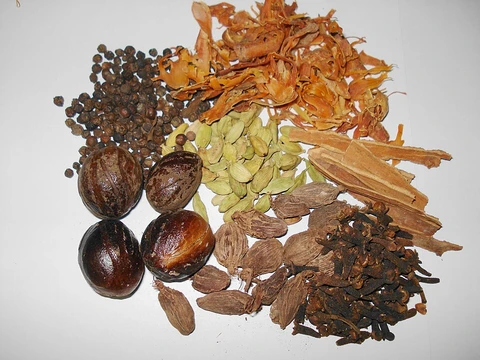
Cardamom
A spice made from seeds of plants in the genera Elettaria and Amomum, native to the Indian subcontinent and Indonesia.
The word "cardamom" derives from the Latin cardamōmum, a Latinisation of the Greek καρδάμωμον.[1] The spice known as cardamom comes from seeds of plants belonging to the genera Elettaria and Amomum, both of which are native to the Indian subcontinent and Indonesia.[2]
Quick Facts
- Plant
- Elettaria cardamomum, Amomum subulatum
- Part
- Seed
- Uses
- Flavoring, spice
Facts from the source article.
Key facts and history
In medieval times, Venice became the principal importer of cardamom into the west, along with pepper, cloves and cinnamon.[3] To preserve its flavor, cardamom should be kept inside the pod, since seeds that are exposed or ground rapidly lose their taste.[4] Nair (2011) states that even in years when India produces a good harvest, its yield remains lower than Guatemala's.[5]
What the cited sources add
The Garden Guides account states that cardamom grows natively in the Ghat Mountains of southwest India.[6] According to the same source, Arabs consume over one half of the world's cardamom annually.[6] The Garden Guides account notes that in Hoodoo, carrying cardamom seeds is believed to bring good luck and improve relationships.[6] It also reports that the ancient Romans felt cardamom made an excellent, exotic aphrodisiac to stimulate passions.[6]
The Garden Guides account mentions that cardamom tinctures go into medicines like cough syrup to improve their flavors.[6] It further states that cardamom germination usually takes between 20 and 25 days, but can take up to 40 days.[6]
References
- Wikipedia, "Cardamom" (CC BY-SA 4.0), which cites: Lewis, "cardamomum", Perseus Digital Library at Tufts University; Liddell, Perseus Digital Library at Tufts University; Liddell, "κάρδαμον", Perseus Digital Library at Tufts University; Liddell, "ἄμωμον", Perseus Digital Library at Tufts University (original not read by us) en.wikipedia.org
- Wikipedia, "Cardamom" (CC BY-SA 4.0), which cites: "Cardamom"; Ramadan, "Cardamom (Elettaria cardamomum): Production, Processing and Properties", Springer International Publishing, 2023; "Cardamom", 2024-04-05 (original not read by us) en.wikipedia.org
- Wikipedia, "Cardamom" (CC BY-SA 4.0), which cites: Cumo 2013, p. 216 (original not read by us) en.wikipedia.org
- Wikipedia, "Cardamom" (CC BY-SA 4.0), which cites: "Ingredient of the Month: Cardamom", acfchefs.org, February 2022 (original not read by us) en.wikipedia.org
- Wikipedia, "Cardamom" (CC BY-SA 4.0), which cites: Nair 2011, p. 267; Nair 2011, p. 267 (original not read by us) en.wikipedia.org
- "The Uses of Cardamom", Garden Guides, 2017-09-21. facts only, no text reused. gardenguides.com
Each numbered sentence above was checked against the source it cites before publication. Sentences citing Wikipedia adapt text from the English Wikipedia article Cardamom (contributors), used under CC BY-SA 4.0; this entry is available under the same licence. Other sources were used for facts only; no text or images are copied from them.
Spotted an error? Know more?
Reader corrections go straight into our review queue. Suggest an edit · How this site is sourced