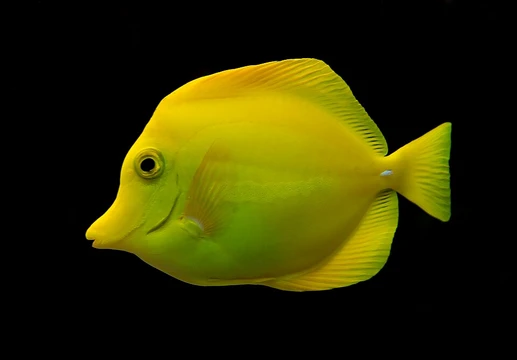
Yellow tang (Zebrasoma flavescens)
Source-cited species reference: taxonomy from WoRMS, biology from FishBase, occurrence map from GBIF, conservation from IUCN Red List, description from Wikipedia.

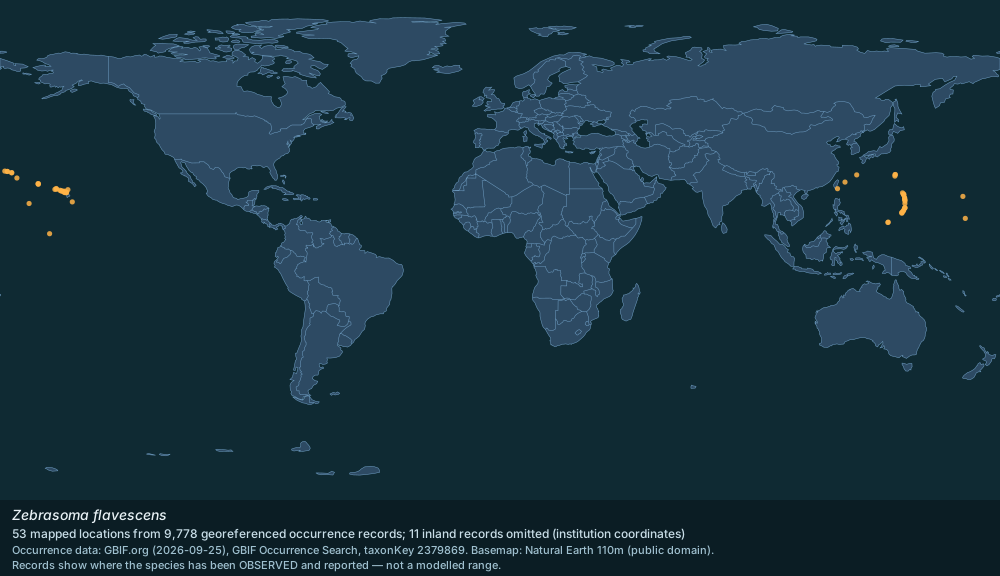
Distribution map plotted from GBIF.org occurrence records; basemap Natural Earth 110m · GBIF records CC0 / CC BY; Natural Earth public domain
The yellow tang (Zebrasoma flavescens), also known as the lemon sailfin, yellow sailfin tang or somber surgeonfish, is a species of marine ray-finned fish belonging to the family Acanthuridae which includes the surgeonfishes, unicornfishes and tangs. Bright yellow in color, this Pacific reef fish is also one of the most popular marine aquarium fish. The yellow tang spawns around a full moon, eats algae, and has a white barb located just before the tail fin to protect itself.
- Scientific name
- Zebrasoma flavescens
- Authority
- (Bennett, 1828)
- Family
- Acanthuridae
- Order
- Acanthuriformes
- Maximum length
- 20 cm
- Depth range
- 2–46 m
- Habitat zone
- reef-associated
- Iucn red list
- Least Concern
- Gbif occurrence records
- 9,778
Classification (WoRMS)
Full classification as recorded by WoRMS: Kingdom: Animalia · Phylum: Chordata · Class: Teleostei · Order: Acanthuriformes · Family: Acanthuridae · Genus: Zebrasoma.
Accepted name: Zebrasoma flavescens · Authority: (Bennett, 1828) · Taxonomic status: accepted · AphiaID: 219683.
Synonyms and superseded combinations recorded for this taxon: Acanthurus flavescens Bennett, 1828.
Source: World Register of Marine Species (WoRMS) — https://www.marinespecies.org/aphia.php?p=taxdetails&id=219683 (CC BY 4.0). Accessed 2026-09-25.
Biology and life history (FishBase)
Measured values published by FishBase for Zebrasoma flavescens. Only fields the database actually holds for this species are shown; these are database values, not aquarium guidance.
Maximum length: 20 cm · Depth range: 2–46 m · Habitat zone: reef-associated · Body shape: short and / or deep · Vulnerability index: 57.4 of 100 · Fishery importance: commercial · Aquarium trade: commercial.
FishBase notes: Adults inhabit coral-rich areas of lagoon and seaward reefs from below the surge zone to about 46 m (Ref. 9710). Benthopelagic over rock at 1-81 m (Ref. 58302). They occur singly or in loose groups. Mainly herbivorous, browsing on filamentous algae. Group spawning and pair-spawning by territorial males that court passing females were observed. Spawning activity occurs around the full moon indicating lunar periodicity (Ref. 86544). Spawn in batches throughout the year (Ref. 86544). Presence of a venom gland could not be determined despite the presence of distinct anterolateral grooves; this may be due to the loss of venom glands in adults (Ref. 57406). A popular aquarium fish and the top marine fish export from Hawaii.
Source: FishBase species summary (SpecCode 6018) — https://www.fishbase.se/summary/Zebrasoma-flavescens.html (CC BY-NC 3.0 — non-commercial use only). Accessed 2026-09-25.
Distribution and occurrence records (GBIF)
9,778 georeferenced occurrence records for Zebrasoma flavescens are published through GBIF from 31 countries or marine areas. The map above plots 53 distinct locations from a sample of 3,000 records, omitting 11 inland records that carry an institution's coordinates rather than a collection site; it shows where the species has been observed and reported, not a modelled range.
Most records by country or area: United States of America (7,007); Northern Mariana Islands (1,502); United States Minor Outlying Islands (900); Guam (166); Japan (42).
The full country table, WoRMS marine regions and the sampling notes are on this species' Distribution page.
Source: GBIF Occurrence Search (taxonKey 2379869) — https://www.gbif.org/occurrence/search?taxon_key=2379869&has_coordinate=true (records CC0 / CC BY); WoRMS distribution records (MarineRegions) — https://www.marinespecies.org/aphia.php?p=taxdetails&id=219683 (CC BY 4.0); Natural Earth 110m basemap — https://www.naturalearthdata.com/ (public domain). Accessed 2026-09-25.
Conservation status (IUCN Red List)
The IUCN Red List assesses Zebrasoma flavescens (Bennett, 1828) as Least Concern (code LC). No trend, population estimate or threat analysis is given here, because none is available from this source without the Red List API; follow the source link for the full assessment, including its date.
Source: IUCN Red List of Threatened Species (taxon 178015) — https://www.iucnredlist.org/species/178015/0; GBIF IUCN Red List category endpoint (taxonKey 2379869) — https://api.gbif.org/v1/species/2379869/iucnRedListCategory. Accessed 2026-09-25.
Description and natural history (Wikipedia)
The yellow tang was first formally described by English naturalist Edward Turner Bennett as Acanthurus flavescens in 1828 from a collection in the Hawaiian Islands. Zebrasoma refers to the body and the zebra-like stripes or bars on the body of the type species the genus, the sailfin tang (Z. velifer). Its species name is the Latin adjective, which refers to the tang's yellow color.
Within the genus Zebrasoma the yellow tang forms a species pair with the scopas tang (Z. scopas).
It is commonly found in shallow reefs, from 2 - 46 m deep, in the Pacific Ocean (Ryukyu, Mariana, Marshall, Marcus, Wake, and Hawaiian islands), west of Hawaii and east of Japan.
There have also been reports that they have been found off the coast of Florida in the Western Central Atlantic. A single specimen was filmed in the Mediterranean Sea in Spanish waters in 2008, a likely aquarium release. As of July of 2024, yellow tangs have been spotted several times on the shallow reefs of Mexico's Riviera Maya.
Their habitat is tropical with a temperature range of 24 - 28 C.
Adult fish can grow to 20 cm in length, and 1 - 2 cm in thickness. Adult males tend to be larger than females. Yellow tangs are bright yellow in color. At night, the yellow coloring fades slightly, and a prominent brownish patch develops in the middle with a horizontal white band. They rapidly regain their bright yellow color during daylight. They can be aggressive, are prone to marine ich, and may damage coral within a reef tank. Male and female yellow tang look very similar. When mating, however, males change color and have a "shimmering" behavior which makes them identifiable.
The yellow tang has 5 dorsal spines along with 23–26 dorsal soft rays. The yellow tang also has 3 anal spines as well as 19–22 anal soft rays. There is a white spine on its caudal peduncle that it can use for defense. Its snout is moderately protruding. Its mouth is small with spatulate teeth that are place classed relatively close together inside of the yellow tang's mouth. In juveniles, there are 12 upper and 14 lower teeth. In adults, there are 18 upper and 22 lower teeth.
In the wild, yellow tangs can live for over 40 years.
The yellow tang is a marine fish that lives in reefs and is typically found by itself or in small groups/schools. It is mainly herbivorous and eats filamentous algae. Natural predators include larger fish, sharks, crabs, and octopuses.
Spawning happens throughout the year, and it peaks once, normally occurring around the time the moon is full, so this suggests there is some sort of lunar periodicity to the spawning behavior. Spawning happens in pairs or groups, and fertilization is external. Eggs are left in open water and yellow tang are substratum egg scatterers. Yellow tang do not guard their eggs, and once the eggs hatch, the juveniles receive no parental care.
The larvae of the yellow tang can drift more than 100 miles and reseed in a distant location.
In the wild, yellow tangs feed on benthic, uncalcified and filamentous turf algae and other marine plant material, as well as some types of zooplankton. In captivity, they are commonly fed meat/fish-based aquarium food, but the long-term health effects of this diet are questionable. However, most experts in the marine aquarium industry express little scepticism that such a well rounded and balanced diet including plant and animal material would be in any way detrimental to mostly herbivorous fishes like tangs since they still need on occasion, complex amino acids and nutrients that only ocean animals can provide. In the wild, yellow tangs provide cleaner services to marine turtles, by removing algal growth from their shells.
The yellow tang is listed as "Least Concern" by the International Union for Conservation of Nature (IUCN). The tropical yellow tang is heavily fished by the aquarium trade. Every year, 300,000 to 500,000 yellow tang were collected from the wild in Hawaii alone. Hawaii was the most common place for aquarium harvesting, prior to the export ban, where up to 70% of the yellow tangs for the aquarium industry were sourced from. By the late 1990s, their stocks were collapsing. Nine marine protected areas were established off the coast of Hawaii to protect them. Over 70% of the yellow tang's natural range is protected from collection and fishing.
Source: Wikipedia: Yellow tang — https://en.wikipedia.org/wiki/Yellow_tang (CC BY-SA 4.0). Accessed 2026-09-25.
Gallery
Related in Yellow tang
Links follow this subject's own source article.
Elsewhere in Yellow tang
Spotted an error? Know more?
Reader corrections go straight into our review queue. Suggest an edit · How this site is sourced