
Whitecheek shark (Carcharhinus dussumieri)
Source-cited species reference: taxonomy from WoRMS, biology from FishBase, occurrence map from GBIF, conservation from IUCN Red List, description from Wikipedia.
The whitecheek shark or widemouth blackspot shark (Carcharhinus dussumieri) is a requiem shark of the family Carcharhinidae, found in the Indo-West Pacific Ocean between latitudes 34°N and 25°S. It can reach a length of 1 m. It feeds mainly on fish, cephalopods, and crustaceans. It is a viviparous species, with the female giving birth to up to four live young.
- Scientific name
- Carcharhinus dussumieri
- Authority
- (Müller & Henle, 1839)
- Family
- Carcharhinidae
- Order
- Carcharhiniformes
- Maximum length
- 121 cm
- Depth range
- 0–100 m
- Habitat zone
- reef-associated
- Iucn red list
- Endangered
- Gbif occurrence records
- 330
Classification (WoRMS)
Full classification as recorded by WoRMS: Kingdom: Animalia · Phylum: Chordata · Class: Elasmobranchii · Order: Carcharhiniformes · Family: Carcharhinidae · Genus: Carcharhinus.
Accepted name: Carcharhinus dussumieri · Authority: (Müller & Henle, 1839) · Taxonomic status: accepted · AphiaID: 217347.
Synonyms and superseded combinations recorded for this taxon: Carcharias dussumieri Valenciennes, 1839; Carcharias malabaricus Day, 1873.
Source: World Register of Marine Species (WoRMS) — https://www.marinespecies.org/aphia.php?p=taxdetails&id=217347 (CC BY 4.0). Accessed 2026-09-23.
Biology and life history (FishBase)
Measured values published by FishBase for Carcharhinus dussumieri. Only fields the database actually holds for this species are shown; these are database values, not aquarium guidance.
Maximum length: 121 cm · Depth range: 0–100 m · Habitat zone: reef-associated · Body shape: fusiform / normal · Vulnerability index: 55.5 of 100 · Fishery importance: commercial · Aquarium trade: never/rarely.
FishBase notes: A common but little-known shark found on the continental and insular inshore areas (Ref. 9997). Feeds mainly on fishes but also on cephalopods, and crustaceans (Ref. 6871). Viviparous (Ref. 50449), with a yolk-sac placenta; gives birth to litters of 1-4 (usually 2) pups (Ref. 58048). Pregnant females (79-100.7 cm TL) that were caught contained 2-5 late-term embryos between 32-38.7 cm TL, thus birth size is presumed to be around 37-39 cm TL. From more than 1000 market specimens (in Kuwait, Qatar and Abu Dhabi), size of males and females range from 36-85 cm TL and 36-100.7 cm TL, respectively, with males reaching maturity between 63-80 cm TL (Ref. 89954). Taken in artisanal and small-scale commercial fisheries and marketed for human consumption (Ref. 244). Fins also utilized (Ref. 6871).
Source: FishBase species summary (SpecCode 867) — https://www.fishbase.se/summary/Carcharhinus-dussumieri.html (CC BY-NC 3.0 — non-commercial use only). Accessed 2026-09-23.
Distribution and occurrence records (GBIF)
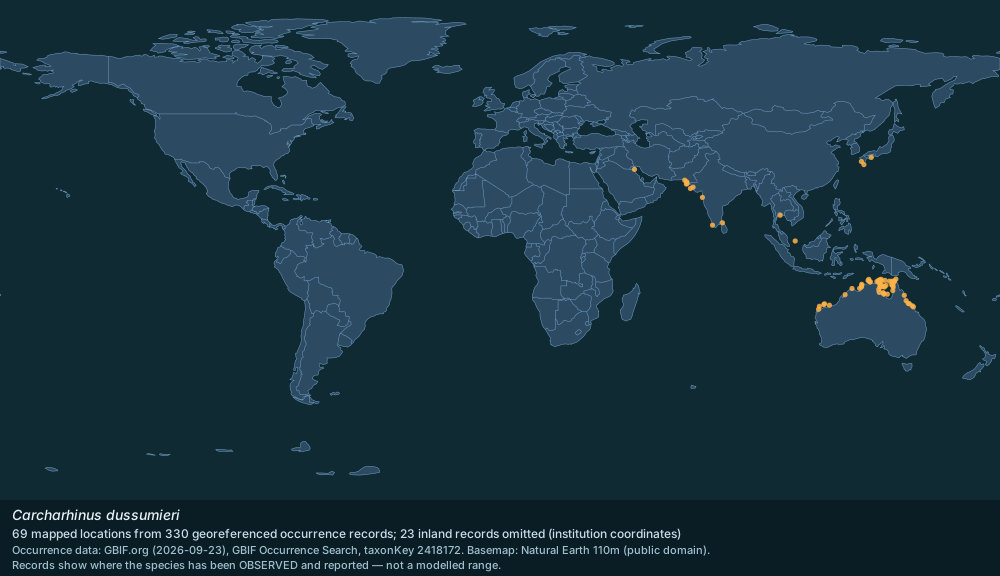
330 georeferenced occurrence records for Carcharhinus dussumieri are published through GBIF from 13 countries or marine areas. The map above plots 69 distinct locations from a sample of 330 records, omitting 23 inland records that carry an institution's coordinates rather than a collection site; it shows where the species has been observed and reported, not a modelled range.
Most records by country or area: Australia (268); Japan (14); Pakistan (11); United Arab Emirates (7); India (7); Kuwait (6); Qatar (6); Indonesia (5); Philippines (2); Iran (Islamic Republic of) (1); Sri Lanka (1); Singapore (1); Thailand (1).
Marine regions with a valid WoRMS distribution record: Seychellois Exclusive Economic Zone.
Source: GBIF Occurrence Search (taxonKey 2418172) — https://www.gbif.org/occurrence/search?taxon_key=2418172&has_coordinate=true (records CC0 / CC BY); WoRMS distribution records (MarineRegions) — https://www.marinespecies.org/aphia.php?p=taxdetails&id=217347 (CC BY 4.0); Natural Earth 110m basemap — https://www.naturalearthdata.com/ (public domain). Accessed 2026-09-23.
Conservation status (IUCN Red List)
The IUCN Red List assesses Carcharhinus dussumieri (Valenciennes in Müller & Henle, 1839) as Endangered (code EN). No trend, population estimate or threat analysis is given here, because none is available from this source without the Red List API; follow the source link for the full assessment, including its date.
Source: IUCN Red List of Threatened Species (taxon 70680197) — https://www.iucnredlist.org/species/70680197/0; GBIF IUCN Red List category endpoint (taxonKey 2418172) — https://api.gbif.org/v1/species/2418172/iucnRedListCategory. Accessed 2026-09-23.
Description and natural history (Wikipedia)
The specific name honours the French explorer and trader Jean-Jacques Dussumier (1792–1883).
The whitecheek shark grows to a length around 100 cm. It has a slender body and long head with a rounded snout. The eyes are oval and both jaws have multiple rows of backward-pointing, serrated teeth. The pectoral fins are long, narrow, and curved and have narrow, pointed tips. The first dorsal fin is triangular, uncurved, and moderately sized, and the second dorsal fin is much smaller than the first and bears a large black patch at its apex. The whitecheek shark's dorsal (upper) surface is grey or brownish-grey, while its ventral (under) surface is pale.
The whitecheek shark is native to the Indo-Pacific Ocean, where it is found on continental shelves and inshore slopes around islands down to about 170 m. Its range extends from the Arabian Sea and Persian Gulf to Java, Indonesia, Japan, and Australia.
The whitecheek shark mostly feeds on fish, but also eats octopus, squid, and various crustaceans including crabs. It sometimes picks off molluscs and worms from the seabed.
It is a common species, but not well known, and it is sometimes confused with the blackspot shark (Carcharhinus sealei). Both males and females mature when they are about 70 cm long. Females are viviparous and breeding takes place throughout the year, with females normally being either pregnant or having recently given birth. One to four, but usually two, pups are retained in the uterus, where they feed from a yolk sac. They are about 38 cm at the time of birth.
The IUCN lists the whitecheek shark as near threatened in its Red List of Threatened Species because it is often caught in shallow-water fisheries by rod and line, gillnetting, and trawling. Its population trend seems to be decreasing and it is facing local extinction in some parts of its range. It is usually caught as bycatch rather than as the target species, and in Australian waters, makes up around 2–3% of the total biomass caught. It is not harmful to man and its flesh is marketed for human consumption.
Source: Wikipedia: Whitecheek shark — https://en.wikipedia.org/wiki/Whitecheek_shark (CC BY-SA 4.0). Accessed 2026-09-23.
Gallery
Spotted an error? Know more?
Reader corrections go straight into our review queue. Suggest an edit · How this site is sourced