
Tridacna squamosina
Source-cited species reference: taxonomy from WoRMS, biology from SeaLifeBase, occurrence map from GBIF, conservation from IUCN Red List, description from Wikipedia.
Tridacna squamosina is a species of the Tridacna genus, the giant clams. These animals are bivalve mollusks belonging to the family Cardiidae identified by Sturany 1899.
- Scientific name
- Tridacna squamosina
- Authority
- Sturany, 1899
- Family
- Cardiidae
- Order
- Cardiida
- Maximum length
- 32 cm
- Depth range
- 0–5 m
- Habitat zone
- benthic
- Iucn red list
- Endangered
- Gbif occurrence records
- 46
Classification (WoRMS)
Full classification as recorded by WoRMS: Kingdom: Animalia · Phylum: Mollusca · Class: Bivalvia · Order: Cardiida · Family: Cardiidae · Genus: Tridacna.
Accepted name: Tridacna squamosina · Authority: Sturany, 1899 · Taxonomic status: accepted · AphiaID: 466758.
Synonyms and superseded combinations recorded for this taxon: Tridacna (Chametrachea) costata Roa-Quiaoit, Kochzius, Jantzen, Zibdah & C. Richter, 2008; Tridacna (Chametrachea) squamosina Sturany, 1899; Tridacna costata Roa-Quiaoit, Kochzius, Jantzen, Zibdah & C. Richter, 2008; Tridacna elongata var. squamosina Sturany, 1899.
Source: World Register of Marine Species (WoRMS) — https://www.marinespecies.org/aphia.php?p=taxdetails&id=466758 (CC BY 4.0). Accessed 2026-09-23.
Biology and life history (SeaLifeBase)
Measured values published by SeaLifeBase for Tridacna squamosina. Only fields the database actually holds for this species are shown; these are database values, not aquarium guidance.
Maximum length: 32 cm · Depth range: 0–5 m · Habitat zone: benthic · Vulnerability index: 37.9 of 100 · Aquarium trade: never/rarely.
SeaLifeBase notes: Inhabits shallow reef areas and seagrass beds (Ref. 117184).
Source: SeaLifeBase species summary (SpecCode 141800) — https://www.sealifebase.se/summary/Tridacna-squamosina.html (CC BY-NC 3.0 — non-commercial use only). Accessed 2026-09-23.
Distribution and occurrence records (GBIF)
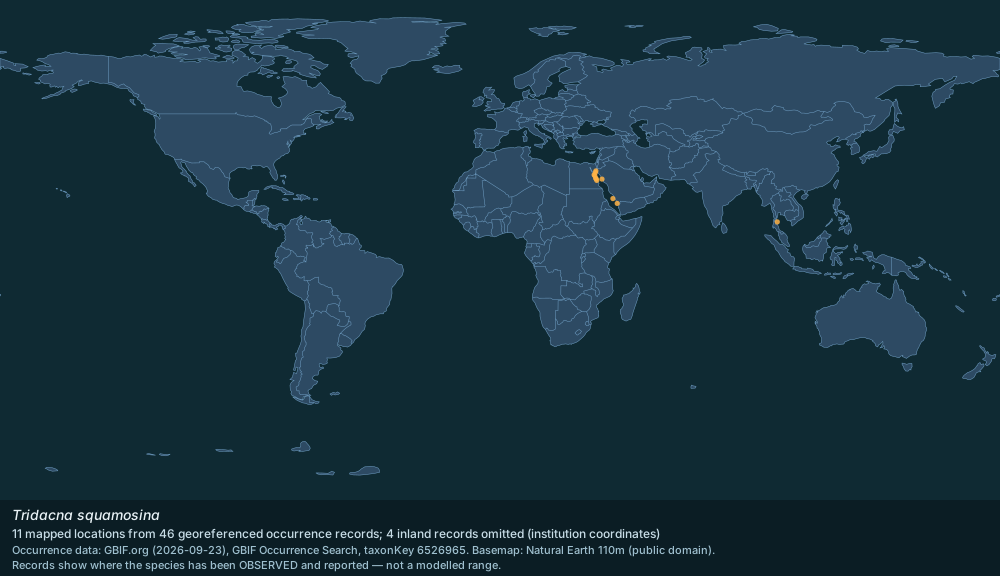
46 georeferenced occurrence records for Tridacna squamosina are published through GBIF from 5 countries or marine areas. The map above plots 11 distinct locations from a sample of 46 records, omitting 4 inland records that carry an institution's coordinates rather than a collection site; it shows where the species has been observed and reported, not a modelled range.
Most records by country or area: Egypt (30); Saudi Arabia (9); Israel (5); Jordan (1); Thailand (1).
Source: GBIF Occurrence Search (taxonKey 6526965) — https://www.gbif.org/occurrence/search?taxon_key=6526965&has_coordinate=true (records CC0 / CC BY); WoRMS distribution records (MarineRegions) — https://www.marinespecies.org/aphia.php?p=taxdetails&id=466758 (CC BY 4.0); Natural Earth 110m basemap — https://www.naturalearthdata.com/ (public domain). Accessed 2026-09-23.
Conservation status (IUCN Red List)
The IUCN Red List assesses Tridacna squamosina Sturany, 1899 as Endangered (code EN). No trend, population estimate or threat analysis is given here, because none is available from this source without the Red List API; follow the source link for the full assessment, including its date.
Source: IUCN Red List of Threatened Species (taxon 96378503) — https://www.iucnredlist.org/species/96378503/0; GBIF IUCN Red List category endpoint (taxonKey 6526965) — https://api.gbif.org/v1/species/6526965/iucnRedListCategory. Accessed 2026-09-23.
Description and natural history (Wikipedia)
In 2008 Roa-Quiaoit, Kochzius, Jantzen, Zibdah & Richter identified what they believed was a new species of giant clam they called Tridacna costata, however in 2011 Markus Huber and Anita Eschner examined a collection of Rudolf Sturanys specimens, held in the Natural History Museum, Vienna, that had remained not properly identified for over 100 years and discovered it was actually Tridacna squamosina. The collection held seven syntypes were identified and Tridacna squamosina was accepted and Tridacna costata formally synonymized.
Tridacna squamosina has is a bivalve mollusk with an elongated. The shell has a few folds compared to other bivalve tridacnas, about 5–7 of the on each shell. The upper shell has somewhat large tooth-like formations projecting form its outer edge. Even when compressed as much as they can be, the T. squamosina has major spaces between the two halves of its shell, especially in the areas of the tooth-like formations. The mollusk also has a well-sized byssus upon its bottom, quite similar to the T. maxima. Common for other bivalve giant clams, the T. squamosina's papillose mantle tissue varies a wide array of hues and colors, which range in various patterns. Unlike the T. maxima or the T. squamosa however, these formations are much more pronounced in the T. squamosina; although some T. maxima and T. squamosa do bear relatively few amounts of papillae. All three's siphon is also ringed with tentacles.
The species is distributed across the Tropical areas of the Indo-Pacific, although when originally formally described it was thought to only exist in the Red Sea where it is actually rare. It inhabits shallow reef areas and various seagrass beds, usually 0–5 m below the surface. T. squamosina is most concentrated around Oceania and Southeast Asia—with the most being around the Philippines and the Malay Archipelago. T. squamosina is also found in areas of the Red Sea. In 2005, a student found a giant clam found in the Gulf of Aqaba. An expedition of the 19th century also collected specimens of the same species in the Gulf of Aqaba and of the coast of modern day Yemen. Yet these were taxonomically identified as the Tridacna elongata with the variation squamosina. The species is also reported to be abundant near the Bazaruto Archipelago off the coast of Southern Mozambique. A survey showed that the T. squamosina makes up only 1% of all tridacnas located in the Red Sea, making the species a rarity in the place they were discovered in. The species also is reported to make up 80% of all tridacnid fossils in the area. This idea leads scientists to believe that the species was heavily hunted nearly 100,000 years ago, when humans had only begun their occupation of the area.
Source: Wikipedia: Tridacna squamosina — https://en.wikipedia.org/wiki/Tridacna_squamosina (CC BY-SA 4.0). Accessed 2026-09-23.
Gallery
Spotted an error? Know more?
Reader corrections go straight into our review queue. Suggest an edit · How this site is sourced