Tridacna
Genus of giant clams with symbiotic algae and CITES protection.

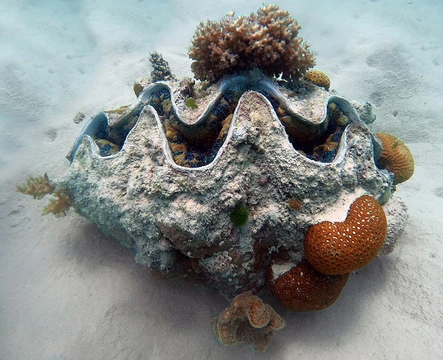
Tridacna is a genus of large, saltwater bivalve molluscs in the subfamily Tridacninae, commonly called giant clams. Many species within this genus are considered threatened. Their shells are heavy and feature four to six folds, while the mantle is often vividly colored. These clams live in the shallow waters of coral reefs across the warm seas of the Indo-Pacific region. They are a popular choice for marine aquariums, and in places like the Philippines, some species are farmed specifically for this trade. The clams rely on a symbiotic relationship with photosynthetic algae known as zooxanthellae. Certain species are also consumed by humans. All Tridacna species are listed under CITES Appendix II.
The name *Tridacna* comes from the Greek words *tri*, meaning three, and *dacno*, meaning bite. In his work *Natural History*, the Roman author Pliny the Elder explained that the name refers to the clams being so large that eating one requires three bites.
The genus includes several species, such as *Tridacna crocea*, *Tridacna derasa*, *Tridacna elongatissima*, *Tridacna gigas*, *Tridacna maxima*, *Tridacna mbalavuana*, *Tridacna noae*, *Tridacna rosewateri*, *Tridacna squamosa*, and *Tridacna squamosina*. An older classification system places *T. derasa* and *T. mbalavuana* in a separate subgenus, Persikima. Recent biochemical studies suggest that some morphologically similar but genetically distinct cryptic species may exist.
Anatomically, the soft mantle that secretes the shell is much larger than in other clams. The mantle contains small, lens-like structures called ocelli, which allow light to pass through.
In terms of ecology and behavior, these clams are common in shallow-water benthic communities on Indo-Pacific coral reefs. They are sessile as adults. During the day, they spread out their mantle so that the symbiotic dinoflagellate algae (genus *Symbiodinium*) living in the tissue can photosynthesize. The pigments in the mantle protect the clam from excessive light and UV radiation. Adult clams obtain 70 to 100 percent of their nutrients from the algae, with the remainder coming from filter feeding. When disturbed, the clam slowly closes its shell; the idea that they pose a serious danger to divers by trapping them is largely unrealistic, as the closing reaction is quite slow.
Quick Facts
- Taxon
- Tridacna
Facts from the source article.
Lore & Background
The name Tridacna arises from Greek words tri, meaning three, and dacno, meaning bite. In the Ancient Roman text Natural History, Pliny the Elder explained the nomenclature comes from the fact that 'they are so large as to require three bites in eating them.' All species in the genus Tridacna are protected under CITES Appendix II. The genus contains ten species including Tridacna gigas, Tridacna maxima, and Tridacna squamosa, among others. An alternative older classification recognises a third subgenus Persikima containing T. derasa and T. mbalavuana. Recent biochemical studies have suggested that there may exist morphologically indistinct cryptic species.
Reader's Guide
Tridacna clams are common inhabitants of Indo-Pacific coral reef benthic communities in shallower waters. They live in symbiosis with photosynthetic dinoflagellate algae (Symbiodinium) that grow in the mantle tissues. Light penetrates the mantle through small lens-like structures called ocelli. They are sessile in adulthood. By day, the clams spread out their mantle so that the algae receive sunlight, while colour pigments protect against excessive light and UV radiation. Adult clams can get most (70–100%) of their nutrients from the algae and the rest from filter feeding. Their large size and easy accessibility has caused overfishing and collapse of natural stocks in many places and extirpation in some species. They are being sustainably farmed in some areas, both for the seafood market and for the aquarium trade. Tridacna clams can produce large white pearls with an undulating, porcelain-like surface, described as 'non-nacreous pearls'. The 'Pearl of Lao Tzu', also known as the 'Pearl of Allah', is the world's largest pearl weighing 6.4 kilogrammes; it was said to have been found inside a Tridacna gigas by a Filipino diver in 1934. Over a hundred examples of carved Tridacna shells have been found in archaeological expeditions from Italy to the Near East, probably produced in the mid-seventh century and used to store eye cosmetics.
Did You Know?
- The name Tridacna comes from Greek words meaning 'three bites,' referencing Pliny the Elder's comment on their size.
- All Tridacna species are protected under CITES Appendix II.
- The world's largest pearl, weighing 6.4 kg, was reportedly found inside a Tridacna gigas.
- Over a hundred carved Tridacna shells have been found in archaeological sites from Italy to the Near East.
More in Giant Clams and Marine Bivalves 1-24
Spotted an error? Know more?
Reader corrections go straight into our review queue. Suggest an edit · How this site is sourced