
Fluted giant clam (Tridacna squamosa)
Source-cited species reference: taxonomy from WoRMS, biology from SeaLifeBase, occurrence map from GBIF, conservation from IUCN Red List, description from Wikipedia.
Tridacna squamosa, known commonly as the fluted giant clam and scaly clam, is a species of bivalve in the family Cardiidae.
- Scientific name
- Tridacna squamosa
- Authority
- Lamarck, 1819
- Family
- Cardiidae
- Order
- Cardiida
- Maximum length
- 45 cm
- Depth range
- 0–42 m
- Habitat zone
- benthic
- Iucn red list
- Least Concern
- Gbif occurrence records
- 4,264
Classification (WoRMS)
Full classification as recorded by WoRMS: Kingdom: Animalia · Phylum: Mollusca · Class: Bivalvia · Order: Cardiida · Family: Cardiidae · Genus: Tridacna.
Accepted name: Tridacna squamosa · Authority: Lamarck, 1819 · Taxonomic status: accepted · AphiaID: 207674.
Synonyms and superseded combinations recorded for this taxon: Tridacna (Chametrachea) squamosa Lamarck, 1819; Tridacna lamarcki Hidalgo, 1903.
Source: World Register of Marine Species (WoRMS) — https://www.marinespecies.org/aphia.php?p=taxdetails&id=207674 (CC BY 4.0). Accessed 2026-09-23.
Biology and life history (SeaLifeBase)
Measured values published by SeaLifeBase for Tridacna squamosa. Only fields the database actually holds for this species are shown; these are database values, not aquarium guidance.
Maximum length: 45 cm · Common length: 30 cm · Depth range: 0–42 m · Habitat zone: benthic · Vulnerability index: 50.5 of 100 · Fishery importance: commercial.
SeaLifeBase notes: Maximum depth from Ref. 87928. In eastern Polynesia, it is known to be restricted to deep water (Ref. 87928). Found in intertidal areas on corals (Ref. 75831). Abundant on outer reef slope (Ref. 2923). Also found in a lagoon (Ref. 87813), on sandy bottoms (Ref. 106695), rubble or in reef pockets (Ref. 2923). Unattached or weakly attached by byssus as an adult (Ref. 2923). Tridacnids derive their nutrition from uptake of dissolved matter through their epidermis and from their symbiotic zooanthella Symbiodinium microadriaticum (Ref. 107098).
Source: SeaLifeBase species summary (SpecCode 83871) — https://www.sealifebase.se/summary/Tridacna-squamosa.html (CC BY-NC 3.0 — non-commercial use only). Accessed 2026-09-23.
Distribution and occurrence records (GBIF)
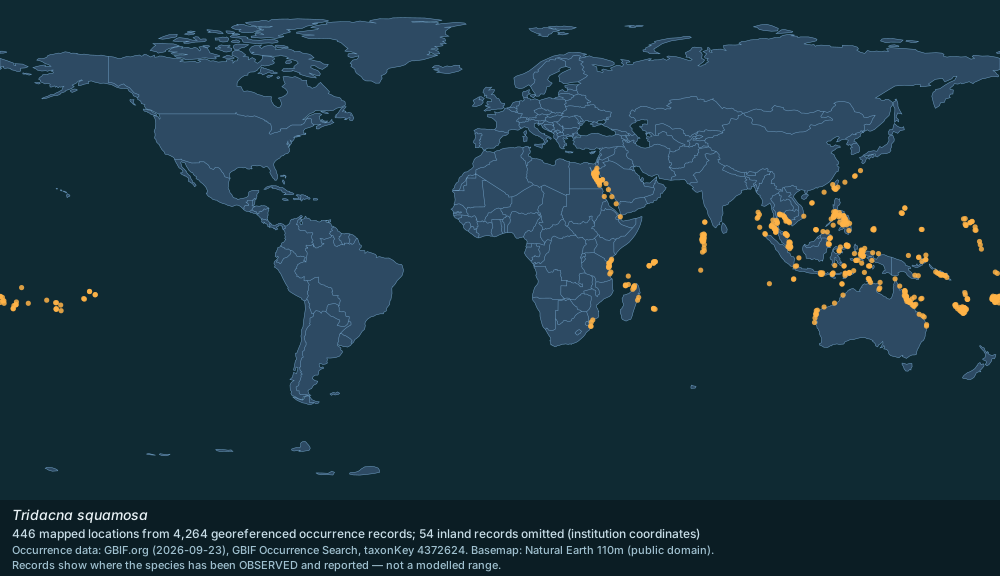
4,264 georeferenced occurrence records for Tridacna squamosa are published through GBIF from 61 countries or marine areas. The map above plots 446 distinct locations from a sample of 3,000 records, omitting 54 inland records that carry an institution's coordinates rather than a collection site; it shows where the species has been observed and reported, not a modelled range.
Most records by country or area: Indonesia (838); Australia (564); New Caledonia (396); Philippines (303); Egypt (280).
The full country table, WoRMS marine regions and the sampling notes are on this species' Distribution page.
Source: GBIF Occurrence Search (taxonKey 4372624) — https://www.gbif.org/occurrence/search?taxon_key=4372624&has_coordinate=true (records CC0 / CC BY); WoRMS distribution records (MarineRegions) — https://www.marinespecies.org/aphia.php?p=taxdetails&id=207674 (CC BY 4.0); Natural Earth 110m basemap — https://www.naturalearthdata.com/ (public domain). Accessed 2026-09-23.
Conservation status (IUCN Red List)
The IUCN Red List assesses Tridacna squamosa Lamarck, 1819 as Least Concern (code LC). No trend, population estimate or threat analysis is given here, because none is available from this source without the Red List API; follow the source link for the full assessment, including its date.
Source: IUCN Red List of Threatened Species (taxon 22140) — https://www.iucnredlist.org/species/22140/0; GBIF IUCN Red List category endpoint (taxonKey 4372624) — https://api.gbif.org/v1/species/4372624/iucnRedListCategory. Accessed 2026-09-23.
Description and natural history (Wikipedia)
It is one of a number of large clam species native to the shallow coral reefs of the South Pacific and Indian Oceans. It is distinguished by the large, leaf-like fluted edges on its shell called 'scutes' and a byssal opening that is small compared to those of other members of the subfamily Tridacninae. Normal coloration of the mantle ranges from browns and purples to greens and yellows arranged in elongated linear or spot-like patterns. Tridacna squamosa grows to 40 cm across.
Sessile in adulthood, the clam's mantle tissues act as a habitat for the symbiotic single-celled dinoflagellate algae (zooxanthellae) from which it gets a major portion of its nutrition. By day, the clam spreads out its mantle tissue so that the algae receive the sunlight they need to photosynthesize.
The native range spans from South Africa to the Red Sea, and to the Marshall Islands.
Tridacna squamosa is sometimes kept in aquaria, where it requires moderate care. This species is a relatively hardy member of the Tridacnidae.
A moderate amount of light is required by this species because it relies on zooxanthellae for part of its nutrition. These dinoflagellates use the mantle as a habitat. However, it is not nearly as dependent on this photosynthesis as other tridacnids such as Tridacna crocea or T. maxima, and it also consumes phytoplankton to complete its diet.
Tridacna squamosa is a peaceful resident and does not harm other organisms, in the wild or otherwise. Despite its ability to shut completely, anemones, triggerfish, and puffers may be predators in a domestic environment. It is also recommended not to be kept with anemones as the anemone may move close to the clam and sting or eat it. Clams should be inspected for Pyramidellidae snails and quarantined, if possible, before being added to aquaria.
In aquaria, it should be kept lower in the display. Although some specimens prefer lying in the substrate they will occasionally attach their byssal threads to rocks above the substrate.
All clams require good to excellent water quality but may help reduce nitrate levels in a system. Clams are noted to consume free nitrates to a degree.
The International Union for the Conservation of Nature lists this clam as least concern The species is listed in Appendix II of the Convention on International Trade in Endangered Species (CITES) meaning international trade (including in parts and derivatives) is regulated.
Source: Wikipedia: Tridacna squamosa — https://en.wikipedia.org/wiki/Tridacna_squamosa (CC BY-SA 4.0). Accessed 2026-09-23.
Gallery
Related in Fluted giant clam
Links follow this subject's own source article.
Elsewhere in Fluted giant clam
Spotted an error? Know more?
Reader corrections go straight into our review queue. Suggest an edit · How this site is sourced