
Smooth giant clam (Tridacna derasa)
Source-cited species reference: taxonomy from WoRMS, biology from SeaLifeBase, occurrence map from GBIF, conservation from IUCN Red List, description from Wikipedia.
Tridacna derasa, the southern giant clam or smooth giant clam, is a species of extremely large marine clam in the family Cardiidae.
- Scientific name
- Tridacna derasa
- Authority
- (Röding, 1798)
- Family
- Cardiidae
- Order
- Cardiida
- Maximum length
- 60 cm
- Depth range
- 0–20 m
- Habitat zone
- benthic
- Iucn red list
- Endangered
- Gbif occurrence records
- 792
Classification (WoRMS)
Full classification as recorded by WoRMS: Kingdom: Animalia · Phylum: Mollusca · Class: Bivalvia · Order: Cardiida · Family: Cardiidae · Genus: Tridacna.
Accepted name: Tridacna derasa · Authority: (Röding, 1798) · Taxonomic status: accepted · AphiaID: 382205.
Synonyms and superseded combinations recorded for this taxon: Persikima whitleyi Iredale, 1937; Tridachnes derasa Röding, 1798; Tridacna (Persikima) derasa (Röding, 1798); Tridacna glabra Link, 1807; Tridacna obesa G. B. Sowerby III, 1899; Tridacna serrifera Lamarck, 1819.
Source: World Register of Marine Species (WoRMS) — https://www.marinespecies.org/aphia.php?p=taxdetails&id=382205 (CC BY 4.0). Accessed 2026-09-23.
Biology and life history (SeaLifeBase)
Measured values published by SeaLifeBase for Tridacna derasa. Only fields the database actually holds for this species are shown; these are database values, not aquarium guidance.
Maximum length: 60 cm · Common length: 50 cm · Depth range: 0–20 m · Habitat zone: benthic · Vulnerability index: 56.8 of 100 · Fishery importance: commercial.
SeaLifeBase notes: Locally exploited for meat and shell. This species was previously quite abundant, but has been over collected in many areas. Aquaculture attempts being made (Ref. 348). Found in intertidal areas on corals (Ref. 75831), mainly on reef flats, barrier reefs, fore reefs and atoll lagoons (Ref. 117184). Common in shallow waters wherein juveniles are byssally attached to the tops and sides of coral outcrops. Adults are thought to detach their byssus and settle in clear ocean conditions at 20 m depth (Ref. 101207).
Source: SeaLifeBase species summary (SpecCode 83868) — https://www.sealifebase.se/summary/Tridacna-derasa.html (CC BY-NC 3.0 — non-commercial use only). Accessed 2026-09-23.
Distribution and occurrence records (GBIF)
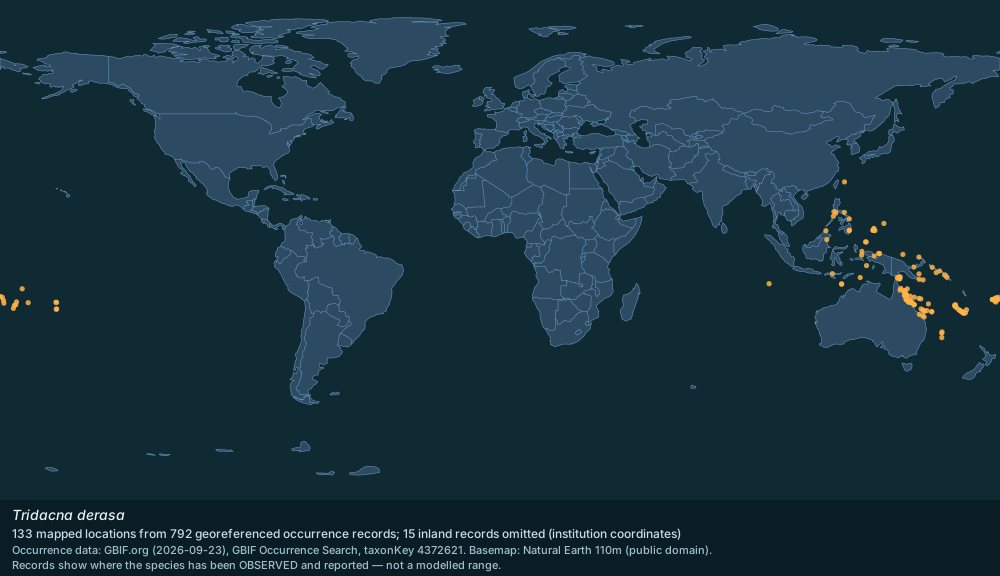
792 georeferenced occurrence records for Tridacna derasa are published through GBIF from 16 countries or marine areas. The map above plots 133 distinct locations from a sample of 792 records, omitting 15 inland records that carry an institution's coordinates rather than a collection site; it shows where the species has been observed and reported, not a modelled range.
Most records by country or area: Australia (490); New Caledonia (119); Palau (68); Fiji (26); Papua New Guinea (20); Indonesia (15); Cook Islands (13); Solomon Islands (8); Philippines (7); Tonga (7); Niue (5); Japan (4); Samoa (4); Cocos (Keeling) Islands (2); Micronesia (Federated States of) (2).
Marine regions with a valid WoRMS distribution record: Indonesian Exclusive Economic Zone; West Pacific.
Source: GBIF Occurrence Search (taxonKey 4372621) — https://www.gbif.org/occurrence/search?taxon_key=4372621&has_coordinate=true (records CC0 / CC BY); WoRMS distribution records (MarineRegions) — https://www.marinespecies.org/aphia.php?p=taxdetails&id=382205 (CC BY 4.0); Natural Earth 110m basemap — https://www.naturalearthdata.com/ (public domain). Accessed 2026-09-23.
Conservation status (IUCN Red List)
The IUCN Red List assesses Tridacna derasa (Röding, 1798) as Endangered (code EN). No trend, population estimate or threat analysis is given here, because none is available from this source without the Red List API; follow the source link for the full assessment, including its date.
Source: IUCN Red List of Threatened Species (taxon 22136) — https://www.iucnredlist.org/species/22136/0; GBIF IUCN Red List category endpoint (taxonKey 4372621) — https://api.gbif.org/v1/species/4372621/iucnRedListCategory. Accessed 2026-09-23.
Description and natural history (Wikipedia)
The southern giant clam is one of the largest of the "giant clams", reaching up to 60 cm in length. The species is also known as the smooth giant clam because of the relative lack of ribbing and scales on its thick shell. The smoothness of the southern giant clam's shell and its six to seven vertical folds help to distinguish it from its larger relative, Tridacna gigas, which has four to five folds and a rougher texture. Lack of scutes (scale-like protrusions of the shell) that are present in most other Tridacna species is a defining characteristic of this species, although in aquacultures specimens have been observed to develop scutes in at least one abnormal case. The mantle usually has a pattern of wavy stripes or spots, and may be various mixtures of orange, yellow, black and white, often with brilliant blue or green lines. Derasa produce the color white in their mantle using multi-colored crystalline pigment cells, while T. maxima cluster red, blue and green cells.
The southern giant clam is native to waters around Australia, Cocos Islands, Fiji, Indonesia, New Caledonia, Palau, Papua New Guinea, Philippines, Solomon Islands, Tonga and Vietnam. Populations have also been introduced to American Samoa, Cook Islands, Marshall Islands and Samoa, and reintroduced after extinction in Guam, the Federated States of Micronesia and Northern Mariana Islands. The southern giant clam is found on the outer edges of reefs at depths of 4 to 10 meters.
The Tridacna clam has muscles for opening and closing its shell and a foot for attaching to reef substrate. It respires through gills and feeds through a mouth. Most clams fulfill their nutritional requirements by filter feeding and absorbing dissolved organic compounds from the water, but Tridacna clams have gone further than this by using photosymbiotic algae, zooxanthellae, in their tissues to provide food for them. Through photosynthesis the zooxanthellae transform carbon dioxide and dissolved nitrogen, such as ammonium, into carbohydrates and other nutrients for their hosts.
When Tridacna clams first attain sexual maturity they are male, but about a year later become hermaphrodites, possessing both male and female reproductive organs. However, the release of sperm and eggs are separate in order to prevent self-fertilisation, although self-fertilisation can occur. The breeding season of the southern giant clam usually occurs in spring and summer, although they may be induced to spawn through the year.
The southern giant clam is classified as Vulnerable (VU) on the IUCN Red List, and is listed on Appendix II of CITES. The southern giant clam is a popular food item and aquarium species, and has therefore been hunted extensively throughout its natural habitat. However, specimens traded today tend to be the result of aquaculture farms rather than wild-caught individuals, because the southern giant clam was one of the first clams to be bred commercially. This occurred at the MMDC Giant Clam Hatchery in Palau, which focused on Tridacna derasa in pioneering large-scale developments.
Source: Wikipedia: Tridacna derasa — https://en.wikipedia.org/wiki/Tridacna_derasa (CC BY-SA 4.0). Accessed 2026-09-23.
Gallery
Spotted an error? Know more?
Reader corrections go straight into our review queue. Suggest an edit · How this site is sourced