Where Tomato clownfish has been recorded
GBIF occurrence records for Amphiprion frenatus, mapped and tabulated by country.

1,186 georeferenced occurrence records with coordinates are published for Amphiprion frenatus through GBIF, from 18 countries or marine areas. This page maps those records and lists where they come from. Occurrence records reflect where people have looked as well as where the species lives, so well-surveyed coastlines are over-represented.
- Georeferenced records
- 1,186
- Countries / areas
- 18
- Mapped locations
- 120
- Records sampled for the map
- 1,186
- Inland records omitted
- 20
- Gbif taxonkey
- 5212111
The Anemone Partnership
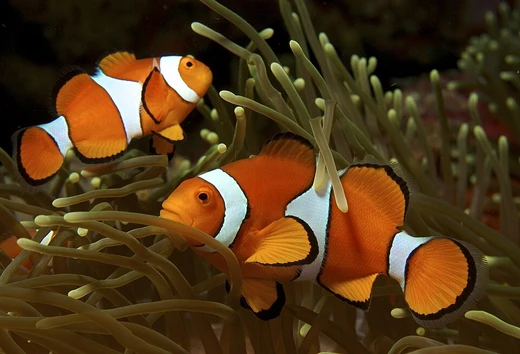
Clownfish occupy the warm, tropical waters stretching across the Indo-Pacific, where they anchor their lives to coral reef ecosystems. At the heart of their existence lies one of marine biology's most celebrated partnerships: a mutually beneficial bond with sea anemones. The anemone provides a living fortress, shielding the small fish from predators that would otherwise make reef life far more dangerous. In exchange, the clownfish acts as a dedicated caretaker. It wards off anemone-eating fish that might strip the host of its tentacles, fans water across the anemone's surface to keep it oxygenated, and performs regular cleaning. Even the clownfish's waste plays a constructive role, drawing in beneficial microorganisms that enrich the anemone's immediate environment. This interdependence is so fundamental that juvenile clownfish, after drifting as larvae in the open ocean, actively search for an anemone host upon settling to the seafloor, underscoring how central this relationship is to their survival.
Social Order and the Fluidity of Sex
Within a clownfish group, a strict size-based pecking order governs every interaction. The breeding female sits at the apex, followed by the breeding male, then non-breeding members ranked from largest to smallest. This hierarchy is not static; it is a living system that reshapes itself when the dominant female vanishes. In that moment, the breeding male undergoes a complete sex change, assuming the female's role while the remaining individuals shift upward in rank. Reproduction follows a set ritual: the female lays her eggs on a rock positioned near their shared anemone, and the male fertilises them. Once the eggs hatch, the young scatter into the open ocean as tiny larvae, spending a dispersal phase far from the reef before eventually settling to the bottom as juveniles. As for feeding, clownfish are omnivorous, drawing most of their nutrition from plankton. The smallest members of a group can measure as little as six to fifteen millimetres, while the maroon clownfish, the largest species, can grow to one hundred and sixty millimetres.
A Taxonomic Odyssey
The classification of clownfish has been a story of ongoing revision. The genus Amphiprion was established in 1801 by Bloch and Schneider, using the red saddleback anemonefish as the type species, with the name derived from Greek words meaning 'on both sides' and 'saw'—a reference to the saw-shaped edges along the gill cover. For over two centuries, the maroon clownfish occupied a contested position: Cuvier proposed its own genus Premnas in 1816, and the taxon bounced between synonymy and independent status until 2021, when two broad phylogenetic analyses confirmed it belongs within Amphiprion. Gerald Allen carved out the subfamily Amphiprioninae in 1975, and a 2009 genetic study proposed the tribe Amphiprionini. On the evolutionary front, the clownfish lineage split from other damselfishes roughly thirty-five million years ago in the late Eocene, with the most recent common ancestor of all living species dating to about ten and a half million years ago. A 2014 study traced their origin to the Malay Archipelago, and a burst of diversification around five million years ago produced two major adaptive radiations, one in the Malay Archipelago and a later one in the western Indian Ocean.
Spotlight, Aquarium, and the Threat of Warming Seas
The bold colouration and social charm of clownfish have made them icons far beyond the reef. Their most famous appearance came in the 2003 Disney-Pixar film Finding Nemo, which introduced the species to a global audience and cemented their place in popular culture. In the aquarium trade, the ocellaris clownfish stands out as one of the most commonly sold marine fish. Yet this very popularity carries a cost: many captive specimens were harvested from the wild, contributing to measurable population declines. Marine protected areas, where collection is prohibited, have shown that clownfish populations can be more robust when left undisturbed. Beyond direct harvesting, the broader threat of climate change looms large. Global warming drives both ocean temperature increases and acidification, conditions that stress coral reef ecosystems and, by extension, the anemone hosts that clownfish depend on for survival. The interplay between human fascination and ecological vulnerability makes clownfish a compelling case study in conservation.
Related in Tomato clownfish
Links follow this subject's own source article.
Elsewhere in Tomato clownfish
Spotted an error? Know more?
Reader corrections go straight into our review queue. Suggest an edit · How this site is sourced