Indonesian sharpnose ray (Telatrygon biasa)
Source-cited species reference: taxonomy from WoRMS, biology from FishBase, occurrence map from GBIF, conservation from IUCN Red List, description from Wikipedia.
Last updated

Distribution map plotted from GBIF.org occurrence records; basemap Natural Earth 110m · GBIF records CC0 / CC BY; Natural Earth public domain
Telatrygon biasa, the Indonesian sharpnose ray, is a type of whiptail stingray identified from many reported specimens in the Indo-Malay Archipelago (including Indonesia, Malaysia, Singapore, Brunei, and Thailand). It inhabits shallow coastal region up to approximately 40 meters depth. It is currently experiencing population decrease due to being captured by small-scale local fisheries and retained as human consumption.
Scientific classification
- KingdomAnimalia
- PhylumChordata
- ClassChondrichthyes
- SubclassElasmobranchii
- OrderMyliobatiformes
- FamilyDasyatidae
- GenusTelatrygon
- SpeciesTelatrygon biasa
Named by Last, W. T. White, & Naylor, 2016
Close relatives
Other species of Telatrygon with a Codexery entry.
- Pale-edged stingray (Telatrygon zugei) Telatrygon zugei
- Telatrygon acutirostra Telatrygon acutirostra
Sources: Wikipedia taxobox: Telatrygon biasa (CC BY-SA 4.0) · order, family and genus agree with WoRMS AphiaID 1043626 (CC BY 4.0)
Conservation status
Vulnerable (VU)
- LC
- NT
- VU▲ this species
- EN
- CR
- EW
- EX
Source: IUCN Red List assessment · GBIF copy of the Red List category
How big is it?
Largest length in the source, 0.29 m, next to a 1.8 m person.
Diagram: drawn by Codexery, schematic shapes to scale (not a likeness). Length: FishBase species summary
Where the indonesian sharpnose ray (telatrygon biasa) has been recorded
Each dot is a place where the species has been observed and reported (20 records, half-degree grid) — not a modelled range. 5 inland records left out (institution coordinates).
Map: drawn by Codexery. Data: GBIF occurrence search (records CC0 / CC BY) · Natural Earth basemap (public domain) · place coordinates: Wikipedia (CC BY-SA 4.0)
Classification (WoRMS)
Full classification as recorded by WoRMS: Kingdom: Animalia · Phylum: Chordata · Class: Elasmobranchii · Order: Myliobatiformes · Family: Dasyatidae · Genus: Telatrygon.
Accepted name: Telatrygon biasa · Authority: Last, White & Naylor, 2016 · Taxonomic status: accepted · AphiaID: 1043626.
Source: World Register of Marine Species (WoRMS) — https://www.marinespecies.org/aphia.php?p=taxdetails&id=1043626 (CC BY 4.0). Accessed 2026-09-25.
Biology and life history (FishBase)
Measured values published by FishBase for Telatrygon biasa. Only fields the database actually holds for this species are shown; these are database values, not aquarium guidance.
Maximum length: 28.700000762939453 cm · Habitat zone: pelagic-neritic · Body shape: other · Vulnerability index: 90 of 100 · Aquarium trade: never/rarely.
FishBase notes: Demersal on the continental and insular shelves of up to approximately 40 m depth. Birth size is 7.0 - 9.0 cm WD (Ref. 110363).
Source: FishBase species summary (SpecCode 68036) — https://www.fishbase.se/summary/Telatrygon-biasa.html (CC BY-NC 3.0 — non-commercial use only). Accessed 2026-09-25.
Distribution and occurrence records (GBIF)
20 georeferenced occurrence records for Telatrygon biasa are published through GBIF from 4 countries or marine areas. The map above plots 4 distinct locations from a sample of 20 records, omitting 5 inland records that carry an institution's coordinates rather than a collection site; it shows where the species has been observed and reported, not a modelled range.
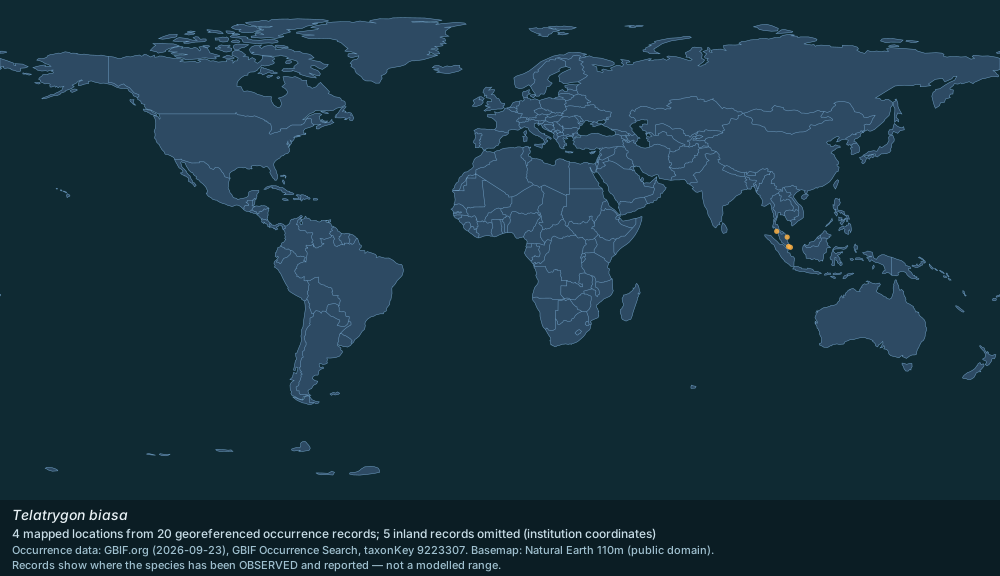
Most records by country or area: Malaysia (14); Singapore (3); Thailand (2); Indonesia (1).
Source: GBIF Occurrence Search (taxonKey 9223307) — https://www.gbif.org/occurrence/search?taxon_key=9223307&has_coordinate=true (records CC0 / CC BY); WoRMS distribution records (MarineRegions) — https://www.marinespecies.org/aphia.php?p=taxdetails&id=1043626 (CC BY 4.0); Natural Earth 110m basemap — https://www.naturalearthdata.com/ (public domain). Accessed 2026-09-25.
Conservation status (IUCN Red List)
The IUCN Red List assesses Telatrygon biasa Last, White & Naylor, 2016 as Vulnerable (code VU). No trend, population estimate or threat analysis is given here, because none is available from this source without the Red List API; follow the source link for the full assessment, including its date.
Source: IUCN Red List of Threatened Species (taxon 116855963) — https://www.iucnredlist.org/species/116855963/0; GBIF IUCN Red List category endpoint (taxonKey 9223307) — https://api.gbif.org/v1/species/9223307/iucnRedListCategory. Accessed 2026-09-25.
Description and natural history (Wikipedia)
The fish's name is an Indonesian and Malaysian word meaning “ordinary, common or normal,” referring to its frequent occurrence in the local fish markets of the western North Pacific
This sharpnose ray has several characteristics, including relatively short snout and disc, small eyes, 107-114 pectoral radials, and 85-94 vertebral centra in total. It can reach the maximum size of 29 cm disc width, while the birth size is around 7-9 cm disc width.
This demersal species is found living at the depths of up to 40 m in the coastal regions of Indonesia (Sumatra, Java, Borneo, and Bali), Malaysia (Malay Peninsula, Sabah, and Sarawak), Singapore, Brunei Darussalam, and Thailand.
Indonesian sharpnose rays are often caught by local or national fisheries as fresh or salted seafood delicacies for local communities. Its species name "biasa", meaning "ordinary" in Malay and Indonesian, might suggest that this ray is commonly consumed and found in local fish markets.
Source: Wikipedia: Telatrygon biasa — https://en.wikipedia.org/wiki/Telatrygon_biasa (CC BY-SA 4.0). Accessed 2026-09-25.
Sources
Compiled from Wikipedia and the sources listed below. Text from Wikipedia is available under CC BY-SA 4.0; this entry is adapted from it.
- Wikipedia: Telatrygon biasa (CC BY-SA 4.0).
- Classification: the source article's taxobox; order, family and genus checked against WoRMS, the World Register of Marine Species (CC BY 4.0).
- Conservation status: IUCN Red List assessment.
- Occurrence records: GBIF (CC0 / CC BY). Basemap: Natural Earth (public domain).
- Biology values: FishBase species summary (CC BY-NC 3.0, non-commercial).
- Word definitions: the , each quoted from its Wikipedia article.
Spotted an error? Know more?
Reader corrections go straight into our review queue. Suggest an edit · How this site is sourced