Synaptula spinifera
Source-cited species reference: taxonomy from WoRMS, biology from SeaLifeBase, occurrence map from GBIF, description from Wikipedia.
Last updated

Distribution map plotted from GBIF.org occurrence records; basemap Natural Earth 110m · GBIF records CC0 / CC BY; Natural Earth public domain
Synaptula spinifera is a species of sea cucumber from the family Synaptidae, the worm-like sea cucumbers. The species was first described from the anchialine lagoon of Kakaban island, part of Indonesia's Derawan Islands, and is thought to be endemic to that waterbody.
Scientific classification
- KingdomAnimalia
- PhylumEchinodermata
- ClassHolothuroidea
- OrderApodida
- FamilySynaptidae
- GenusSynaptula
- SpeciesSynaptula spinifera
Named by Massin & Tomascik, 1996
Close relatives
Other species of Synaptula with a Codexery entry.
- Synaptula lamperti Synaptula lamperti
- Synaptula recta Synaptula recta
Sources: Wikipedia taxobox: Synaptula spinifera (CC BY-SA 4.0) · order, family and genus agree with WoRMS AphiaID 529027 (CC BY 4.0)
How big is it?
Largest length in the source, 0.09 m, next to a 1.8 m person.
Diagram: drawn by Codexery, schematic shapes to scale (not a likeness). Length: SeaLifeBase species summary
Where the synaptula spinifera has been recorded
Each dot is a place where the species has been observed and reported (26 records, half-degree grid) — not a modelled range.
Map: drawn by Codexery. Data: GBIF occurrence search (records CC0 / CC BY) · Natural Earth basemap (public domain) · place coordinates: Wikipedia (CC BY-SA 4.0)
Quick Facts
- Authority
- Massin & Tomascik, 1996
- Family
- Synaptidae
- Order
- Apodida
- Maximum length
- 8.5 cm / 3.35 in
- Habitat zone
- benthic
- Gbif occurrence records
- 26
Facts from the source article.
Classification (WoRMS)
Full classification as recorded by WoRMS: Kingdom: Animalia · Phylum: Echinodermata · Class: Holothuroidea · Order: Apodida · Family: Synaptidae · Genus: Synaptula.
Accepted name: Synaptula spinifera · Authority: Massin & Tomascik, 1996 · Taxonomic status: accepted · AphiaID: 529027.
Source: World Register of Marine Species (WoRMS) — https://www.marinespecies.org/aphia.php?p=taxdetails&id=529027 (CC BY 4.0). Accessed 2026-09-25.
Biology and life history (SeaLifeBase)
Measured values published by SeaLifeBase for Synaptula spinifera. Only fields the database actually holds for this species are shown; these are database values, not aquarium guidance.
Maximum length: 8.5 cm · Habitat zone: benthic · Vulnerability index: 10 of 100.
Source: SeaLifeBase species summary (SpecCode 84750) — https://www.sealifebase.se/summary/Synaptula-spinifera.html (CC BY-NC 3.0 — non-commercial use only). Accessed 2026-09-25.
Distribution and occurrence records (GBIF)
26 georeferenced occurrence records for Synaptula spinifera are published through GBIF from 1 countries or marine areas. The map above plots 2 distinct locations from a sample of 26 records; it shows where the species has been observed and reported, not a modelled range.
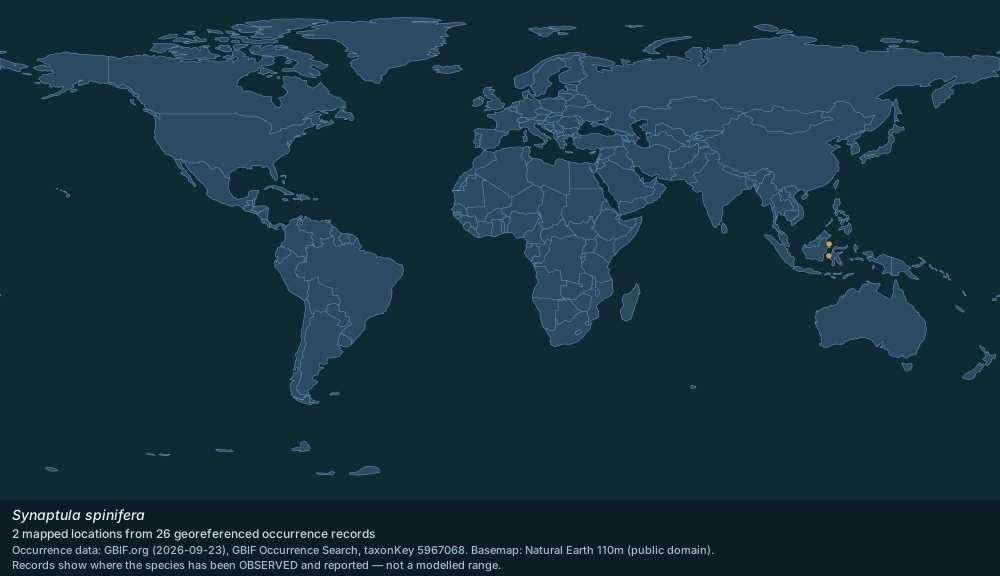
Most records by country or area: Indonesia (26).
Source: GBIF Occurrence Search (taxonKey 5967068) — https://www.gbif.org/occurrence/search?taxon_key=5967068&has_coordinate=true (records CC0 / CC BY); WoRMS distribution records (MarineRegions) — https://www.marinespecies.org/aphia.php?p=taxdetails&id=529027 (CC BY 4.0); Natural Earth 110m basemap — https://www.naturalearthdata.com/ (public domain). Accessed 2026-09-25.
Description and natural history (Wikipedia)
S. spinifera is a small species of holothurian, with the biggest of the preserved specimens being 85 mm long and 8 mm in diameter. In life, they are various hues of brown-red with white-colored very fine longitudinal lines and small dots. There are 13 tentacles on its anterior end, each possessing 18 to 22 digitations which are united by a web. Akin to other members of its order, these tentacles are used for feeding, and this species is primarily a suspension feeder.
Within its body, a "very large" or prominent cartilagenous ring encloses the white calcareous ring. The species' ossicles have a few forms, being anchors, anchor-plates, and miliary granules, though the granules are often absent. Ossicles are spread throughout the body wall but are absent in the tentacles. The specific name spinifera refers to the long spine on the bridge of the anchor-plate.
Habitat
Synaptula spinifera inhabits the lagoon of Kakaban Island, which is completely encircled by a densely vegetated limestone ridge; being anchialine, its only connection to the sea is through submarine connections through the porous carbonate rock and small fissures. Prehistorically an atoll, the island was uplifted 40 - 60 m above today's sea level, which isolated the lagoon's ecosystem. The salinity of the lagoon is lower than that of seawater, being 26-28 psu (physical salinity units). Echinoderms and especially holothurians appear to be sensitive to low salinities, so it is proposed that the species currently inhabiting the lagoon gradually adapted to the changing conditions after it was uplifted, and are the remnants of an initially more diverse fauna.
This holothurian species is found throughout the 1.5 lagoon, often being found between the thalli of the dominant Halimeda algae or upon Enteromorpha clathrata which often grows on the Halimeda. S. spinifera is found at depths of between 0.25 to 8 m, with a density of 20-34 individuals per m² in the Halimeda "meadows". The species may also live on the roots of Rhizophora mangroves that fringe the lagoon, which are often overgrown with epiphytic algae and invertebrates, such as encrusting sponges.
Extensive surveys of the outer reef of Kakaban atoll, part of the surrounding marine ecosystem, have failed to find Synaptula spinifera, suggesting that it is endemic to the isolated lagoon within Kakaban.
Source: Wikipedia: Synaptula spinifera — https://en.wikipedia.org/wiki/Synaptula_spinifera (CC BY-SA 4.0). Accessed 2026-09-25.
Sources
Compiled from Wikipedia and the sources listed below. Text from Wikipedia is available under CC BY-SA 4.0; this entry is adapted from it.
- Wikipedia: Synaptula spinifera (CC BY-SA 4.0).
- Classification: the source article's taxobox; order, family and genus checked against WoRMS, the World Register of Marine Species (CC BY 4.0).
- Occurrence records: GBIF (CC0 / CC BY). Basemap: Natural Earth (public domain).
- Biology values: SeaLifeBase species summary (CC BY-NC 3.0, non-commercial).
- Word definitions: the , each quoted from its Wikipedia article.
Spotted an error? Know more?
Reader corrections go straight into our review queue. Suggest an edit · How this site is sourced