
Maculated synaptid (Synapta maculata)
Source-cited species reference: taxonomy from WoRMS, biology from SeaLifeBase, occurrence map from GBIF, description from Wikipedia.

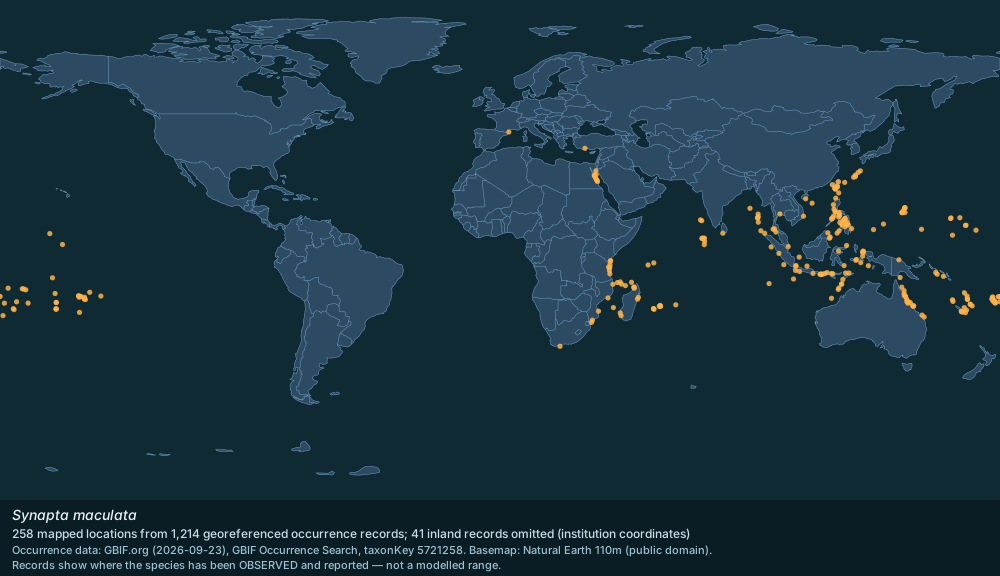
Distribution map plotted from GBIF.org occurrence records; basemap Natural Earth 110m · GBIF records CC0 / CC BY; Natural Earth public domain
Synapta maculata, the snake sea cucumber, is a species of sea cucumber in the family Synaptidae. It is found in shallow waters in the tropical Indo-Pacific Ocean. Sometimes growing as long as 3 m, it is one of the longest sea cucumbers in the world.
- Scientific name
- Synapta maculata
- Authority
- (Chamisso & Eysenhardt, 1821)
- Family
- Synaptidae
- Order
- Apodida
- Maximum length
- 200 cm
- Depth range
- 0–25 m
- Habitat zone
- benthic
- Gbif occurrence records
- 1,214
Classification (WoRMS)
Full classification as recorded by WoRMS: Kingdom: Animalia · Phylum: Echinodermata · Class: Holothuroidea · Order: Apodida · Family: Synaptidae · Genus: Synapta.
Accepted name: Synapta maculata · Authority: (Chamisso & Eysenhardt, 1821) · Taxonomic status: accepted · AphiaID: 210974.
Synonyms and superseded combinations recorded for this taxon: Fistularia doreyana Quoy & Gaimard, 1834; Holothuria (Fistularia) oceanica Lesson, 1830; Holothuria (Tiedemannia) beselii Jaeger, 1833; Holothuria maculata Chamisso & Eysenhardt, 1821; Oncinolabes fuscescans Brandt, 1835; Synapta agassizii Selenka, 1867; Synapta astrolabi Held, 1857; Synapta beselii (Jaeger, 1833); Synapta mammillosa Eschscholtz, 1829; Synapta oceanica (Lesson, 1830).
Source: World Register of Marine Species (WoRMS) — https://www.marinespecies.org/aphia.php?p=taxdetails&id=210974 (CC BY 4.0). Accessed 2026-09-23.
Biology and life history (SeaLifeBase)
Measured values published by SeaLifeBase for Synapta maculata. Only fields the database actually holds for this species are shown; these are database values, not aquarium guidance.
Maximum length: 200 cm · Depth range: 0–25 m · Habitat zone: benthic · Vulnerability index: 90 of 100 · Aquarium trade: never/rarely.
SeaLifeBase notes: Occurs on sandy areas (Ref. 115900), seagrass beds or under rocks on reef flats (Ref. 118). Feeds on organic material gathered using its tentacles (Ref. 800).
Source: SeaLifeBase species summary (SpecCode 86839) — https://www.sealifebase.se/summary/Synapta-maculata.html (CC BY-NC 3.0 — non-commercial use only). Accessed 2026-09-23.
Distribution and occurrence records (GBIF)
1,214 georeferenced occurrence records for Synapta maculata are published through GBIF from 51 countries or marine areas. The map above plots 258 distinct locations from a sample of 1,214 records, omitting 41 inland records that carry an institution's coordinates rather than a collection site; it shows where the species has been observed and reported, not a modelled range.
Most records by country or area: Philippines (135); Fiji (125); Indonesia (124); French Polynesia (107); Australia (85).
The full country table, WoRMS marine regions and the sampling notes are on this species' Distribution page.
Source: GBIF Occurrence Search (taxonKey 5721258) — https://www.gbif.org/occurrence/search?taxon_key=5721258&has_coordinate=true (records CC0 / CC BY); WoRMS distribution records (MarineRegions) — https://www.marinespecies.org/aphia.php?p=taxdetails&id=210974 (CC BY 4.0); Natural Earth 110m basemap — https://www.naturalearthdata.com/ (public domain). Accessed 2026-09-23.
Description and natural history (Wikipedia)
S. maculata is a long, slender sea cucumber with fifteen tentacles, growing to a length of about 2 m. Although not the heaviest or bulkiest sea cucumber in the world, it is probably the longest, with individuals exceptionally reaching to over 3 m. Its colouring is variable, being some shade of yellowish-brown with wide longitudinal stripes and patches of darker colour. The ossicles (microscopic calcareous spike-like structures that support the body wall) are large and shaped like anchors and are used in locomotion; they can be as long as 2 mm. The ossicles are adhesive, and the sea cucumber is very difficult to detach from a wetsuit.
The species is native to the tropical western Indo-Pacific region. It occurs at depths down to about 20 m on reefs and on soft sediments on the seabed among seagrasses and seaweeds. It can also bury itself under rubble.
The tentacles of Synapta maculata surround the mouth and are used in surface feeding. They are about 2.5 cm long when extended and have a short stem and a feather-like blade with thirty to forty pairs of pinnules. The outer surfaces of the tentacles have numerous bulges and are adhesive while the inner surfaces are smooth, with clusters of cilia on the proximal parts. The tentacles are in continuous motion; they flatten themselves against the substrate or seagrass leaf blades and collect food particles by adhesion, then bend inwards until the tips are in the mouth, where the food is scraped off by the buccal sphincter muscle. The whole process takes only a few seconds, and several tentacles can deliver their loads at the same time. If the animal is disturbed, the tentacles can contract back into the pharynx, but before long they are out again, collecting more particles.
The outer surface of the tentacles bears numerous vesicular cells, and there are a few scattered vesicles on the body surface also. The function of these cells is unclear, but it is suggested that they may contain a noxious substance and serve a defensive function. The tentacles are particularly vulnerable to predation by fish, but if they taste nasty, that enables the sea cucumber to spend a greater proportion of its time feeding, rather than having to keep retracting its tentacles whenever a fish approaches. There are also some cup-shaped structures on the inside of the tentacles near the stem. It is hypothesized that these are rudimentary sensory organs, able to taste the edibility of the food material that the animal is transporting to its mouth.
A defensive response made by many sea cucumbers is evisceration, but in the case of S. maculata, autotomy is preferred, with large individuals dispensing with sections near the rear end while smaller individuals break into many pieces. Two previously unknown triterpene holostane glycosides have been isolated from S. maculata; one has moderate activity against HeLa tumour cells while the other is inactive.
Naturalist Gerald Durrell's 1977 observations of this creature were made when he was snorkeling in shallow water in Mauritius:
"At first, I could not believe that these weird objects were alive. I thought they must be strange, dead strands of some deep-sea seaweed now washed into the shallows by the tide, to roll and undulate helplessly on the sand to the small movements of the sea. Closer inspection showed me that they were indeed alive, unlikely though it seemed. Sinucta muculata, as this strange creature is called, is really a sort of elongated tube, which sucks in water at one end and with it microscopic organisms, and expels the water at the other."
Source: Wikipedia: Synapta maculata — https://en.wikipedia.org/wiki/Synapta_maculata (CC BY-SA 4.0). Accessed 2026-09-23.
Gallery
Related in Maculated synaptid
Links follow this subject's own source article.
Elsewhere in Maculated synaptid
Spotted an error? Know more?
Reader corrections go straight into our review queue. Suggest an edit · How this site is sourced