Where Spiny chromis has been recorded
GBIF occurrence records for Acanthochromis polyacanthus, mapped and tabulated by country.

7,724 georeferenced occurrence records with coordinates are published for Acanthochromis polyacanthus through GBIF, from 10 countries or marine areas. This page maps those records and lists where they come from. Occurrence records reflect where people have looked as well as where the species lives, so well-surveyed coastlines are over-represented.
- Georeferenced records
- 7,724
- Countries / areas
- 10
- Mapped locations
- 128
- Records sampled for the map
- 3,000
- Inland records omitted
- 9
- Gbif taxonkey
- 5212126
Taxonomy & the Story Behind the Name
The spiny chromis entered the scientific record in 1855, when the Dutch ichthyologist Pieter Bleeker formally described the species under the binomial Dascyllus polyacanthus. Bleeker designated Batman, located in the Moluccas, as the type locality for this new fish. Over time, taxonomists recognized that this particular damselfish warranted its own genus, Acanthochromis, of which the spiny chromis remains the sole representative. The genus name is a deliberate compound: 'acanthus,' the Greek word for spine, likely nods to the seventeen prominent spines that line the dorsal fin, while 'Chromis' signals a perceived evolutionary kinship with that better-known genus. The specific epithet polyacanthus translates straightforwardly as 'many-spined,' a fitting descriptor for a fish whose most striking morphological feature is precisely that dense array of dorsal spines. Together, these names encode both the fish's physical character and its taxonomic isolation within the damselfish family.
Range & Reef Habitat
The spiny chromis is a creature of the western Pacific, with a distribution that stretches across a remarkable arc of tropical waters. Its range encompasses western and central Indonesia, the waters surrounding Papua New Guinea, the northern coastal reefs of Australia, and the island chains of Melanesia. Within the Philippines, it is present on every major island group with one notable exception: Luzon. This fish is a dedicated reef dweller, associating with coral reef structures throughout its range. In terms of vertical habitat use, individuals have been recorded from as shallow as one metre down to a maximum of sixty-five metres, though the bulk of observations place them in a narrower band between four and twenty metres. This preference for the mid-shelf zone suggests a strong association with the structurally complex, light-penetrated portions of the reef where their preferred food sources and shelter are most abundant. The geographic breadth of this range, combined with the species' limited dispersal ability, has set the stage for the striking local adaptations discussed elsewhere in this entry.
Morphology & the Colour Puzzle
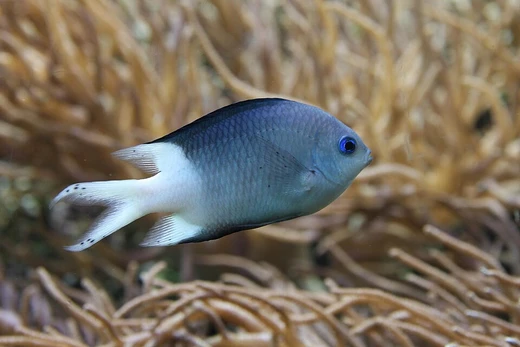
Adult spiny chromis reach a modest maximum length of fourteen centimetres, roughly five and a half inches. Their fin architecture is distinctive: the dorsal fin carries seventeen spines followed by fourteen to sixteen soft rays, while the anal fin bears two spines and fourteen to sixteen rays. Perhaps the most visually arresting feature of this species is its extraordinary range of colour morphs. Populations across different parts of the western Pacific display markedly different hues and patterns, and the precise reason lies in their unusual reproductive biology. Because spiny chromis lack a free-swimming pelagic larval phase and adults are largely sedentary, gene flow between geographically separated groups is minimal. This isolation has allowed divergent evolution to produce a mosaic of local colour forms. The scientific community has not yet reached consensus on whether all these variants represent a single species or whether they collectively constitute a species complex. One consistent trait across morphs is the presence of a yellow lateral stripe in juveniles, a feature that fades as the fish matures.
Lifecycle, Diet & Parental Care
What sets the spiny chromis apart from the vast majority of coral reef fishes is its mode of larval development. Rather than releasing eggs and larvae into the open water column, the parents guard a brood of eggs laid directly on the reef substrate. The offspring remain under parental protection from the egg stage, through hatching, all the way to the fully formed juvenile stage. There is no pelagic phase at all. This direct development means young fish essentially never leave the vicinity of their birth reef, a fact that has driven the high degree of local adaptation seen across the species' range. In terms of feeding, adults are both planktivorous and algivorous, and they have been observed raiding algae cultivated by farming damselfish. Juveniles display a particularly endearing behaviour: they consume mucus secreted from their parent's skin, a practice shared with young discus. This intimate, site-faithful lifecycle makes the spiny chromis a fascinating outlier among reef-dwelling damselfishes.
Related in Spiny chromis
Links follow this subject's own source article.
Elsewhere in Spiny chromis
Spotted an error? Know more?
Reader corrections go straight into our review queue. Suggest an edit · How this site is sourced