
Silky shark (Carcharhinus falciformis)
Source-cited species reference: taxonomy from WoRMS, biology from FishBase, occurrence map from GBIF, conservation from IUCN Red List, description from Wikipedia.
The silky shark (Carcharhinus falciformis), also known by numerous names such as blackspot shark, gray whaler shark, olive shark, ridgeback shark, sickle shark, sickle-shaped shark and sickle silk shark, is a species of requiem shark, in the family Carcharhinidae, named for the smooth texture of its skin. It is one of the most abundant sharks in the pelagic zone, and can be found around the world in tropical waters. Highly mobile and migratory, this shark is most often found over the edge of the continental shelf down to 50 m. The silky shark has a slender, streamlined body and typically grows to a length of 2.5 m. It can be distinguished from other large requiem sharks by its relatively small first dorsal fin with a curving rear margin, its tiny second dorsal fin with a long free rear tip, and its long, sickle-shaped pectoral fins.
- Scientific name
- Carcharhinus falciformis
- Authority
- (Müller & Henle, 1839)
- Family
- Carcharhinidae
- Order
- Carcharhiniformes
- Maximum length
- 350 cm
- Depth range
- 0–4000 m
- Habitat zone
- reef-associated
- Iucn red list
- Vulnerable
- Gbif occurrence records
- 23,839
Classification (WoRMS)
Full classification as recorded by WoRMS: Kingdom: Animalia · Phylum: Chordata · Class: Elasmobranchii · Order: Carcharhiniformes · Family: Carcharhinidae · Genus: Carcharhinus.
Accepted name: Carcharhinus falciformis · Authority: (Müller & Henle, 1839) · Taxonomic status: accepted · AphiaID: 105789.
Synonyms and superseded combinations recorded for this taxon: Aprionodon sitankaiensis Herre, 1934; Carcharhinus atrodorsus Deng, Xiong & Zhan, 1981; Carcharhinus falciformes (Bibron, 1839); Carcharhinus floridanus Bigelow, Schroeder & Springer, 1943; Carcharhinus floridianus Bigelow, Schroeder & Springer, 1943; Carcharhinus menisorrah (Valenciennes, 1839); Carcharhinus menissorrah (Valenciennes, 1839); Carcharias (Prionodon) menisorrah Valenciennes in Müller & Henle, 1839; Carcharias falciformis Bibron, 1839; Carcharias falcipinnis Lowe, 1839; Carcharias menisorrah Valenciennes, 1839; Carcharias pharaonis Ehrenberg, 1871; Carcharins menisorrah Valenciennes, 1839; Carcharius falcipinnis Lowe, 1839; Carcharius menisorrah Valenciennes, 1839; Eulamia malpeloensis Fowler, 1944; Eulamia menisorrah (Valenciennes, 1839); Gymnorhinus pharaonis Hemprich & Ehrenberg, 1899; Prionodon tiburo (Poey, 1860); Squalus tiburo Poey, 1860.
Source: World Register of Marine Species (WoRMS) — https://www.marinespecies.org/aphia.php?p=taxdetails&id=105789 (CC BY 4.0). Accessed 2026-09-23.
Biology and life history (FishBase)
Measured values published by FishBase for Carcharhinus falciformis. Only fields the database actually holds for this species are shown; these are database values, not aquarium guidance.
Maximum length: 350 cm · Common length: 250 cm · Depth range: 0–4000 m · Habitat zone: reef-associated · Body shape: fusiform / normal · Vulnerability index: 82.1 of 100 · Fishery importance: highly commercial · Aquarium trade: never/rarely.
FishBase notes: Found abundantly near the edge of continental and insular shelves, but also in the open sea and occasionally inshore (Ref. 244). Often found in deepwater reefs and near insular slopes (Ref. 244). Littoral and epipelagic, in the open sea or near the bottom at 18-500 m (Ref. 58302). It is quick-moving and aggressive (Ref. 244). Solitary (Ref. 26340); often associated with schools of tuna (Ref. 244). Feeds mainly on fishes, but also squid, paper nautiluses, and pelagic crabs (Ref. 244; 37816). Viviparous (Ref. 50449). Regarded as dangerous to humans (Ref. 9997). Flesh utilized fresh and dried-salted for human consumption; its hide for leather; its fin for shark-fin soup; its liver for oil (Ref. 244). 2 to 14 young, 73 to 87 cm, are born per litter (Ref. 1602).
Source: FishBase species summary (SpecCode 868) — https://www.fishbase.se/summary/Carcharhinus-falciformis.html (CC BY-NC 3.0 — non-commercial use only). Accessed 2026-09-23.
Distribution and occurrence records (GBIF)
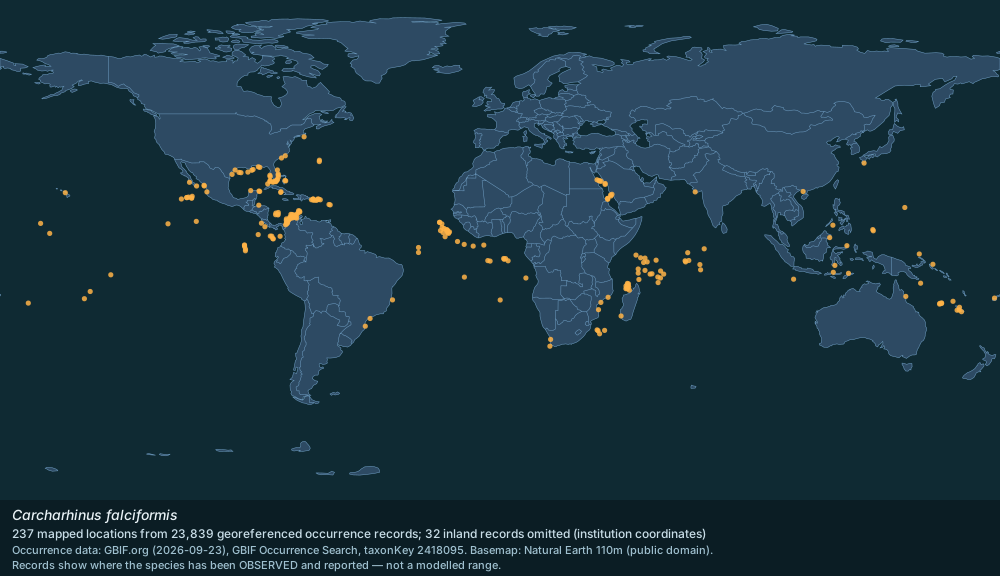
23,839 georeferenced occurrence records for Carcharhinus falciformis are published through GBIF from 105 countries or marine areas. The map above plots 237 distinct locations from a sample of 3,000 records, omitting 32 inland records that carry an institution's coordinates rather than a collection site; it shows where the species has been observed and reported, not a modelled range.
Most records by country or area: United States of America (15,567); Mexico (1,717); Seychelles (1,031); Puerto Rico (446); Brazil (411).
The full country table, WoRMS marine regions and the sampling notes are on this species' Distribution page.
Source: GBIF Occurrence Search (taxonKey 2418095) — https://www.gbif.org/occurrence/search?taxon_key=2418095&has_coordinate=true (records CC0 / CC BY); WoRMS distribution records (MarineRegions) — https://www.marinespecies.org/aphia.php?p=taxdetails&id=105789 (CC BY 4.0); Natural Earth 110m basemap — https://www.naturalearthdata.com/ (public domain). Accessed 2026-09-23.
Conservation status (IUCN Red List)
The IUCN Red List assesses Carcharhinus falciformis (Bibron, 1839) as Vulnerable (code VU). No trend, population estimate or threat analysis is given here, because none is available from this source without the Red List API; follow the source link for the full assessment, including its date.
Source: IUCN Red List of Threatened Species (taxon 39370) — https://www.iucnredlist.org/species/39370/0; GBIF IUCN Red List category endpoint (taxonKey 2418095) — https://api.gbif.org/v1/species/2418095/iucnRedListCategory. Accessed 2026-09-23.
Description and natural history (Wikipedia)
With prey often scarce in its oceanic environment, the silky shark is a swift, inquisitive, and persistent hunter. It feeds mainly on bony fishes and cephalopods, and has been known to drive them into compacted schools before launching open-mouthed, slashing attacks. This species often trails schools of tuna, a favored prey. Its sense of hearing is extremely acute, allowing it to localize the low-frequency noises generated by other feeding animals, and, by extension, sources of food. The silky shark is viviparous, meaning that the developing embryos are sustained by a placental connection to their mother. Significant geographical variation is seen in its life history details. Reproduction occurs year-round except in the Gulf of Mexico, where it follows a seasonal cycle. Females give birth to litters of up to 16 pups annually or biennially. The newborn sharks spend their first months in relatively sheltered reef nurseries on the outer continental shelf, growing substantially before moving into the open ocean.
The large size and cutting teeth of the silky shark make it potentially dangerous, and it has behaved aggressively towards divers. However, attacks are rare, as few humans enter its oceanic habitat. Silky sharks are valued for their fins, and to a lesser extent their meat, hide, liver oil, and jaws. Because of their abundance, they form a major component of commercial and artisanal shark fisheries in many countries. Furthermore, their association with tuna results in many sharks being taken as bycatch in tuna fisheries. Although slow-reproducing like most other sharks, the wide distribution and large population of the silky shark was once thought to buffer the species against fishing pressures. However, data suggest that silky shark numbers are declining around the world, which prompted the IUCN to reassess its conservation status to Vulnerable in 2017.
A scientific description of the silky shark was first published by the German biologists Johannes Müller and Jakob Henle under the name Carcharias (Prionodon) falciformis, in their 1839 Systematische Beschreibung der Plagiostomen. Subsequent authors have assigned this species to the genus Carcharhinus. Because Müller and Henle's type specimen was a 53-cm-long female fetus from Cuba, adult silky sharks were historically not recognized as C. falciformis and were described as a separate species, Carcharhinus floridanus, by Henry Bigelow, William Schroeder, and Stewart Springer in 1943. Jack Garrick, Richard Backus, and Robert Gibbs Jr. synonymized C. floridanus with C. falciformis in 1964.
The specific epithet falciformis is Latin for "sickle-shaped", which refers to the outline of the dorsal and pectoral fins. The silky shark's common name comes from the fine texture of its skin compared to other sharks, a product of its tiny, densely packed dermal denticles. It may also be referred to as blackspot shark (usually used for C. sealei), grey reef shark (usually used for C. amblyrhynchos), grey whaler shark, olive shark, reef shark, ridgeback shark, sickle shark, sickle silk shark, sickle-shaped shark, silk shark, and silky whaler.
Fossilized teeth belonging to the silky shark have been found in North Carolina: from the vicinity of two baleen whales, one in mud dating to the Pleistocene-Holocene (circa 12,000 years ago) and the other in Goose Creek Limestone dating to the Late Pliocene (circa 3.5 million years ago – Mya), as well as from the Pungo River, dating to the Miocene (23–5.3 Mya). Fossil teeth have also been found in Pliocene strata at the Cava Serredi quarry in Tuscany, Italy. The Aquitanian-aged Khari Nadi Formation of western India likewise has had silky shark fossils recovered from it. The earliest presumed fossil teeth of this species are from the Early Miocene of Malta. †Carcharhinus elongatus, an earlier representative of its lineage with smooth-edged teeth, is known from Oligocene (34–23 Mya) deposits in the Old Church formation of Virginia, and the Ashley formation of South Carolina. A set of poorly described, Eocene (56–34 Mya) teeth resembling those of this species are known from Egypt.
Initial efforts to resolve the evolutionary relationships of the silky shark were inconclusive; based on morphology, Jack Garrick in 1982 suggested the blackspot shark (C. sealei) as its closest relative. In 1988, Leonard Compagno assigned it phenetically to an informal "transitional group" also containing the blacknose shark (C. acronotus), the blacktip reef shark (C. melanopterus), the nervous shark (C. cautus), the copper shark (C. brachyurus), and the night shark (C. signatus).
More recently, Gavin Naylor's 1992 phylogenetic analysis, based on allozyme sequence data, found that the silky shark is part of a group containing large sharks with a ridge between the dorsal fins. One branch within this group contains the sandbar shark (C. plumbeus) and the bignose shark (C. altimus), while the silky shark is the basal member of the other branch and the sister taxon to a clade containing the Caribbean reef shark (C. perezi), Galapagos shark (C. galapagensis), oceanic whitetip shark (C. longimanus), dusky shark (C. obscurus), and blue shark (Prionace glauca). Mine Dosay-Abkulut's 2008 ribosomal DNA analysis, which included the silky, blue, and bignose sharks, confirmed the closeness of those three species.
The silky shark has a cosmopolitan distribution in marine waters warmer than 23 C. In the Atlantic Ocean, it is found from Massachusetts (USA) to Spain in the north, and from southern Brazil to northern Angola in the south, including the Gulf of Mexico and the Caribbean Sea. In the Mediterranean Sea, it has been recorded first in the Alboran Sea, subsequently in Algerian waters, the Gulf of Gabes (Tunisia) and more recently in the Ligurian Sea. It occurs throughout the Indian Ocean, as far south as Mozambique in the west and Western Australia in the east, including the Red Sea and the Persian Gulf. In the Pacific Ocean, the northern extent of its range runs from southern China and Japan to southern Baja California and the Gulf of California, while the southern extent runs from Sydney, Australia, to northern New Zealand to northern Chile. Based on life history differences, four distinct populations of silky sharks have been identified in ocean basins worldwide: in the northwestern Atlantic, in the western and central Pacific, in the eastern Pacific, and in the Indian Ocean.
Primarily an inhabitant of the open ocean, the silky shark is most common from the surface to a depth of 200 m, but may dive to 500 m or more. Tracking studies in the tropical eastern Pacific and northern Gulf of Mexico have found that cruising silky sharks spend 99% of their time within 50 m of the surface, and 80–85% of their time in water with a temperature of 26 - 30 C; the pattern was constant regardless of day or night. This species favors the edges of continental and insular shelves, often over deepwater reefs and around islands. Its range extends farther north and south along continental margins than in oceanic waters. On occasion, it may venture into coastal waters as shallow as 18 m. Silky sharks are highly mobile and migratory, though the details of their movements are little-known. Tagging data have recorded individual sharks moving up to 60 km per day, and covering distances up to 1339 km. Larger sharks generally move longer distances than smaller ones. In the Pacific Ocean and possibly elsewhere, it spends the summer at slightly higher latitudes, particularly during warmer El Niño years. In the northern Atlantic, most sharks follow the Gulf Stream northward along the U.S. East Coast. In the Gulf of Aden, it is most common in late spring and summer.
Source: Wikipedia: Silky shark — https://en.wikipedia.org/wiki/Silky_shark (CC BY-SA 4.0). Accessed 2026-09-23.
Gallery
Related in Silky shark
Links follow this subject's own source article.
Elsewhere in Silky shark
Spotted an error? Know more?
Reader corrections go straight into our review queue. Suggest an edit · How this site is sourced