
Saccharina japonica
Source-cited species reference: taxonomy from WoRMS, biology from SeaLifeBase, occurrence map from GBIF, description from Wikipedia.
Saccharina japonica is a marine species of the Phaeophyceae (brown algae) class, a type of kelp or seaweed, which is extensively cultivated on ropes between the seas of China, Japan and Korea. It has the common name sweet kelp. It is widely eaten in East Asia. A commercially important species, S. japonica is also called ma-konbu () in Japanese, dasima () in Korean and hǎidài () in Chinese. Large harvests are produced by rope cultivation which is a simple method of growing seaweeds by attaching them to floating ropes in the ocean.
- Scientific name
- Saccharina japonica
- Authority
- (Areschoug) C.E.Lane, C.Mayes, Druehl & G.W.Saunders, 2006
- Family
- Laminariaceae
- Order
- Laminariales
- Habitat zone
- sessile
- Gbif occurrence records
- 6,658
Classification (WoRMS)
Full classification as recorded by WoRMS: Kingdom: Chromista · Phylum: Ochrophyta · Class: Phaeophyceae · Order: Laminariales · Family: Laminariaceae · Genus: Saccharina.
Accepted name: Saccharina japonica · Authority: (Areschoug) C.E.Lane, C.Mayes, Druehl & G.W.Saunders, 2006 · Taxonomic status: accepted · AphiaID: 377084.
Synonyms and superseded combinations recorded for this taxon: Hafgygia japonica (Areschoug) Areschoug, 1883; Laminaria fragilis Miyabe, 1902; Laminaria japonica Areschoug, 1851; Laminaria japonica f. typica Okamura, 1896; Laminaria japonica var. ochotensis (Miyabe) Okamura, 1936; Oxyglossum japonicum (Areschoug) Areschoug, 1880; Phycodendrum japonicum (Areschoug) O.Kuntze, 1898; Pleurophycus japonicus (Areschoug) O.C.Schmidt, 1938.
Source: World Register of Marine Species (WoRMS) — https://www.marinespecies.org/aphia.php?p=taxdetails&id=377084 (CC BY 4.0). Accessed 2026-09-23.
Biology and life history (SeaLifeBase)
Measured values published by SeaLifeBase for Saccharina japonica. Only fields the database actually holds for this species are shown; these are database values, not aquarium guidance.
Habitat zone: sessile · Fishery importance: commercial · Aquarium trade: never/rarely.
Source: SeaLifeBase species summary (SpecCode 152325) — https://www.sealifebase.se/summary/Saccharina-japonica.html (CC BY-NC 3.0 — non-commercial use only). Accessed 2026-09-23.
Distribution and occurrence records (GBIF)
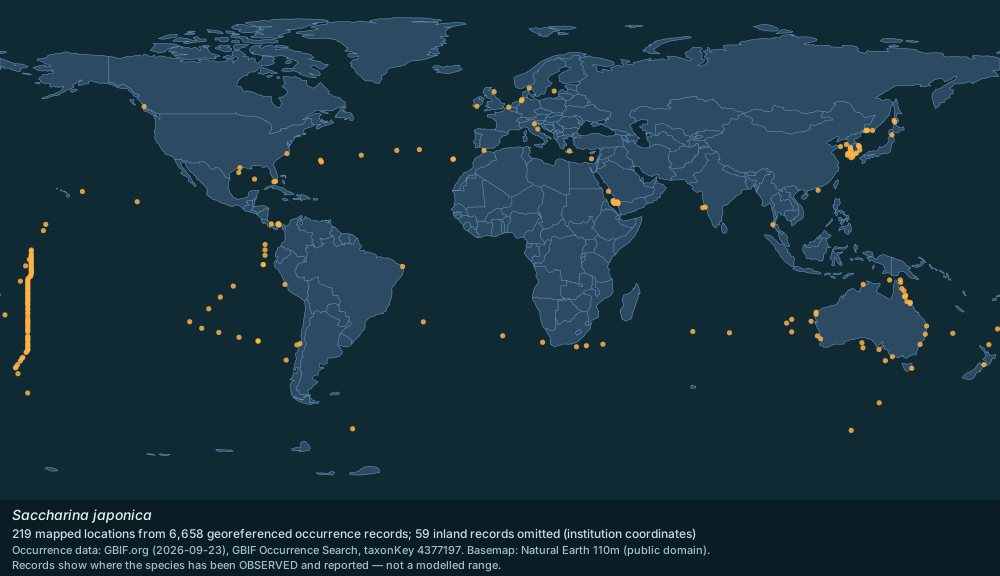
6,658 georeferenced occurrence records for Saccharina japonica are published through GBIF from 61 countries or marine areas. The map above plots 219 distinct locations from a sample of 3,000 records, omitting 59 inland records that carry an institution's coordinates rather than a collection site; it shows where the species has been observed and reported, not a modelled range.
Most records by country or area: Japan (3,009); Australia (1,823); Korea, Republic of (407); United States of America (382); Germany (173).
The full country table, WoRMS marine regions and the sampling notes are on this species' Distribution page.
Source: GBIF Occurrence Search (taxonKey 4377197) — https://www.gbif.org/occurrence/search?taxon_key=4377197&has_coordinate=true (records CC0 / CC BY); WoRMS distribution records (MarineRegions) — https://www.marinespecies.org/aphia.php?p=taxdetails&id=377084 (CC BY 4.0); Natural Earth 110m basemap — https://www.naturalearthdata.com/ (public domain). Accessed 2026-09-23.
Description and natural history (Wikipedia)
The species has been cultivated in China, Japan, Korea, Russia and France. It is one of the two most consumed species of kelp in China and Japan. Saccharina japonica is also used for the production of alginates, with China producing up to ten thousand tons of the product each year.
S. japonica contains very high amounts of iodine. Excessive consumption (15 g/day, containing 35 mg iodine) suppresses thyroid function, though thyroid hormone levels remain within normal limits.
The species was transferred to Saccharina in 2006. Three synonyms for this species name are Laminaria japonica (J. E. Areschoug 1851), its variety Laminaria japonica var. ochotensis (Miyabe & Okamura 1936) and Laminaria ochotensis (Miyabe 1902).
Over 90% of Japanese kombu is cultivated in Hokkaidō. With the development of cultivation technology, production can also be found as far as south of the Seto Inland Sea.
In Chinese cuisine, sliced kelp is a common hors d'oeuvre which is often consumed with alcohol.
In Korean cuisine, dasima is used to make broth, deep-fried into bugak or twigak (coated and uncoated fries), pickled in soy sauce as jangajji, and eaten raw as a sea vegetable for ssam (wraps).
It is also used to make dasima-cha (kelp tea).
Cheonsa-chae (kelp noodles) is made from the alginic acid from dasima.
One of Nongshim's instant noodle, the Korean original versions of Neoguri, contains one (or rarely more) big piece of dasima in every package. Odongtong Myon, Ottogi's copy of Neoguri, also has big piece of dasima in every package - Ottogi uses 2 dasimas since 2020.
Source: Wikipedia: Saccharina japonica — https://en.wikipedia.org/wiki/Saccharina_japonica (CC BY-SA 4.0). Accessed 2026-09-23.
Gallery
Related in Saccharina japonica
Links follow this subject's own source article.
Elsewhere in Saccharina japonica
Spotted an error? Know more?
Reader corrections go straight into our review queue. Suggest an edit · How this site is sourced