
Queen scallop (Aequipecten opercularis)
Source-cited species reference: taxonomy from WoRMS, biology from SeaLifeBase, occurrence map from GBIF, description from Wikipedia.
The queen scallop (Aequipecten opercularis) is a medium-sized species of scallop, an edible marine bivalve mollusk in the family Pectinidae, the scallops. It is found in the northeast Atlantic and is important in fisheries.
- Scientific name
- Aequipecten opercularis
- Authority
- (Linnaeus, 1758)
- Family
- Pectinidae
- Order
- Pectinida
- Maximum length
- 11 cm
- Depth range
- 0–400 m
- Habitat zone
- benthic
- Gbif occurrence records
- 44,987
Classification (WoRMS)
Full classification as recorded by WoRMS: Kingdom: Animalia · Phylum: Mollusca · Class: Bivalvia · Order: Pectinida · Family: Pectinidae · Genus: Aequipecten.
Accepted name: Aequipecten opercularis · Authority: (Linnaeus, 1758) · Taxonomic status: accepted · AphiaID: 140687.
Synonyms and superseded combinations recorded for this taxon: Chlamys (Aequipecten) opercularis (Linnaeus, 1758); Chlamys bruei coeni F. Nordsieck, 1969; Chlamys bruei pulchricostata F. Nordsieck, 1969; Chlamys opercularis (Linnaeus, 1758); Ostrea dubia Gmelin, 1791; Ostrea elegans Gmelin, 1791; Ostrea florida Gmelin, 1791; Ostrea opercularis Linnaeus, 1758; Ostrea plana Gmelin, 1791; Ostrea radiata Gmelin, 1791; Ostrea regia Gmelin, 1791; Ostrea versicolor Gmelin, 1791; Pecten (Aequipecten) opercularis (Linnaeus, 1758); Pecten (Chlamys) opercularis (Linnaeus, 1758); Pecten (Chlamys) opercularis var. perdix Bavay, 1906; Pecten (Chlamys) vescoi Bavay, 1903; Pecten audouinii Payraudeau, 1826; Pecten cretatus Reeve, 1853; Pecten daucus Reeve, 1853; Pecten dubius (Gmelin, 1791); Pecten lineatus da Costa, 1778; Pecten lineatus var. albida Locard, 1888; Pecten lineatus var. bicolor Locard, 1888; Pecten malvinae var. tschokrakensis Davitashvili, 1932; Pecten opercularis (Linnaeus, 1758).
Source: World Register of Marine Species (WoRMS) — https://www.marinespecies.org/aphia.php?p=taxdetails&id=140687 (CC BY 4.0). Accessed 2026-09-23.
Biology and life history (SeaLifeBase)
Measured values published by SeaLifeBase for Aequipecten opercularis. Only fields the database actually holds for this species are shown; these are database values, not aquarium guidance.
Maximum length: 11 cm · Depth range: 0–400 m · Habitat zone: benthic · Vulnerability index: 25.3 of 100 · Fishery importance: commercial.
SeaLifeBase notes: Max depth range from Ref. 113966. Suspension feeder (Ref. 3477). Found on sand, mud, gravel; also associated with maerl beds and mussel beds (Ref. 114800).
Source: SeaLifeBase species summary (SpecCode 47421) — https://www.sealifebase.se/summary/Aequipecten-opercularis.html (CC BY-NC 3.0 — non-commercial use only). Accessed 2026-09-23.
Distribution and occurrence records (GBIF)
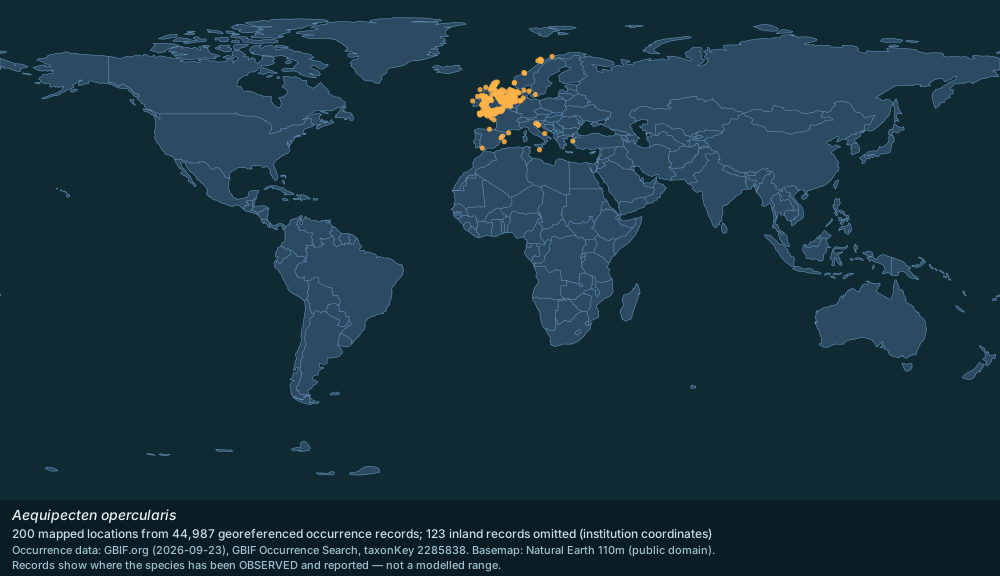
44,987 georeferenced occurrence records for Aequipecten opercularis are published through GBIF from 40 countries or marine areas. The map above plots 200 distinct locations from a sample of 3,000 records, omitting 123 inland records that carry an institution's coordinates rather than a collection site; it shows where the species has been observed and reported, not a modelled range.
Most records by country or area: United Kingdom of Great Britain and Northern Ireland (25,922); France (5,460); Netherlands (4,001); Ireland (3,422); Isle of Man (1,730).
The full country table, WoRMS marine regions and the sampling notes are on this species' Distribution page.
Source: GBIF Occurrence Search (taxonKey 2285838) — https://www.gbif.org/occurrence/search?taxon_key=2285838&has_coordinate=true (records CC0 / CC BY); WoRMS distribution records (MarineRegions) — https://www.marinespecies.org/aphia.php?p=taxdetails&id=140687 (CC BY 4.0); Natural Earth 110m basemap — https://www.naturalearthdata.com/ (public domain). Accessed 2026-09-23.
Description and natural history (Wikipedia)
At about 7 cm in size, this is one of the smaller scallop species which are commercially exploited. The shell of this species is sometimes quite colourful, and it is also thin and brittle. It has about twenty radiating ribs. The left valve is slightly more convex than the right one. One auricle of the right valve is larger than the other which creates a notch near the hinge used by the modified foot in young scallops to spin byssal threads. Older scallops are free swimming.
The queen scallop feeds on a diet of plankton, and is commonly found up to 40 m below mean sea level, although it has been known to exist up to 400 m below sea level.
This species is distributed from Norway south to the Canary Islands and the Mediterranean and is common in the North Sea on beds of sand and gravel.
Fishery around the Isle of Man
The Isle of Man in the British Isles is famous for the queen scallop, or "Manx queenie" as it is known locally. Due to the vagaries of landings over the years, Manx fishermen have worked on technical conservation regulations, in order to ensure that stocks of the queenie have remained robust. These have included restrictions on fishing times, closed seasons, and limitations on the number of dredges permitted. There are also two conservation areas in the island's territorial waters; one has been in place since 1989 and the other was created in 2008; these areas are closed to mobile fishing. These conservation areas are supported by the fishing industry; the fishermen themselves started the initiative to create the Douglas closed area. Data analysis appears to support the viability of these areas, which appear to help ensure that the Manx queenie can be fished sustainably.
The Isle of Man Queenie Festival is an annual, week-long celebration of the Manx queenie, with many restaurants, hotels and pubs serving queen scallops. This festival includes various events including sailing, diving, barbecues, beach days, sea swims, entertainment and plenty of queen scallops.
Isle of Man queenies have been awarded the European Union Protected Designation of Origin (PDO) stamp.
Source: Wikipedia: Queen scallop — https://en.wikipedia.org/wiki/Queen_scallop (CC BY-SA 4.0). Accessed 2026-09-23.
Gallery
Related in Queen scallop
Links follow this subject's own source article.
Elsewhere in Queen scallop
Spotted an error? Know more?
Reader corrections go straight into our review queue. Suggest an edit · How this site is sourced